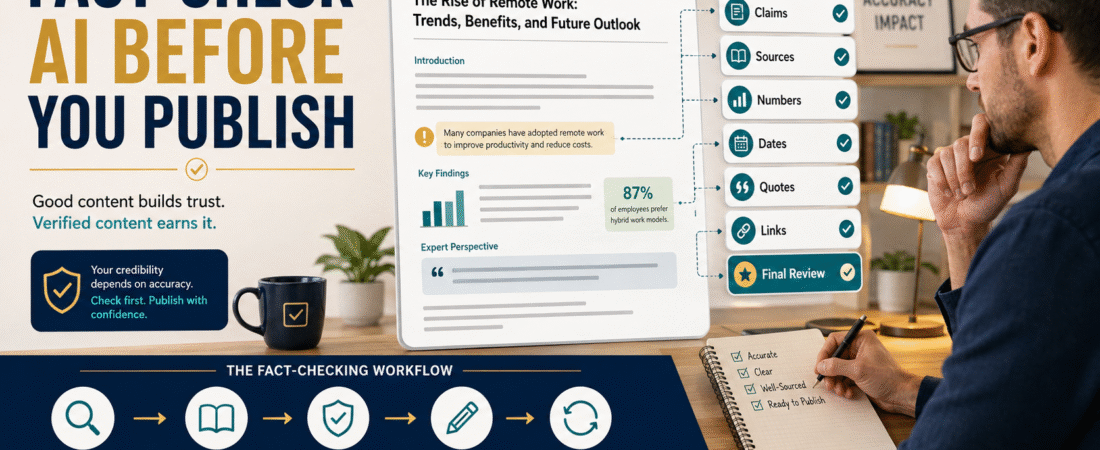
AI can help you organize ideas, produce a first draft, explain a complicated subject, or speed up repetitive writing tasks. What it cannot do is remove your responsibility to make sure the finished content is accurate.
That matters because an AI-generated sentence can sound polished and still contain the wrong date, an outdated feature, an invented statistic, a distorted conclusion, or a source that does not support the claim being made.
A practical solution is to treat AI-generated content as a draft that must earn its way to publication.
You do not need to investigate every ordinary sentence as though you were conducting an academic research project. Instead, identify the claims that can be checked, give the highest-risk claims the most attention, verify them against trustworthy sources, correct the draft, and then check the corrected version one more time.
That creates a manageable AI fact-checking workflow instead of depending on whether a paragraph merely sounds believable.
Editing and Fact-Checking Are Different Jobs
One of the easiest mistakes for a beginner to make is assuming that proofreading an AI-generated article also verifies it.
It does not.
Editing asks questions such as:
- Is this explanation clear?
- Does the paragraph flow properly?
- Is the wording repetitive?
- Is the grammar correct?
- Does the article sound appropriate for the audience?
Fact-checking asks different questions:
- Is this statement true?
- Is the information still current?
- Does the source actually support the claim?
- Is the number accurate?
- Is the date correct?
- Is an example being presented as a fact?
- Has important context been removed?
A beautifully edited article can still be factually wrong.
That is why a good publishing system needs both processes.
If you already use a beginner’s AI content quality checklist before publishing, think of fact-checking as a deeper accuracy layer inside that larger quality-control process.
Step 1: Mark the Statements That Can Be Verified
Begin by reading the AI-assisted draft once without rewriting it.
This time, look specifically for factual claims.
These may include:
- Prices.
- Product features.
- Software plan limits.
- Dates.
- Names.
- Statistics.
- Laws or regulations.
- Research findings.
- Technical instructions.
- Platform policies.
- Quotes.
- Company information.
- Historical claims.
- Current recommendations.
- Statements about what a particular tool can or cannot do.
Mark each one.
You are creating a simple claim inventory.
Consider the sentence:
“Platform X includes unlimited automation on every paid plan.”
That is not merely explanatory writing. It is a verifiable product claim.
It needs a source.
Compare that with:
“For a beginner, a simpler automation system may be easier to manage.”
That is primarily judgment or advice. It should still be reasonable, but it is not verified in the same way as a pricing or feature statement.
Learning to separate those two kinds of sentences makes fact-checking much faster.
Step 2: Sort Claims by Risk
Not every fact deserves the same amount of research time.
A small wording mistake in a hypothetical example is very different from publishing the wrong refund policy or telling a reader that a paid feature is free.
A useful three-level system is:
Low risk: General background facts that are stable and easy to confirm.
Medium risk: Product features, terminology, processes, comparisons, or instructions that could change.
High risk: Prices, financial information, legal requirements, health claims, statistics, policies, contracts, licenses, guarantees, or information that could cause someone to make an important decision.
The higher the consequence of being wrong, the stronger your verification should be.
This also keeps the process manageable. You do not need to spend ten minutes verifying a harmless illustrative sentence while giving only ten seconds to a pricing claim.
Step 3: Go to the Original Source When Possible
Suppose AI tells you that a software product costs $29 per month.
Do not search for another blog that repeats $29.
Go to the software company’s current pricing page.
If the claim concerns Google Analytics, look at Google’s current documentation.
If it concerns a government requirement, look for the appropriate government source.
If it refers to a research finding, look for the original study or organization responsible for the research.
A useful source priority is:
- Original or first-party source.
- Government or official regulatory source.
- Original research or documentation.
- Established high-authority secondary source.
- Other secondary commentary when necessary.
This is especially important with AI because the model may be drawing from information that was correct at one time but has since changed.
Step 4: Verify the Entire Claim, Not Just One Word
Finding the product name on an official website is not enough.
You need to determine whether the source supports the specific statement you plan to publish.
Imagine your draft says:
“The Starter plan includes unlimited landing pages and advanced automation.”
You find an official page showing that the company offers landing pages and automation.
That does not necessarily prove those features are available on the Starter plan.
You still need to verify:
- Which plan includes them.
- Whether limits apply.
- Whether the feature requires an add-on.
- Whether the feature is available in all regions.
- Whether the page is describing a current or retired plan.
This is where many weak fact checks fail.
The researcher confirms the general subject instead of confirming the actual claim.
Step 5: Check Dates, Numbers, and Quotes Separately
Numbers deserve special attention because a single incorrect digit can change the meaning of an article.
Whenever your AI-assisted draft contains a number, ask where it came from.
Check:
- Dollar amounts.
- Percentages.
- Subscriber limits.
- Email-send limits.
- Trial periods.
- Dates.
- Time periods.
- Survey sizes.
- Research figures.
- Counts.
- Rankings.
Do the same with quotes.
Never assume quotation marks mean an AI system retrieved someone’s exact words correctly. If you cannot locate the original quotation in a trustworthy source, paraphrase the verified idea or remove the quote.
You can apply a simple rule:
No source, no precise quote.
Step 6: Check Whether the Information Is Still Current
Accuracy has a time dimension.
A blog article published two years ago might have been perfectly correct when written and still be wrong today.
Software makes this especially obvious. Companies change:
- Pricing.
- Features.
- Plan names.
- Free trials.
- Integrations.
- Usage limits.
- Interfaces.
- Terms.
- Support options.
When current details matter, look for the newest trustworthy source available.
Also be careful with phrases such as:
“currently,” “now,” “as of today,” and “the latest.”
Those words turn a general statement into a time-sensitive one.
If you use them, make sure the information really was checked recently.
Step 7: Make Illustrations Look Like Illustrations
AI is good at generating realistic examples.
That can also create a problem.
Suppose a draft says:
“The platform may display a warning labeled ‘Your Account Requires Immediate Verification.’”
If that exact warning has not been verified, readers could believe it is the platform’s real wording.
A safer version would be:
“Hypothetically, the platform might display a warning telling you that additional account verification is required.”
The second version communicates the lesson without pretending that invented interface wording is official.
Use phrases such as:
- “For example…”
- “A hypothetical situation might be…”
- “Imagine that…”
- “An illustrative example would be…”
That small change can prevent an example from becoming accidental misinformation.
Step 8: Correct the Draft—and Then Recheck It
Fact-checking is not finished when you discover an error.
You still have to correct the article.
Then read the corrected section again.
Why?
Because revisions can create new errors.
You may correct a price but leave another sentence describing the old plan. You may remove a statistic while leaving a conclusion that depended on that statistic. You may replace one product feature and accidentally create a contradiction three paragraphs later.
A useful revision process is:
Identify → Verify → Correct → Recheck
If you need to make targeted corrections without rebuilding an entire article, my guide on revising AI-generated content without rewriting everything explains a focused revision approach.
A Simple AI Fact-Checking Worksheet
You can make this process repeatable with six columns:
Claim: What does the draft say?
Risk: Low, medium, or high?
Source: Where should the claim be verified?
Status: Verified, corrected, removed, or still uncertain?
Verification Date: When was it checked?
Notes: What changed?
For a short article, this might contain only five or ten important claims.
For a detailed software comparison, it could contain considerably more.
The objective is not bureaucracy.
The objective is preventing yourself from thinking, “I know I checked that somewhere,” when you cannot remember what was actually verified.
Do Not Ask AI to Be Its Own Only Fact-Checker
AI can help identify statements that deserve verification.
For example, you can ask:
“List every factual, numerical, time-sensitive, or product-specific claim in this draft that should be independently verified.”
That can save time.
But asking the same AI:
“Is everything you just wrote accurate?”
is not independent verification.
The system may confidently repeat the same error.
Use AI to help organize the checking process, not to replace the evidence.
This fits naturally with an AI content workflow that does not produce generic content: AI handles suitable production work, while human judgment remains responsible for decisions that affect trust and quality.
When Should You Remove a Claim?
Sometimes you will not be able to verify something confidently.
You then have three choices:
- Keep researching.
- Rewrite the section so it makes only what can be supported clear.
- Remove the claim.
The third option is often underrated.
A blog post does not become more valuable simply because it contains another statistic, feature claim, or impressive-sounding fact.
If a detail is optional and unreliable, removing it can make the article better.
Build Verification Into the Workflow Before Publication
The easiest time to fact-check is before the article is published.
Once inaccurate information is public, you may have to:
- Correct the article.
- Update social promotions.
- Change emails.
- Answer confused readers.
- Repair internal documentation.
- Rebuild trust.
Pre-publication verification is usually much simpler.
A manageable workflow can be:
Draft → Content Edit → Claim Check → Source Verification → Correction → Final Read → Publish
That adds a deliberate accuracy stage without turning every article into a major research project.
Conclusion
AI can accelerate content creation, but speed should not eliminate verification.
A dependable AI fact-checking workflow begins by identifying factual claims, sorting them by risk, checking important details against trustworthy original sources, verifying dates and numbers, distinguishing illustrations from official wording, correcting the article, and reviewing the corrected version again.
The most useful mindset is simple:
AI-generated information is a draft until important claims have been verified.
Start with your next AI-assisted article. Mark every statement involving a price, date, statistic, product feature, policy, quote, or technical instruction. Verify the highest-risk claims first and record what you checked.
That single habit can make your AI publishing process far more reliable.