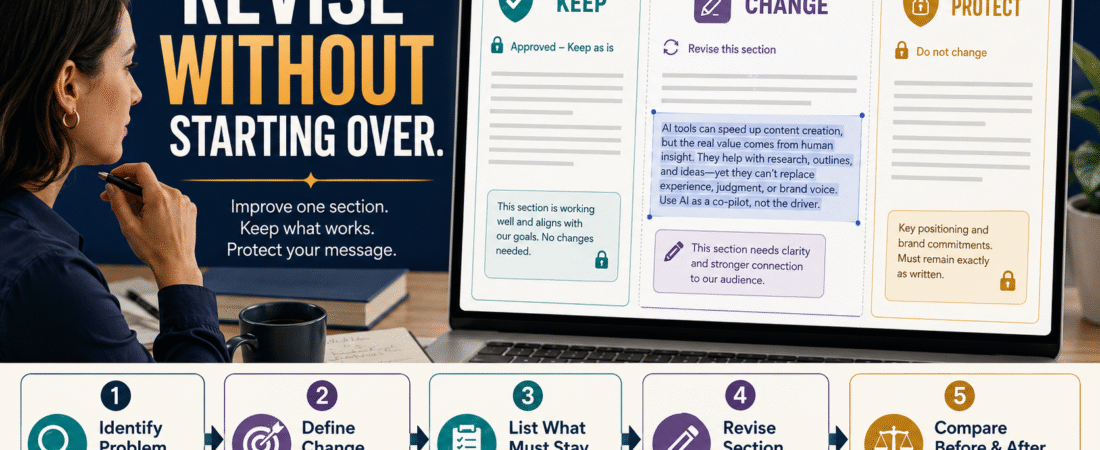
One of the most frustrating AI-writing problems happens after the first draft is already mostly correct.
You may have an article where the introduction works, the examples are useful, the facts have been checked, the headings are organized, and the conclusion is strong.
Only one section needs improvement.
So you tell the AI:
“Make this better.”
The result comes back with a completely different introduction, revised headings, changed examples, new wording in sections you already approved, and possibly altered facts or links.
Instead of fixing one problem, you now have another full draft to review.
A better approach is to create a small AI revision brief that defines three things before the edit begins:
What is wrong → what should change → what must remain unchanged.
That turns AI from a full-draft generator into a focused editing assistant.
Recent guidance about targeted AI editing follows the same basic principle: isolate the section that needs work and give narrow revision instructions rather than regenerating the entire response. OpenAI Academy also describes using ChatGPT to revise paragraphs or sections for clarity and structure while preserving the writer’s underlying ideas.
Why “Make It Better” Is a Weak Revision Instruction
“Better” is not measurable.
Does better mean:
- Shorter?
- More detailed?
- More conversational?
- More professional?
- More persuasive?
- Easier for beginners?
- More accurate?
- Less repetitive?
- Better organized?
The AI has to guess.
When the instruction is broad, the revision can also become broad.
This is especially risky after you have already spent time checking:
- Facts.
- Product names.
- Statistics.
- Quotes.
- Links.
- Examples.
- Terminology.
- Affiliate disclosures.
- Internal links.
- Headings.
A full rewrite may disturb information that was already correct.
The smarter rule is:
Do not regenerate approved work merely because one part needs repair.
Step 1: Identify the Exact Problem
Before giving the AI another prompt, describe what is wrong in one sentence.
For example:
Problem: This paragraph repeats the previous section.
Or:
Problem: The explanation assumes the reader understands email automation.
Or:
Problem: This example is too complicated for a beginner.
Or:
Problem: The paragraph sounds promotional rather than educational.
Notice how much more useful these statements are than:
“I don’t like this.”
You are turning a vague reaction into an editing target.
Step 2: Decide Whether the Problem Is Local or Structural
A local problem affects one small area.
Examples:
- One paragraph is repetitive.
- One example is weak.
- One heading is unclear.
- One sentence is too long.
- One transition is awkward.
A structural problem affects a larger part of the document.
Examples:
- The article answers the wrong search intent.
- Sections are in the wrong order.
- The main conclusion is unsupported.
- Half the article repeats the same idea.
- The audience was misunderstood.
Do not use a tiny paragraph edit to repair a structural problem.
Likewise, do not rewrite 2,000 words when only 100 words need attention.
Step 3: Mark What Is Already Approved
This is the step many people skip.
Create a preserve list.
For example:
Keep unchanged:
- Article title.
- Introduction.
- Existing headings.
- All verified facts.
- Product names.
- Dates.
- Numbers.
- Internal hyperlinks.
- Affiliate hyperlinks.
- Conclusion.
Now the AI has boundaries.
This is particularly useful after completing the kind of human-controlled checking described in my fact-checking workflow for AI-generated content. You do not want a later style edit quietly changing information you already verified.
Step 4: Define the Revision Objective
Next, state exactly what the replacement needs to accomplish.
For example:
Revision objective: Rewrite this paragraph so a beginner understands the difference between an email broadcast and an automated sequence.
Or:
Revision objective: Replace the example with one involving a solo digital-product creator rather than a large ecommerce company.
Or:
Revision objective: Cut this section by approximately 30% while retaining every factual point.
The AI now knows what success looks like.
Step 5: Specify What May Change
This sounds unnecessary, but it helps.
For example:
You may change:
- Sentence order.
- Transitions.
- Example wording.
- Paragraph length.
Do not change:
- Facts.
- Numbers.
- Product names.
- URLs.
- Meaning.
- Recommendations.
This creates a controlled editing space.
A Simple AI Revision Brief
A reusable revision brief can look like this:
SECTION TO REVISE:
[Paste only the relevant section.]
PROBLEM:
[Describe the exact problem.]
REVISION GOAL:
[Describe the result you want.]
KEEP:
[List facts, wording, examples, links, or structure that must remain.]
CHANGE:
[List what may be changed.]
DO NOT ADD:
[List unwanted claims, examples, recommendations, or assumptions.]
AUDIENCE:
[Who the revision is for.]
OUTPUT:
Return only the replacement section.
That final instruction is important.
If you ask for the whole article again, you increase the chance that unrelated material changes.
Example: Fixing a Repetitive Paragraph
Suppose your original paragraph says:
Email automation can save time because automated emails are sent automatically. Once an email automation is set up, the automated emails can automatically go to subscribers.
The idea is correct, but the wording is repetitive.
Your revision brief could say:
Problem: Excessive repetition of “automation,” “automated,” and “automatically.”
Goal: Explain the same idea in plain beginner language.
Keep: The idea that a prepared sequence can send based on predefined conditions.
Do not add: Statistics, income claims, or new software recommendations.
Output: One replacement paragraph only.
The AI now has a narrow task.
Example: Replacing an Overcomplicated Example
Imagine an AI-generated article explains list segmentation using:
- Predictive scoring.
- Multichannel attribution.
- Enterprise CRM synchronization.
- Behavioral lead scoring.
- API-triggered workflows.
That may be accurate but completely wrong for the intended beginner.
A better revision brief might say:
Problem: The example is too advanced for a beginner running a small email list.
Goal: Replace it with a simple example involving subscribers who downloaded two different lead magnets.
Keep: The explanation that segmentation groups people according to meaningful differences.
Do not add: Enterprise CRM terminology.
Now you are correcting audience fit without rebuilding the article.
Use “Keep, Change, Protect”
For longer content, I like a simple three-part editing mindset.
Keep
What already works?
Examples:
- Strong hook.
- Useful analogy.
- Verified facts.
- Clear workflow.
- Good conclusion.
Change
What specifically is weak?
Examples:
- Repetition.
- Tone.
- Missing explanation.
- Poor example.
- Excess length.
Protect
What would create extra work if altered?
Examples:
- Approved product names.
- Legal wording.
- Affiliate disclosure.
- Verified URLs.
- Research findings.
- Exact quotations.
- Technical instructions.
This is a practical way to reduce revision drift.
Compare Before and After
Never assume the new version is better because it sounds smoother.
Compare:
Original vs revised.
Ask:
- Did the targeted problem improve?
- Did meaning change?
- Did facts remain intact?
- Did the tone still fit?
- Did the AI introduce unsupported details?
- Is the revision genuinely easier to understand?
- Did useful nuance disappear?
Sometimes the original should win.
That is normal.
AI editing is not a command that must be accepted.
It is a proposed revision.
Keep Human Judgment in the Workflow
An AI-generated revision can become:
- More fluent but less accurate.
- Shorter but incomplete.
- More persuasive but exaggerated.
- Simpler but misleading.
- More detailed but unnecessarily complicated.
That is why AI content should move through a repeatable review process rather than directly from generation to publication.
My AI content workflow for avoiding generic output provides a broader foundation for keeping human judgment involved throughout content creation.
Avoid Endless Revision Loops
A common pattern is:
Draft → rewrite → rewrite again → “make it stronger” → “make it friendlier” → “make it professional” → “make it more natural.”
Eventually, the article becomes different rather than better.
Instead, require a reason for each edit.
Ask:
What problem am I fixing?
If you cannot answer that question, consider leaving the section alone.
Save Useful Revision Instructions
When a revision prompt works particularly well, keep it.
For example:
- Reduce repetition without changing facts.
- Simplify for beginners.
- Replace advanced example.
- Shorten while protecting key points.
- Improve transition only.
- Convert explanation into steps.
- Remove promotional tone.
- Clarify one ambiguous paragraph.
Those instructions can become part of a reusable prompt library.
My guide to building a reusable AI prompt library for your online business shows how repeatable prompts can reduce the need to recreate instructions every time.
A Final Revision Checklist
Before accepting an AI revision, check:
- Did I identify one clear problem?
- Did I specify the exact section?
- Did I explain what should improve?
- Did I list what must remain?
- Did I protect verified facts?
- Did I protect URLs and names?
- Did I request only the replacement section?
- Did I compare before and after?
- Did I fact-check anything newly introduced?
- Is the new version actually more useful?
If the answer is yes, you have turned AI revision into a controlled process.
Conclusion
You do not have to start over every time one part of an AI-generated draft needs work.
Identify the exact problem, isolate the section, define the revision goal, specify what must remain unchanged, request only the replacement, and compare the revision against the approved original.
The key idea is simple:
Protect what already works. Fix only what does not.
That approach reduces unnecessary rewriting, makes fact-checking easier, and gives you much more control over the final content.