A refund request can feel more complicated than the original sale.
A customer writes:
“I want my money back.”
Now you have to determine:
- Did this person actually purchase?
- Which product did they buy?
- When did they buy it?
- What refund policy applied?
- Is the real problem product access?
- Did the customer misunderstand what was included?
- Should access be removed after a refund?
- Where should the decision be documented?
Without a process, every refund request becomes a new judgment call.
That is unnecessary.
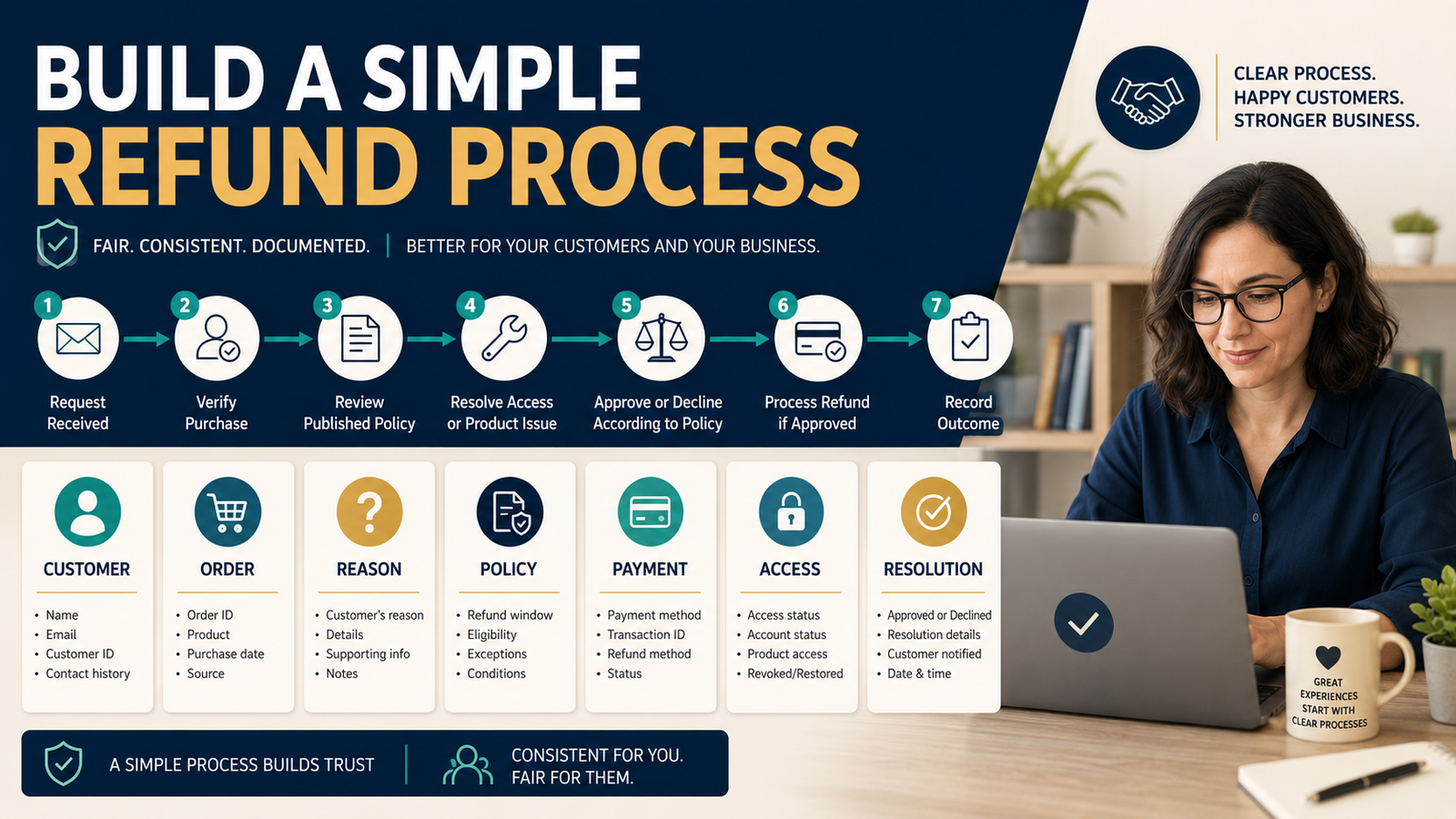
A simple digital-product refund system can follow this path:
Request Received → Verify Purchase → Review Policy → Understand Problem → Apply Policy Consistently → Process Resolution → Update Access → Record Outcome
The purpose is not to make refunds difficult.
It is to make the response consistent, fair, and manageable.
A recent July 2026 FTC order involving Publishing.com is also a useful reminder that refund and cancellation terms should not be buried or represented one way during the sale and handled differently afterward. The FTC alleged that consumers encountered additional conditions when seeking refunds, and the resulting order included requirements relating to disclosure and honoring the company’s refund policies.
Step 1: Write the Policy Before the Refund Request Arrives
Do not wait until an unhappy customer contacts you to decide your rules.
Document:
- Refund period.
- Products covered.
- Products excluded, if appropriate.
- What information the customer should provide.
- How refunds are requested.
- How you handle duplicate purchases.
- What happens to product access after a refund.
- How subscription cancellations are handled if you sell recurring access.
The exact policy should reflect your products, payment providers, applicable laws, and business model.
Do not copy another marketer’s policy without understanding it.
Make the Policy Easy to Find
A refund policy that exists only inside a 12-page legal document may not do much to prevent misunderstandings.
Consider making important purchase terms visible:
- On the sales page.
- Near checkout where appropriate.
- Inside terms and conditions.
- In the purchase confirmation.
- In customer support documentation.
The customer should not have to become a detective.
Step 2: Create One Refund Request Destination
Avoid having refund requests arrive through:
- Personal email.
- Facebook.
- YouTube.
- Instagram messages.
- Website comments.
- Three different support addresses.
Choose one primary destination.
For example:
Then your order confirmation can say:
For product-access, billing, or refund questions, contact support@yourdomain.com.
That creates one record.
Step 3: Verify the Purchase
Before making a decision, confirm the transaction.
Record:
Customer name
Customer email
Product
Order number
Purchase date
Amount
Payment method/provider
Refund status
Never ask the customer to send complete payment-card information by email.
Use the transaction records available through the checkout or payment system.
Step 4: Determine What the Customer Actually Needs
Not every refund request begins as a product-quality problem.
A customer may write:
“This doesn’t work. Refund me.”
After one question, you discover:
They never received the login email.
The actual problem is access.
Other common problems include:
- Incorrect email address.
- Download link not received.
- Customer cannot find the product.
- Duplicate purchase.
- Customer expected a different format.
- File will not open.
- Course login problem.
- Product genuinely does not fit the customer’s needs.
Do not pressure someone into keeping a purchase.
But understanding the actual issue may allow you to solve it quickly.
Your existing customer onboarding system for a digital product can prevent many access-related problems before they become refund requests.
Step 5: Separate Support From Sales Pressure
Weak approach:
“Before I refund you, let me explain all the reasons you’re wrong.”
Better:
“I’m sorry you’re having trouble. Let me first verify the order and understand whether this is an access problem or a refund request.”
The goal is resolution.
Not winning an argument.
Step 6: Use the Policy Consistently
Suppose your published policy allows refunds within 30 days.
Customer A requests on day 12.
Customer B requests on day 15.
Do not approve one simply because the person is polite while denying the other because the message sounds annoyed.
A policy creates consistency.
There may be legitimate exceptional situations, but exceptions should be intentional rather than emotional.
Create a Simple Decision Tree
Is the Purchase Verified?
No: Ask for enough information to locate the order.
Yes: Continue.
Is the Request Within the Published Refund Period?
Yes: Follow the applicable policy.
No: Continue to the appropriate exception or support process.
Is This Actually an Access Problem?
Yes: Offer help restoring access.
No: Continue.
Is It a Duplicate Charge?
Investigate promptly.
Does the Published Policy Allow the Refund?
Apply the policy.
This removes much of the uncertainty.
Step 7: Process the Refund Through the Original System When Possible
If a refund is approved, use the proper refund functionality of the payment or checkout platform rather than improvising another payment method.
Benefits can include:
- Cleaner transaction records.
- Proper linkage to the original purchase.
- Easier accounting.
- Better customer documentation.
Follow the payment provider’s current procedures.
Step 8: Confirm the Refund Clearly
Send a short confirmation.
Example:
Your refund for [Product] has been processed through the original payment method. Processing time before the credit appears can depend on the payment provider or financial institution.
Do not promise an exact bank-posting time unless your payment processor supports that statement.
Step 9: Decide What Happens to Product Access
If the customer receives a refund, determine whether:
- Course access ends.
- Membership access ends.
- Software license is revoked.
- Download area access is removed.
For downloadable files already received, you obviously cannot make a PDF disappear from someone’s computer.
That is part of the economics of selling digital products.
Do not create a refund policy based on pretending otherwise.
Step 10: Record the Outcome
Maintain a simple refund log.
| Date | Product | Reason | Purchase Verified | Result | Access Updated |
|---|---|---|---|---|---|
| Aug. 21 | Course A | Access problem | Yes | Resolved, no refund | No |
| Aug. 22 | Ebook B | Not right fit | Yes | Refunded | N/A |
Avoid storing unnecessary sensitive information.
The purpose is operational history.
Track Refund Reasons
Over time, categorize requests.
Examples:
ACCESS
WRONG EXPECTATION
DUPLICATE PURCHASE
TECHNICAL PROBLEM
PRODUCT QUALITY
CUSTOMER CHANGED MIND
OTHER
This creates useful product feedback.
Repeated Refund Reasons Are Business Information
Suppose ten customers say:
“I thought this included video training.”
That suggests a sales-page clarity problem.
Suppose customers repeatedly cannot find downloads.
That suggests an onboarding problem.
Suppose one worksheet repeatedly causes confusion.
That suggests a product update.
Refund data is not merely financial data.
It can reveal what should be improved.
Do Not Hide Important Product Limitations
If the product:
- Requires specific software.
- Does not include support.
- Is not a video course.
- Requires a separate subscription.
- Is intended for beginners.
- Does not include commercial rights.
say so before purchase.
Clear expectations can prevent unnecessary refunds.
Your guide to launching a digital product without building a complicated launch funnel emphasizes creating a reliable path from understanding the offer through purchase and delivery.
Refund prevention begins before checkout.
Do Not Make Refund Prevention the Goal
This may sound counterintuitive.
The goal should not be:
How can I stop people from getting their money back?
The better goal is:
How can I make expectations clear, deliver what was promised, solve real customer problems, and apply the published policy consistently?
Sometimes the correct outcome is a refund.
A professional business can handle that.
Create a Refund SOP
Your SOP might say:
1. Receive request
Log date and customer.
2. Locate order
Verify transaction.
3. Read customer message
Identify refund versus access/support issue.
4. Review applicable policy
Use the policy that applied to the transaction.
5. Respond
Resolve access issue or provide refund decision.
6. Process transaction
Use payment platform.
7. Update access
Remove access where appropriate.
8. Confirm
Send customer confirmation.
9. Record
Update refund log.
That is enough.
Use Templates Carefully
Templates improve consistency.
But do not send a robotic response to every situation.
A duplicate billing problem deserves a different message from someone who simply decided the product was not suitable.
Create a few approved templates:
- Access issue.
- Refund approved.
- Need purchase information.
- Refund outside published policy.
- Duplicate-purchase investigation.
Then personalize the necessary details.
Review Refunds Monthly
Once per month ask:
- How many refund requests?
- Which products?
- What reasons?
- Any repeated pattern?
- Any confusing sales-page language?
- Any delivery problem?
- Any product section causing trouble?
If the same problem appears three times, investigate.
Update the Product When Refunds Reveal a Real Problem
Suppose buyers repeatedly say Lesson 2 does not explain an important step.
Do not simply keep processing refunds.
Improve Lesson 2.
That fits naturally with your low-maintenance digital product update plan, where meaningful customer evidence can justify a controlled product update.
Conclusion
Refund requests do not need to become stressful individual negotiations.
Create one process:
Verify the purchase.
Understand the request.
Review the published policy.
Resolve access problems when possible.
Apply the policy consistently.
Process approved refunds correctly.
Update access.
Record the outcome.
Then learn from the reasons customers give you.
A good refund system protects more than money.
It protects consistency, customer trust, and your ability to improve the product.