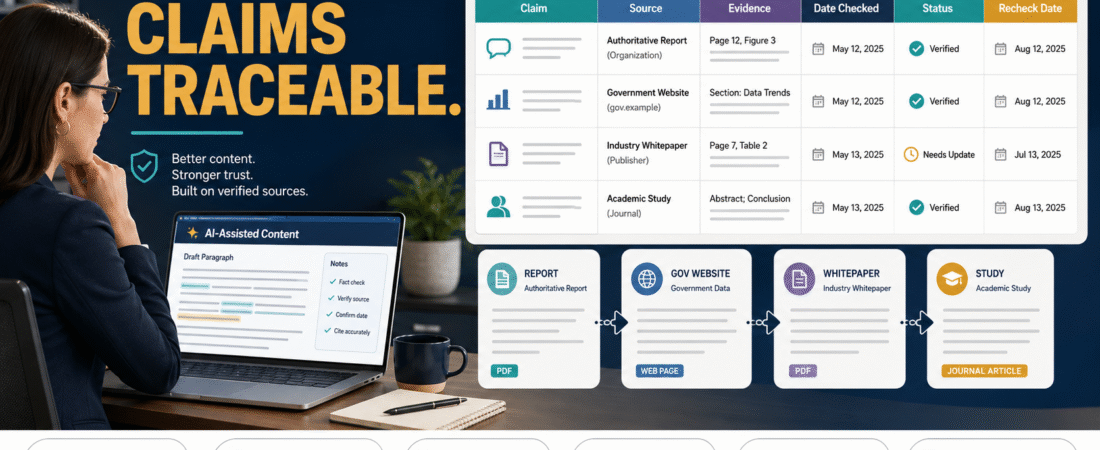
AI can help you research, organize, draft, compare, and explain information much faster than doing every step manually.
But speed creates a new responsibility.
When an AI-assisted article contains a price, statistic, feature claim, policy statement, date, quotation, software instruction, or other fact that matters, you should be able to answer a simple question:
Where did this information come from?
If you cannot answer that later, updating the content becomes harder.
You may remember verifying the claim when the article was written, but six months later you may not remember which official page you checked, when you checked it, or whether the source has changed.
A simple AI content source-verification log solves that problem.
It does not need to become an academic citation database.
For a small online business, it can be a basic record that connects important claims with the sources used to verify them.
The workflow is:
Identify Important Claim → Find Best Source → Verify Exact Evidence → Record Source → Approve Wording → Publish → Recheck When Needed
That small discipline makes AI-assisted content easier to maintain.
A Source Log Is Different From a Source Packet
A source packet is useful before AI begins writing.
You gather trusted information and tell the AI what material it should use.
If you are unfamiliar with that process, my guide to creating an AI source packet before asking for content explains how to control the information going into the task.
A source-verification log serves a different purpose.
It creates a record of the important factual claims that survived into the finished content.
Think of the difference this way:
Source packet: What information are we allowing the AI to use?
Source-verification log: What important claims actually appeared, and what evidence supports them?
You can use both.
Why Traceability Matters
Suppose you publish:
“Software X costs $29 per month.”
Six months later, you update the article.
Now the software costs $39.
Without a source record, you may have to search from the beginning to determine:
- Where the original $29 figure came from.
- Whether it was monthly or annual billing.
- Whether it applied to a specific plan.
- Whether it was a temporary promotion.
- When you last checked it.
With a source log, you can see:
Claim: Entry plan costs $29/month.
Source: Official pricing page.
Verified: September 4, 2026.
Status: Verified at publication.
Recheck: Before next major update.
The log does not guarantee that the claim remains true forever.
It tells you exactly what was verified and when.
Not Every Sentence Needs to Be Logged
Do not create unnecessary work.
A sentence such as:
“A checklist can make a complicated process easier to follow.”
usually does not need a source record.
Prioritize claims that are:
- Specific.
- Important.
- Easy to get wrong.
- Likely to change.
- Potentially consequential.
Examples include:
- Prices.
- Plan limits.
- Product features.
- Statistics.
- Dates.
- Current policies.
- Legal or regulatory information.
- Medical or safety information.
- Direct quotations.
- Technical instructions.
- Current software navigation.
- Claims about what a company includes or excludes.
The higher the consequence of an error, the stronger your verification should be.
Step 1: Identify the Exact Claim
Do not log an entire paragraph if only one sentence needs verification.
Write the claim clearly.
Weak log entry:
“Product pricing.”
Better:
“The Starter plan is listed at $49 per month when billed annually.”
Now you know exactly what you are verifying.
This also helps expose vague language.
If you cannot state the factual claim precisely, you may not know what evidence you need.
Step 2: Prefer the Original Source
For current product information, the best source is usually the organization responsible for the information.
Examples:
- Official pricing page for pricing.
- Official documentation for features.
- Government agency for a government rule.
- Original research publication for a study.
- Company announcement for a company announcement.
Secondary sources can still be helpful.
They may explain complicated information more clearly or provide independent analysis.
But when you are verifying a factual statement about what a platform currently charges, the platform’s own current pricing information normally deserves priority.
Record the source type.
For example:
Source Type: Official first-party documentation.
That makes future review easier.
Step 3: Verify the Entire Claim
A common mistake is finding a source that supports only part of a sentence.
Suppose your draft says:
“Plan A costs $25 per month and includes unlimited automations.”
You confirm the $25 price but never verify the automation limit.
The sentence is only partially verified.
Break compound claims apart when necessary:
Claim 1: Plan A costs $25 per month.
Claim 2: Plan A includes unlimited automations.
Verify each.
This is especially important with AI-generated writing because AI can combine individually plausible facts into one statement that no single source actually supports.
Step 4: Record the Evidence Location
Saving only a homepage URL may not be enough.
A long documentation page could contain hundreds of lines or several sections.
Add a short evidence note such as:
“Pricing table — Starter plan.”
or:
“Section titled Email Automations.”
or:
“FAQ answer under Cancellation Policy.”
You do not need to copy a large passage.
Record enough information to relocate the evidence.
A simple log entry might contain:
Claim: Free plan supports up to 500 contacts.
Source URL: Official pricing documentation.
Evidence Location: Free plan section.
Checked: September 4, 2026.
That may save significant time later.
Step 5: Record the Source Date and Verification Date Separately
These are not always the same.
A document may say:
“Updated August 15, 2026.”
You may verify it on:
“September 4, 2026.”
Record both when the source provides an update date.
Why?
Because later you may discover that the source has not been updated for several years.
That does not automatically make it wrong, but it gives you useful context.
Step 6: Give Every Important Claim a Status
A simple system works well:
VERIFIED
The source clearly supports the wording.
VERIFIED — WORDING ADJUSTED
The original AI wording overstated the evidence, so you corrected it.
NEEDS VERIFICATION
You have not found sufficient evidence yet.
REMOVE
The claim is not necessary and cannot be verified efficiently.
RECHECK BEFORE PUBLISHING
The information changes frequently.
These statuses prevent uncertain facts from quietly slipping into the final article.
Never Let AI Invent the Source Log
AI can help organize your source information.
It should not invent missing sources.
Do not ask:
“Fill in the URLs for all these facts.”
unless you are also going to independently verify every URL.
A fabricated citation can look extremely convincing.
Instead, give AI the sources you actually retrieved and say:
“Organize these verified sources into the following log. Do not create, infer, or substitute any source that I did not provide.”
That places AI in an organizational role.
Use a Separate Rule for Current Information
Some facts should automatically receive a future recheck date.
Examples:
- Software pricing.
- Product features.
- Subscription limits.
- Platform terminology.
- Interface instructions.
- Promotional offers.
- Current statistics.
Your log could contain:
Recheck Frequency: 90 days
or:
Recheck Trigger: Before article update.
or:
Recheck Trigger: Before recommending this product again.
This turns source verification into a maintenance process rather than a one-time event.
Track Screenshots Too
Screenshots can become outdated just like text.
If your content teaches software, record:
- Platform.
- Screen shown.
- Date captured.
- Feature being demonstrated.
- Current or outdated status.
A screenshot does not need replacing merely because the colors changed.
But if the instructions tell a reader to click a button that no longer exists, it needs attention.
Connect the Log to Your AI Review Process
A source log should not replace final content review.
It becomes one part of the review.
My Five-Level AI Output Verification Process provides a broader framework for reviewing AI-generated work before relying on it.
You can also use The Beginner’s AI Content Quality Checklist Before Publishing as the final publication check.
The source log answers one important question:
Can I trace the facts that matter?
A Simple Source-Verification Log Template
You can create the log in a spreadsheet or table with these columns:
Claim ID
A simple number such as C-001.
Article
Name of the article.
Exact Claim
The sentence or factual statement being verified.
Risk Level
Low, Medium, or High.
Source Type
Official documentation, government source, research study, secondary source, etc.
Source Title
Name of the page or document.
Source URL
Direct link.
Evidence Location
Section or heading where support appears.
Source Updated
Date shown by source, if available.
Verified On
Date you checked it.
Status
Verified, Needs Verification, Remove, or Recheck.
Recheck Date
When appropriate.
Notes
Clarifications about wording or limitations.
That is enough for most small-business content systems.
Keep the Log Beside the Final Asset
Do not create a good source log and then store it somewhere you will never find it.
Use a predictable structure:
Article Folder
- Final Article
- Featured Image
- Source Verification Log
- Source Documents
- Reusable Prompt
That makes the research trail part of the publication asset.
Use the Log When Repurposing Content
Source traceability becomes even more valuable when one article becomes:
- YouTube script.
- Short video.
- Email.
- Social post.
- Lead magnet.
- Course lesson.
- Ebook section.
Without a source record, the same outdated statement can spread across six formats.
With the log, you can verify the important facts once and know which assets may need updating when something changes.
Do a Quick Source Audit Before Republishing
Before refreshing an older article:
- Open its source log.
- Filter for changeable claims.
- Reopen the original sources.
- Check whether the information changed.
- Correct the article.
- Update the verification date.
- Record the new version.
Now an update becomes a controlled review instead of another full research project.
Conclusion
AI can help you produce useful content faster, but important factual claims should remain traceable after the chat session ends.
A simple source-verification log gives each significant claim a connection to the evidence that supported it.
You do not need to document every ordinary sentence.
Focus on information that changes, carries consequences, or could damage trust if it is wrong.
For your next article, create a small table with:
Claim → Source → Evidence → Date Checked → Status
Then record the five most important factual claims before publishing.
That small habit can make your AI-assisted content much easier to verify, update, and reuse.