AI can create an organized article, plan, comparison, script, checklist, or product outline in seconds.
Speed is useful, but a fast response is not automatically a reliable response.
AI may produce work that:
- Sounds complete but omits an important step
- Uses outdated product information
- Treats an assumption as a fact
- Repeats an unsupported marketing claim
- Invents personal experience
- Recommends a solution that does not fit your budget
- Follows the requested format while missing the real purpose
A beginner needs more than a grammar review.
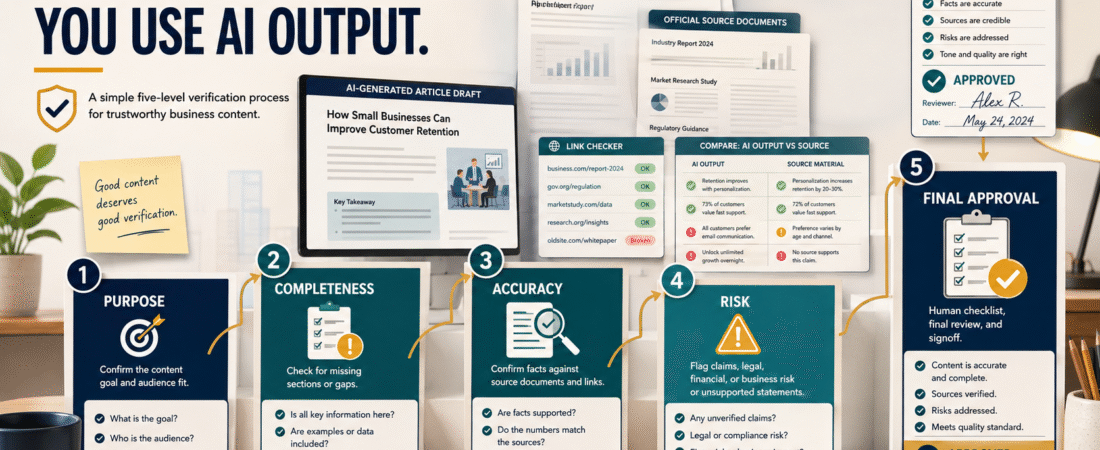
A practical AI output verification process should examine five levels:
- Purpose
- Completeness
- Accuracy
- Risk
- Final approval
This process helps you decide whether the output is useful, what must be corrected, and whether it should be used at all.
Key Takeaways
- Verify the assignment before reviewing individual sentences.
- Check whether every required section and instruction is present.
- Separate factual claims from opinions, examples, and assumptions.
- Apply more scrutiny when the content involves money, customers, licensing, or public claims.
- Give final approval only after reviewing the complete finished version.
Affiliate Disclosure: This article contains affiliate links. If you purchase through one of these links, I may earn a commission at no additional cost to you. Affiliate compensation does not determine the conclusions or recommendations presented in this article.
Why AI Output Can Look Better Than It Is
AI is effective at creating structure.
It can produce:
- Headings
- Numbered steps
- Explanations
- Tables
- Summaries
- Conclusions
- Professional-sounding recommendations
That presentation can make the answer feel trustworthy before the underlying information has been checked.
Consider a software comparison that contains:
- A professional introduction
- A feature chart
- Advantages and disadvantages
- A final recommendation
The article may still be unreliable when:
- The prices are old.
- One plan no longer exists.
- Commercial-use rights were assumed.
- The recommendation ignores the user’s existing software.
- The writer claims to have tested products that were only researched.
The five-level process examines the content beneath the presentation.
Level 1: Verify the Purpose
Begin by returning to the original assignment.
Ask:
- What was AI supposed to create?
- Who was it created for?
- What problem was it supposed to solve?
- What result should the person receive?
- What was the primary question?
- What information was AI instructed to use?
- Which restrictions applied?
A response can be well written and still fail because it completes the wrong task.
Example
You request:
Create a beginner guide that helps retirees choose the simplest digital-product format.
The response provides a detailed explanation of:
- Ebook software
- Course platforms
- Membership tools
- Affiliate funnels
- Advertising
- Automation
The information may be related to digital products, but it does not answer the main question.
The purpose review should identify that failure before you spend time correcting individual paragraphs.
Purpose Verification Checklist
Confirm that:
- The intended audience is recognizable.
- The primary question is answered.
- The requested result is achievable through the content.
- The output remains within the assigned subject.
- Unrequested subjects do not dominate the response.
- The conclusion supports the original purpose.
When the purpose is wrong, request a new draft or complete a major revision.
Do not repair an entire article sentence by sentence when its direction is incorrect.
Level 2: Verify Completeness
The second level checks whether the response contains everything the assignment required.
Create a list from the original instructions.
For a blog article, the list might include:
- Direct introduction
- Key takeaways
- Complete process
- Original example
- Common mistakes
- Relevant product recommendation
- Affiliate disclosure
- Conclusion
- Clear next action
For a product review, the list might include:
- What the product is
- Who it is for
- Features
- Pricing considerations
- Commercial rights
- Advantages
- Limitations
- Who may not need it
- Review methodology
- Final verdict
Mark each requirement as:
- Complete
- Incomplete
- Missing
- Needs verification
- Not applicable
Look for Hidden Gaps
A section may exist without being complete.
For example, an article may have a heading titled “How to Deliver the Product” but provide only this advice:
Upload the product to a delivery platform and send customers the link.
The heading is present, but the reader still does not know:
- How payment connects to delivery
- Whether a login is required
- How access emails are sent
- How a missing download is handled
- How the process should be tested
Completeness is measured by reader usefulness, not by the number of headings.
Level 3: Verify Accuracy
Accuracy review begins by identifying statements that can be checked.
These may include:
- Product features
- Prices
- Plan names
- Policies
- Licenses
- Statistics
- Dates
- Company information
- Platform rules
- Technical instructions
- Links
- Quotations
Do not verify only the claims that appear surprising.
A familiar statement can also be outdated.
Create a Fact Table
Use four columns:
| Claim | Source Needed | Verified Status | Correction |
|---|---|---|---|
| Product includes commercial rights | Official license | Not checked | Review license |
| Plan costs $29 monthly | Official pricing page | Incorrect | Replace with current price |
| Free plan allows client use | Official terms | Unsupported | Remove claim |
| Platform exports customer contacts | Official documentation | Verified | Keep |
This separates factual work from writing style.
Prefer Direct Sources
For changing product information, begin with:
- Official website
- Official pricing page
- Official help center
- Official license
- Official terms
- Official support documentation
- Current checkout page
A promotional affiliate review may help you discover a feature, but the official provider should confirm it whenever possible.
Check Links Individually
Open every link and confirm:
- The destination exists.
- The page matches the description.
- The affiliate link works.
- The product is still available.
- The link does not lead to an unrelated offer.
- The customer can understand what happens after clicking.
Do not assume that a working redirect leads to the intended page.
Level 4: Verify Risk
Some errors create greater consequences than others.
A misspelled heading is different from incorrect licensing information.
Apply a stronger review when the content affects:
- Customer money
- Subscriptions
- Refunds
- Product access
- Commercial rights
- Personal data
- Legal obligations
- Health or safety
- Financial decisions
- Public reputation
- Affiliate disclosures
- Business promises
Use a Three-Level Risk Rating
Lower Risk
Examples:
- Headline options
- Social-media ideas
- General brainstorming
- Visual concepts
- Internal planning notes
These still require review, but mistakes may be easier to correct.
Medium Risk
Examples:
- Public blog articles
- Email sequences
- Product descriptions
- Tutorials
- Software comparisons
- Customer FAQs
Errors may mislead readers or create support problems.
Higher Risk
Examples:
- Licensing instructions
- Refund claims
- Legal or tax guidance
- Medical information
- Investment recommendations
- Privacy policies
- Automated customer decisions
These require authoritative sources and may require qualified professional review.
Check for Invented Authority
AI-generated content should not claim:
- “I personally tested this” when no testing occurred.
- “My customers achieved…” without documented evidence.
- “This is legally compliant” without proper review.
- “This guarantees…” when results depend on many variables.
- “Experts agree…” without identifying reliable sources.
Remove unsupported authority even when it makes the writing sound more persuasive.
Level 5: Give Final Human Approval
Final approval is not the same as finishing the first edit.
Review the complete version as the person who will receive it.
For a blog article:
- Read it from beginning to end.
- Open every link.
- Check the featured-image instructions.
- Confirm the disclosure.
- Review the conclusion.
- Preview it on desktop and mobile.
For a digital product:
- Open every file.
- Follow every instruction.
- Complete every worksheet.
- Test the checkout and delivery.
- Review customer-support information.
- Confirm the license.
For a course:
- Enter through the student login.
- Watch the lessons.
- Download the resources.
- Complete the activities.
- Test password recovery.
- Review the sequence.
The final approver remains responsible for the published work.
A Practical Verification Example
Imagine AI creates an article titled:
How to Build and Sell Your First Online Course in Seven Days
The article looks polished.
Purpose Review
The intended audience is beginners, but the process assumes they already have a topic, videos, checkout, and audience.
The purpose is only partially met.
Completeness Review
The article includes course creation and promotion but omits:
- Student result
- Lesson activities
- Course testing
- Customer onboarding
- Support
The process is incomplete.
Accuracy Review
The article lists current software prices without sources.
Those claims require verification.
Risk Review
The article implies that a complete course can be launched successfully within seven days.
That timeline may be unrealistic and could mislead readers.
Final Approval
The title is changed to:
A Beginner Workflow for Planning and Building a Small Online Course
The missing steps are added, the prices are checked, and the timeline is presented as an example rather than a promise.
The verification process changes more than grammar. It improves the article’s purpose and responsibility.
Use Verification With AI-Created Products
AI product-creation tools can help develop:
- Ebooks
- Guides
- Checklists
- Worksheets
- Sales-page drafts
- Product descriptions
- Course outlines
People evaluating this type of workflow can review the current AI Product Engine offer.
The tool may accelerate production, but each generated asset should pass the five verification levels before it becomes a customer product.
Course creators may also use AI-assisted systems to organize lessons, workbooks, and training assets. Review the current CourseMate AI offer when that workflow fits the project.
A course-generation feature does not confirm that:
- The lessons are accurate.
- The sequence teaches effectively.
- Activities support the result.
- The commercial license fits the intended use.
- Customers can complete the course.
Verification remains necessary.
A Reusable Five-Level Verification Worksheet
Level 1: Purpose
Original task:
[Task]
Audience:
[Audience]
Primary question:
[Question]
Desired result:
[Result]
Purpose met:
[Yes, partially, or no]
Level 2: Completeness
Required sections:
[Sections]
Missing information:
[Information]
Weak sections:
[Sections]
Unanswered questions:
[Questions]
Level 3: Accuracy
Claims requiring verification:
[Claims]
Sources reviewed:
[Sources]
Incorrect information:
[Information]
Links tested:
[Yes or no]
Level 4: Risk
Risk level:
[Lower, medium, or higher]
Possible harm:
[Harm]
Unsupported claims:
[Claims]
Professional review needed:
[Yes or no]
Level 5: Approval
Final revisions completed:
[Revisions]
Complete version tested:
[Yes or no]
Approved for use:
[Yes, no, or approved with limitations]
Approver:
[Name]
Approval date:
[Date]
Common Verification Mistakes
Reviewing Only Spelling and Grammar
Good grammar cannot correct a false claim or missing step.
Trusting a Confident Answer
Confidence is a presentation quality, not evidence.
Checking Only One Section
Review the complete customer or reader experience.
Assuming the AI Used the Latest Information
Verify changing facts directly.
Correcting the Output Without Correcting the Prompt
When the same problem occurs repeatedly, improve the saved instructions.
Approving Several Assets in One Quick Review
An article, email, video script, and product description each serve different purposes.
Review each one separately.
Conclusion
AI output should move through five levels before it is published or used for an important business decision:
- Purpose
- Completeness
- Accuracy
- Risk
- Final human approval
This process helps you find problems that a simple proofreading check will miss.
Choose one important AI-generated asset and complete all five levels before approving it.