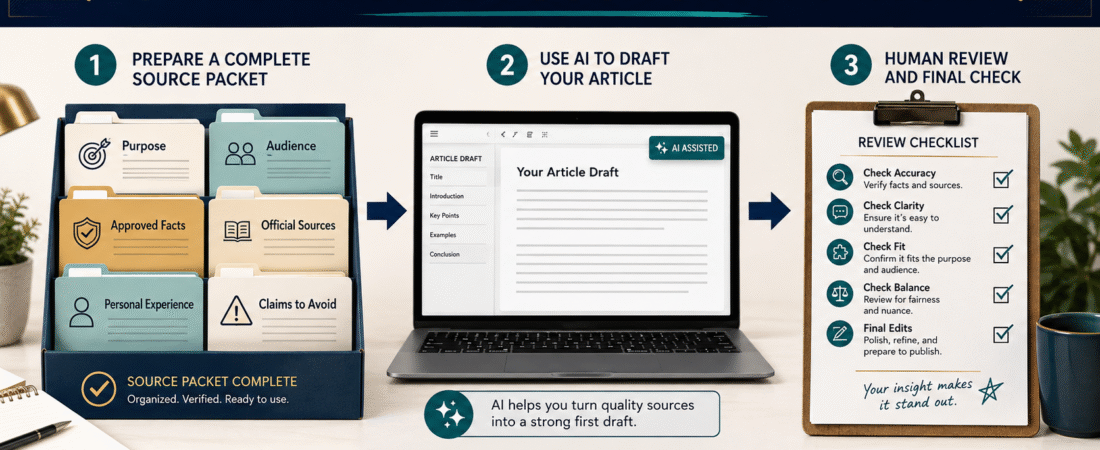
Many weak AI-generated articles begin with an incomplete request.
The user provides a topic and asks for a finished article, but the AI receives no approved facts, audience information, official sources, personal perspective, product details, or instructions about what must not be claimed.
The result may sound organized while remaining generic, incomplete, or inaccurate.
An AI source packet is a collection of the information the system is allowed to use for one assignment. It gives the AI a stronger foundation and gives you a clear standard for reviewing the finished work.
A basic source packet should contain:
- The content purpose
- The intended audience
- The central question
- Approved facts
- Reliable sources
- Relevant personal experience
- Product information
- Claims and topics to avoid
- Required examples
- Final review questions
The source packet does not guarantee a perfect response. It reduces unnecessary guessing and makes errors easier to identify.
Key Takeaways
- Gather important information before requesting the first draft.
- Separate verified facts from opinions and working assumptions.
- Give AI only the personal experiences you approve for public use.
- Identify information that must not be invented.
- Review the final content against the packet instead of judging only writing style.
What Is an AI Source Packet?
An AI source packet is a structured collection of information prepared for a specific content assignment.
It may include:
- Notes
- Official documentation
- Product information
- Approved quotations
- Research summaries
- Website details
- Audience descriptions
- Personal observations
- Examples
- Content rules
- Links
- Questions requiring further research
The packet can be short or detailed.
A narrow social-media post may need one page of information. A complete software review or educational guide may require several pages.
The correct size depends on the risk and complexity of the assignment.
Why a Topic Alone Is Not Enough
Suppose you ask:
Write an article about starting an email list.
The AI does not automatically know:
- Whether the reader is a retiree, blogger, or established company
- Which email service you recommend
- Whether you have firsthand experience
- What business model the reader uses
- Whether the article should include affiliate links
- Which facts require verification
- Which examples match your audience
- Which claims you consider misleading
- Which WordPress fields are required
The AI may fill the gaps with general information.
A source packet replaces missing context with approved direction.
Step 1: Define the Content Purpose
Write one sentence explaining why the content is being created.
Examples:
This article should help a retiree decide whether building an email list is a manageable first online-business step.
This review should help a beginner evaluate whether a specific software platform fits one simple digital product.
This guide should help a blogger update an old article without creating a completely new post.
The purpose should describe the reader’s benefit rather than only the business goal.
“Promote the affiliate product” is not enough.
A stronger purpose would be:
Help readers understand the product, evaluate its limitations, and decide whether it fits their current needs.
Step 2: Describe the Intended Audience
Include details that affect the explanation.
Record:
- Experience level
- Main problem
- Desired result
- Budget concerns
- Technical comfort
- Time limitations
- Existing tools
- Common misunderstandings
Example:
The reader is a beginner or retiree who wants a simple online business, has limited technical knowledge, and does not want to manage a large number of software platforms.
This helps the AI avoid recommending an unnecessarily complicated system.
Step 3: State the Central Question
Every source packet should identify one primary question.
Examples:
- How can a beginner verify an AI-generated article?
- Which email-marketing plan fits a small list?
- What should a digital-product delivery system include?
- How can an ebook become a short course?
- Is this product worth considering for a beginner?
The finished article may answer supporting questions, but the central question keeps the work focused.
Step 4: Separate Approved Facts From Assumptions
Create two sections.
Approved Facts
These may include:
- Confirmed product features
- Current prices
- Official policies
- License language
- Dates
- Website information
- Personal history that has been approved
- Existing business tools
Assumptions Requiring Verification
These may include:
- A product is easy to use.
- A beginner will save time.
- A particular plan provides enough features.
- The audience prefers one format.
- A workflow can be completed within a certain period.
Do not allow assumptions to appear as established facts.
The AI can discuss them carefully, but the final wording should reflect uncertainty.
Step 5: Add Reliable Sources
List the preferred source for each changing fact.
Possible sources include:
- Official product website
- Official help center
- Official pricing page
- Official license
- Government guidance
- Original research
- Your own approved documentation
Avoid supplying several low-quality pages that repeat the same unverified claim.
For a product review, organize sources by subject:
Features:
Official product page
Pricing:
Official pricing or checkout page
Licensing:
Official license or terms
Support:
Official help center
Refunds:
Official refund policy
This makes later verification easier.
Step 6: Include Only Approved Personal Experience
AI should never be asked to invent firsthand use.
Create a section labeled:
Approved Personal Experience
Record only what can be stated truthfully.
Examples:
- Purchased the product
- Logged into the software
- Created one test project
- Used the tool for client work
- Reviewed a demonstration
- Researched the official information
- Did not personally test the platform
Be precise.
“Familiar with the product” may be too vague.
A clearer statement would be:
I purchased the software and reviewed the dashboard, but I have not completed a full customer project with it.
This protects credibility.
Step 7: Add the Important Product Information
When content contains a product recommendation, include:
- Product name
- Official purpose
- Intended audience
- Approved link
- Known features
- Known limitations
- Pricing source
- Commercial-use details
- Personal-use status
- Claims to avoid
Do not give AI only an affiliate link and expect an independent evaluation.
A complete source packet should help the article explain who may not need the product.
Step 8: Create a Claims-to-Avoid Section
This section is one of the most important parts of the packet.
Possible prohibited claims include:
- Guaranteed rankings
- Guaranteed sales
- Guaranteed traffic
- Automatic income
- Effortless success
- Personal testing that did not occur
- Unverified savings
- Invented customer results
- False scarcity
- Unsupported ratings
- Exact completion times without evidence
Add topic-specific restrictions.
For example:
Do not say that the free plan includes commercial rights unless the current license confirms it.
Do not describe the platform as beginner-friendly without explaining which workflow was evaluated.
Step 9: Supply an Original Example
AI content becomes more useful when the example is planned in advance.
Describe the situation.
Example:
Use a retired teacher creating a short digital guide. The teacher has WordPress, an email service, and a checkout but does not want another expensive platform.
The AI can develop the example without inventing a personal story about you.
Clearly label hypothetical examples as examples.
Step 10: State the Required Output
Explain what must be created.
For a blog article, this may include:
- Publishing information
- Featured-image details
- Main title
- Direct introduction
- Required sections
- Practical example
- Common mistakes
- Conclusion
- Affiliate disclosure
- Relevant product links
This prevents the AI from returning an outline when you need a finished article.
A Simple AI Source-Packet Template
Content Title or Topic:
[Topic]
Website:
[Website]
Purpose:
[Why the content is needed]
Primary Audience:
[Audience]
Audience Problem:
[Problem]
Desired Result:
[Result]
Central Question:
[Question]
Approved Facts:
[Facts]
Facts Requiring Verification:
[Facts]
Preferred Sources:
[Sources]
Approved Personal Experience:
[Experience]
Product Information:
[Information]
Approved Links:
[Links]
Original Example:
[Example]
Required Sections:
[Sections]
Claims to Avoid:
[Claims]
Information That Must Remain Private:
[Information]
Final Action:
[Reader’s next step]
A Practical Beginner Example
Suppose a beginner wants an article reviewing an AI course-creation platform.
Without a source packet, the request might be:
Write a positive review of this course tool.
A stronger packet would explain:
- The reader is a beginner creating a five-lesson course.
- The writer has researched but not tested the platform.
- The official sales page is the primary source.
- Pricing must be checked at the current checkout.
- Commercial rights must not be assumed.
- The article should evaluate ease of use, output quality, limits, licensing, support, and delivery.
- The conclusion may recommend or reject the product.
- No income claims are permitted.
The finished review is more balanced because the assignment controls the evidence and the claims.
Use AI to Identify Missing Information
After preparing the source packet, ask:
Review this source packet without drafting the article. Identify any missing information required to answer the central question accurately. Do not fill the gaps or invent details.
The AI may identify missing items such as:
- Current price
- Refund terms
- Export options
- Personal-use status
- Intended publication format
- Official support source
You can then complete the packet before requesting the draft.
Use a Source Packet for Digital-Product Creation
A source packet can also guide an ebook, checklist, workbook, or course.
Include:
- Product purpose
- Customer
- Promised result
- Approved concepts
- Proprietary material that must not be revealed
- Required activities
- Examples
- Final format
- License
- Quality-control requirements
People who want assistance organizing ebooks, guides, checklists, and other digital products can review the current AI Product Engine offer.
A product-creation tool may help structure and draft the material, but the source packet should control what the product teaches.
Common Source-Packet Mistakes
Adding Too Much Unorganized Material
A large folder is not automatically a useful packet.
Label the information and explain why each source matters.
Mixing Facts and Opinions
Keep verified details separate from judgment.
Supplying Outdated Product Information
Record the review date and current source.
Forgetting the Audience
The same facts may require different explanations for beginners and experienced users.
Allowing AI to Fill Missing Policies
Make the business decision first.
Skipping the Final Comparison
Review the finished content against the original packet.
Final Source-Packet Review
Before submitting it, confirm:
- The purpose is clear.
- The audience is specific.
- One central question is identified.
- Important facts are supported.
- Personal experience is accurate.
- Prohibited claims are listed.
- An original example is included.
- Private information is excluded.
- The desired output is defined.
- Missing information is marked instead of guessed.
Conclusion
An AI source packet gives content creation a reliable starting point.
It organizes the purpose, audience, facts, sources, personal experience, examples, product information, and prohibited claims before drafting begins.
Prepare a source packet for one important article and ask AI to identify what is missing before requesting the first draft.