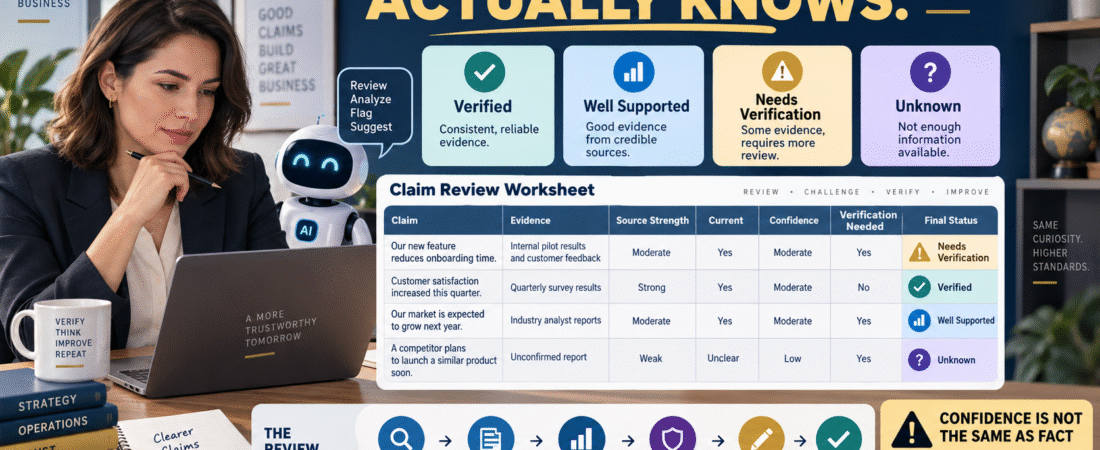
AI often writes uncertain information in the same polished tone it uses for well-supported information.
That creates a problem.
A statement based on:
- Current official documentation.
can sound almost identical to a statement based on:
- Inference.
- Old information.
- Limited evidence.
- A reasonable guess.
If you are using AI for business decisions, research, articles, comparisons, or product planning, those differences matter.
A simple AI confidence labeling system gives you a way to distinguish between:
Verified Fact
and:
Plausible but Not Yet Verified
before both are presented as though they carry equal weight.
The process is:
Claim → Evidence → Confidence Label → Verification → Final Status
Confidence Is Not the Same as Certainty
AI can sound very confident.
That does not mean the underlying information is certain.
Likewise, a carefully qualified answer may be extremely accurate.
Do not judge reliability from writing style.
Judge it from:
- Evidence.
- Source quality.
- Currentness.
- Directness.
- Corroboration.
The confidence label should describe the support behind the claim, not how confidently the sentence is written.
Use Four Simple Labels
You do not need a complicated 1–100 confidence score.
A four-level system is usually more practical.
VERIFIED
Use when the claim has strong current evidence.
Examples:
- Current price confirmed on official pricing page.
- Feature confirmed in official documentation.
- Date confirmed by original announcement.
- User-supplied screenshot directly shows the setting.
This is the strongest category.
WELL SUPPORTED
Use when the evidence is good, but not absolute.
Examples:
- Several reliable sources agree.
- A general principle is strongly established.
- Current evidence supports the conclusion even though no single source directly states it.
This is appropriate for many business explanations.
NEEDS VERIFICATION
Use when the claim may be correct but still needs checking.
Examples:
- Pricing came from an older review.
- Product capability came from a secondary source.
- AI inferred a platform behavior.
- Current documentation has not been checked.
This label tells you:
Do not publish or act yet.
UNKNOWN
Use when sufficient evidence is unavailable.
Examples:
- Platform does not publicly document the behavior.
- Sources conflict and the conflict cannot yet be resolved.
- AI has no evidence for the statement.
Unknown is a legitimate answer.
It is better than inventing certainty.
Why Not Use Percentages?
You might be tempted to use:
92% confident
or:
70% reliable
That sounds scientific.
But where did the number come from?
Unless your process genuinely calculates a validated probability, the percentage itself can create false precision.
Simple labels are easier to understand and harder to misinterpret.
Step 1: Identify the Claim
Do not label an entire article:
High Confidence
Break it into meaningful claims.
Example:
Claim 1: Platform A has a free plan.
Claim 2: Platform A is easier for beginners.
Claim 3: Platform A costs less for a 5,000-contact list.
Each claim requires different evidence.
Step 2: Identify the Evidence
For each important claim, ask:
What supports this?
Possible answers:
- Official documentation.
- First-party support article.
- Independent authoritative source.
- User-provided evidence.
- Community discussion.
- AI inference.
- No source.
Your AI evidence hierarchy can help you rank those sources appropriately once that workflow is available in your system.
Step 3: Check Freshness
A source can be strong and outdated.
For fast-changing subjects such as:
- Software pricing.
- Plan limits.
- Platform interfaces.
- Current policies.
confidence should fall when the information has not been checked recently.
A pricing claim from an official page captured two years ago should not automatically remain:
Verified
today.
Step 4: Separate Direct Evidence From Inference
Suppose official documentation says:
The platform includes automated workflows.
AI writes:
This platform is ideal for every advanced marketer.
The first statement may be directly supported.
The second is an inference.
Do not give both the same label.
A recommendation usually depends on:
- Requirements.
- Alternatives.
- Cost.
- Complexity.
- User preferences.
That means many recommendations should begin as:
Well Supported
rather than:
Verified Fact.
Step 5: Consider the Risk
A low-confidence headline idea is not very dangerous.
A low-confidence recommendation to cancel software can be.
Increase your verification requirements when a claim affects:
- Money.
- Customers.
- Business systems.
- Legal obligations.
- Health.
- Security.
- Irreversible actions.
Your AI assumption checklist can help reveal hidden assumptions behind those higher-risk recommendations.
Step 6: Require Verification Before Promotion to “Verified”
Do not allow AI to label its own statement:
Verified
simply because it believes it is correct.
Require evidence.
For example:
Original status: Needs Verification.
Evidence found: Current official pricing page.
Updated status: Verified.
This creates an explicit promotion process.
Step 7: Allow Confidence to Decrease
Confidence can move both directions.
Example:
Yesterday:
Verified — $29/month.
Today:
Official pricing page changed.
Status becomes:
Needs Reverification
until the article is updated.
This is especially important for evergreen content involving software and digital services.
Use Confidence Labels During Research
A research table might contain:
| Claim | Evidence | Label |
|---|---|---|
| Starter plan costs $19 | Official pricing page | Verified |
| Platform is easier for beginners | Feature comparison + workflow analysis | Well Supported |
| New feature available to every account | One forum comment | Needs Verification |
| Exact rollout date | No reliable source | Unknown |
This makes the research much easier to review.
Use Labels Before AI Writes the Article
One useful approach is:
- Research claims.
- Assign confidence labels.
- Approve the evidence.
- Then ask AI to draft.
This reduces the chance that uncertain information becomes polished prose before anyone notices.
Your AI Source Packet workflow can support this structure.
Use Labels During Revision
Suppose an article contains 30 factual claims.
Ask AI:
“Create a claim table. Assign each claim one of these statuses: Verified, Well Supported, Needs Verification, Unknown. Do not upgrade anything to Verified unless a supplied source directly supports it.”
Then manually check the higher-risk rows.
AI can help organize the review.
It should not be the final authority.
Connect Confidence Labels to Human Review
You do not need to manually investigate every low-risk statement.
Use a rule such as:
VERIFIED
Normal final review.
WELL SUPPORTED
Review if central to recommendation.
NEEDS VERIFICATION
Must be resolved before publication if factual and important.
UNKNOWN
Either remove, qualify clearly, or investigate.
This makes human review more targeted.
The human review checkpoint workflow provides a complementary risk-based system.
Example: Software Comparison
Claim:
Platform A costs $49/month.
Official pricing page confirms it.
Label: Verified
Claim:
Platform A will save beginners more time.
Evidence:
Simpler workflow, fewer setup steps.
Label: Well Supported
Claim:
Platform A has better customer service.
Evidence:
One user comment.
Label: Needs Verification
Claim:
Platform A will increase sales by 25%.
Evidence:
None.
Label: Unknown
The last claim should not appear as fact.
Example: Business Recommendation
Recommendation:
Switch from Tool A to Tool B.
Supporting facts may be verified.
But the recommendation itself depends on:
- Your needs.
- Migration effort.
- Cost.
- Integrations.
- Learning curve.
Therefore, you might label the recommendation:
Well Supported — Conditional on migration testing.
That is much more useful than pretending a business recommendation can always be “verified.”
Do Not Turn Labels Into Decorative Badges
The purpose is not to add colorful labels to everything.
The purpose is to control what enters your finished work.
If the reader never sees the internal labels, they can still improve the article because uncertain claims have already been removed or qualified.
Add a “Why” Column
Whenever practical, record:
Confidence: Well Supported
Why: Current official feature documentation plus two independent sources agree.
This makes the label auditable.
Review Labels When New Evidence Appears
If official support responds with new information:
Update the claim.
If a feature launches:
Update the status.
If old evidence becomes obsolete:
Lower the confidence until it is reverified.
This keeps your research system alive rather than frozen.
A Simple AI Confidence Table
Use:
Claim
Evidence
Source Strength
Freshness
Risk
Confidence Label
Verification Needed
Final Status
You can use this for:
- Articles.
- Product research.
- Business plans.
- Software comparisons.
- AI recommendations.
Conclusion
An AI confidence labeling system helps prevent uncertain information from looking identical to verified fact.
Use four practical labels:
Verified
Well Supported
Needs Verification
Unknown
Assign the label based on:
Evidence → Source Strength → Freshness → Directness → Risk
Do not use AI writing style as a proxy for reliability.
And do not force uncertainty into a false yes-or-no answer.
Sometimes the strongest conclusion is:
We do not know yet.
Your Next Action
Take one AI-generated answer you plan to use or publish.
Identify its 10 most important factual or recommendation claims.
Create three columns:
Claim | Confidence Label | Why
Assign each:
VERIFIED | WELL SUPPORTED | NEEDS VERIFICATION | UNKNOWN
Then highlight every claim labeled:
Needs Verification
or:
Unknown
Do not publish or act on those claims until you either:
- Verify them.
- Qualify them clearly.
- Remove them.
Finally, add this instruction to your reusable AI research prompt:
“Distinguish verified facts, well-supported conclusions, claims needing verification, and unknowns. Do not present them with equal certainty.”
That gives you a practical confidence-control system you can reuse immediately.