A lead-magnet signup should not end with:
Thank you.
That tells the visitor almost nothing.
They may immediately wonder:
- Did the form work?
- Where is my download?
- Should I check my email?
- How long should the email take?
- What sender name should I look for?
- What should I do if the message never arrives?
- Is there anything useful I should do next?
A good lead-magnet thank-you page answers those questions before they turn into confusion.
Recent 2026 marketing guidance continues to treat the thank-you page as an important transition point after a form submission—not merely a polite dead end. Current examples emphasize confirming that the action succeeded, setting expectations, and providing a focused next step.
The page does not need to be complicated.
A simple structure works:
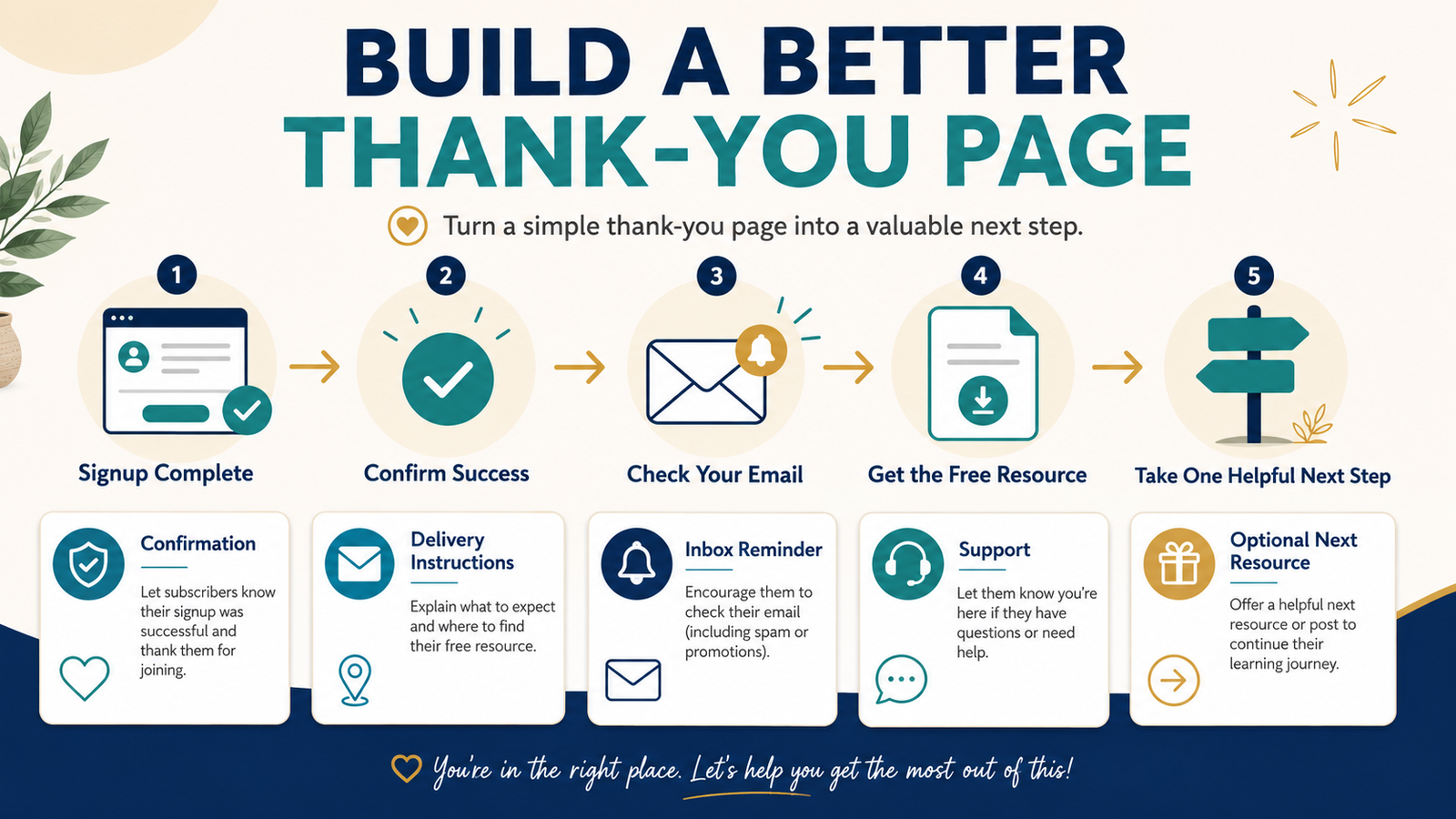
Confirmation → Delivery Instructions → What to Expect → Help if Needed → One Optional Next Step
The First Job Is Confirmation
The visitor has just submitted a form.
Your first message should answer:
Did it work?
For example:
Thank You — Your Request Was Received
Your free Affiliate Marketing Action Checklist is on its way to the email address you entered.
That is much clearer than:
Thanks!
The visitor knows the form succeeded and knows what should happen next.
Tell People Where the Lead Magnet Will Arrive
If your delivery method is email, say so.
For example:
Check your inbox for an email from Michael E. Lee containing your download instructions.
If you use a sender address consistently, you may also tell them which address to expect.
The purpose is to prevent a visitor from searching the thank-you page for a download button that does not exist.
Do Not Contradict Your Delivery System
Suppose your website is designed to capture the email address first and then deliver the resource by email.
Do not create a thank-you page that also gives everyone a public direct PDF link unless that is intentional.
That can undermine the system you built.
Your signup page, confirmation page, email delivery, and download instructions should all follow the same process.
Explain What Happens Next in Three Steps
A simple block can say:
What Happens Next
- Check your inbox.
- Open the email containing your download instructions.
- Use the link in that email to access the free resource.
That is enough.
Do not turn the thank-you page into a user manual.
Mention the Spam or Promotions Folder Carefully
A useful note:
If you do not see the message after a few minutes, check your Spam, Junk, or Promotions folder.
Avoid promising:
It will arrive in exactly 30 seconds.
Email delivery can vary.
Give useful guidance without creating a guarantee you do not control.
Tell the Subscriber What the Email Looks Like
You can reduce confusion further by identifying:
Sender: Michael E. Lee
Subject: Your Affiliate Marketing Action Checklist
Now the subscriber knows what to find.
This becomes especially useful when someone receives a large volume of email.
Provide a Support Path
A thank-you page should answer:
What if nothing arrives?
For example:
If you still cannot locate the message, contact support at [your support email].
Do not make the new subscriber search your entire website for help.
Keep the Page Focused
A common mistake is placing too much on the thank-you page:
- 12 affiliate offers.
- 8 blog posts.
- 5 social channels.
- A course.
- A webinar.
- A second lead magnet.
- A countdown timer.
- Three unrelated products.
That creates another decision problem.
The visitor just took one action.
Help them complete it first.
Then Offer One Useful Next Step
After delivery instructions, you may offer one related action.
Examples:
Read a Related Beginner Article
While you’re waiting, read this beginner guide.
Visit Your Start Here Page
New here? Start with this simple guide to the site.
Review a Related Free Resource
If this checklist is useful, you may also want this free prompt collection.
The key word is related.
Do not use the thank-you page as a dumping ground.
Match the Next Step to the Lead Magnet
Suppose the lead magnet is:
Affiliate Marketing Action Checklist
A logical next step might be:
- Beginner affiliate marketing article.
- Recommended tools page.
- Start Here page.
A less logical next step:
Learn how to create AI voiceovers.
The second topic may be valuable, but it does not continue the immediate journey.
A Lead Magnet Should Solve One Problem
Your existing article on how to create a lead magnet with AI that people will actually want focuses on making the resource itself useful and specific.
The thank-you page should continue that same focus.
If the lead magnet promises:
A checklist to organize your first affiliate-marketing campaign
the thank-you page should not immediately shift into:
Buy my unrelated design course.
Keep the experience coherent.
A Current 2026 Pattern: Confirmation Plus Next Step
Current lead-generation guidance still consistently shows two useful principles:
- Confirm that the visitor completed the action.
- Give the visitor a logical next action rather than abandoning them.
That does not mean every thank-you page needs another conversion.
Sometimes the best next action is simply:
Go check your inbox.
Do You Need an Upsell?
Not necessarily.
For a beginner lead magnet, a hard upsell can feel abrupt.
You can test:
Version A
Confirmation + inbox instructions only.
Version B
Confirmation + inbox instructions + one related resource.
Later, if you have enough traffic and a genuine related offer, you can test a paid next step.
Do not assume every thank-you page must produce immediate revenue.
Consider a Start Here Link
A subscriber who found your website through one article may know nothing about you.
A simple line can say:
While you wait for the email, visit the Start Here page to see how the site is organized.
That is a useful orientation step.
It does not pressure the subscriber.
You Can Also Link to Your Recommended Tools
If the lead magnet relates to building an online business, a tools page may be useful.
But use it as an optional resource.
Example:
Need help choosing the basic tools involved? Visit My Recommended AI Tools for Beginners.
Again, do not overwhelm the page with every possible resource.
Thank-You Pages Help Diagnose Funnel Problems
Suppose people submit your form but frequently ask:
Where is the download?
That tells you something.
Potential problems:
- Thank-you page is unclear.
- Delivery email is delayed.
- Sender name is unfamiliar.
- Subject line is vague.
- Form did not subscribe correctly.
- Email lands in spam.
- Instructions are incomplete.
The thank-you page is part of the operational system.
Connect It With Your Welcome Series
Once someone joins the list, your welcome emails take over.
Your verified guide to building an email list with one lead magnet and a simple welcome series explains that broader subscriber journey.
Think of the roles this way:
Signup page: persuades someone to subscribe.
Thank-you page: confirms success.
Delivery email: provides access.
Welcome sequence: begins the relationship.
Each has one primary job.
A Simple Copy-and-Paste Thank-You Page Structure
Thank You — Your Free Checklist Is on the Way
Your request was successfully received.
I’m sending the Affiliate Marketing Action Checklist to the email address you entered.
What to Do Next
- Check your inbox.
- Look for an email from Michael E. Lee.
- Open the email and follow the download instructions.
If you do not see it, check your Spam, Junk, or Promotions folder.
While You Wait
If you’re just getting started, visit my Start Here page for a simple overview of the resources available on this website.
Need Help?
If you cannot locate the email or have trouble accessing the checklist, contact support at [support email].
That is enough.
Test the Whole Experience Yourself
Do not stop after publishing the page.
Use an email address that is not already on the list.
Complete the same journey as a visitor.
Check:
Form
Does it submit?
Thank-You Page
Does it load?
Confirmation
Does it clearly say what happened?
Does it arrive?
Subject
Is it recognizable?
Download
Does the link work?
Mobile
Can you complete everything from a phone?
Testing the full journey matters more than how attractive the thank-you page looks in the editor.
Track the Page if It Helps You
A thank-you page can also become a useful measurement point.
If every successful signup reaches:
/thank-you/
you can use analytics to understand completed form activity.
But do not assume page views equal confirmed subscribers unless the technical setup supports that interpretation.
Measurement should reflect the actual system.
Do Not Index Every Confirmation Page Automatically
Many thank-you pages exist only to serve people who completed a particular action.
Depending on the page, you may not need it appearing in Google Search.
Discuss appropriate indexing settings with your website/SEO setup rather than allowing utility pages to become accidental search landing pages.
Avoid Sensitive Information in the URL
Do not pass personal data such as an email address openly into a public thank-you-page URL unless you have a specific secure reason and appropriate technical implementation.
A URL like:
/thank-you/?email=customer@example.com
can create unnecessary privacy exposure.
Keep the confirmation simple.
What a Good Thank-You Page Should Accomplish
Before publishing, ask:
Confirmation
Does it clearly tell the subscriber the form worked?
Delivery
Does it explain where the lead magnet will arrive?
Expectation
Does the person know what message to look for?
Help
Is there a support path?
Next Step
Is there one relevant optional next action?
Focus
Is the page free from unnecessary distractions?
If yes, the page is probably doing its job.
Conclusion
A lead-magnet thank-you page does not need clever funnel tricks.
It needs clarity.
Confirm the signup.
Explain where the free resource will arrive.
Tell the subscriber what to look for.
Provide help if delivery fails.
Then, if appropriate, give them one useful next step.
That turns a forgettable “Thank you” message into a small but important part of a reliable email-list-building system.