AI can help create a first draft quickly.
That does not mean the draft should move directly from:
Generate
to:
Publish.
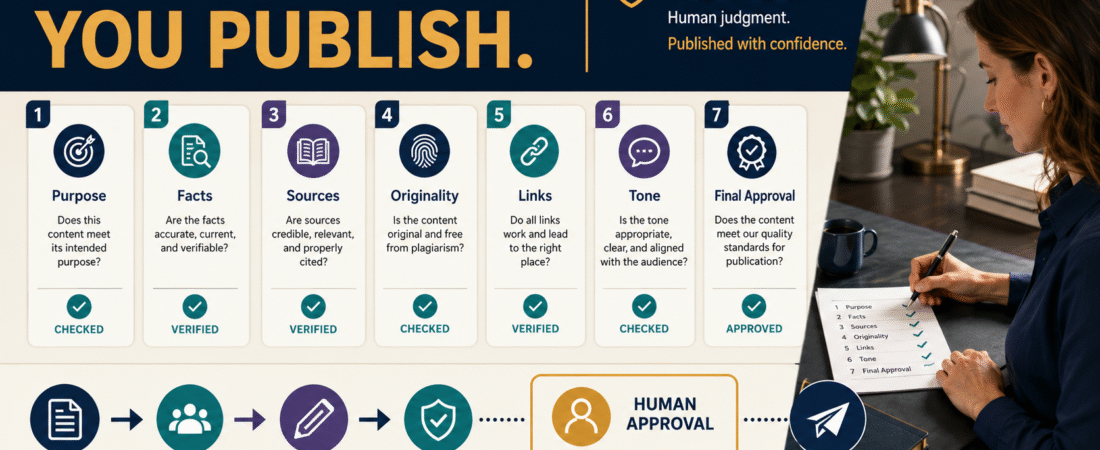
A useful content process needs one final gate.
The purpose of an AI content approval checklist is to answer:
Is this content accurate, useful, original enough, correctly linked, appropriate for the intended audience, and ready to represent the business publicly?
A simple final workflow is:
Draft → Review → Correct → Verify → Approve → Publish
The important step is Approve.
That decision belongs to the human publisher.
Why a Final Approval Step Matters
AI-assisted content can look finished before it is finished.
The grammar may be smooth.
The headings may be organized.
The introduction may sound confident.
But problems can still remain:
- Unsupported facts.
- Invented details.
- Outdated pricing.
- Wrong links.
- Repetitive sections.
- Generic examples.
- Overstated conclusions.
- Incorrect product names.
- Claims that are broader than the evidence.
- Content that does not actually answer the intended question.
A polished sentence is not proof that the sentence is correct.
Review 1: Does the Content Complete the Intended Task?
Return to the original assignment.
Ask:
- What was the article supposed to accomplish?
- Who was it written for?
- What question should it answer?
- What action should the reader be able to take afterward?
An article can be well written and still answer the wrong question.
If the assignment was:
Explain how a beginner can compare two email platforms
but half the article discusses advanced enterprise CRM architecture, the draft may have drifted away from its audience.
Review 2: Check the Audience
Ask:
- Is terminology appropriate?
- Are unfamiliar terms explained?
- Are examples realistic for the intended reader?
- Is the article too advanced?
- Is it too basic?
- Does it assume tools or knowledge the reader may not have?
Do not confuse complexity with expertise.
A strong beginner article explains enough to help without making the reader learn unnecessary terminology first.
Review 3: Separate Facts From Advice
Highlight factual statements.
Examples:
- Prices.
- Dates.
- Plan names.
- Product features.
- Statistics.
- Rules.
- Policies.
- Technical behavior.
- Legal or regulatory claims.
Then ask:
Where did this information come from?
If the article says:
“Platform A costs $29 per month.”
you should know where that number was verified.
The existing AI source packet process can make this easier because approved information is gathered before drafting begins.
Review 4: Fact-Check Every Material Claim
Prioritize claims that could materially affect a reader’s decision.
For example:
High priority:
- Product pricing.
- Refund rules.
- Software features.
- Tax claims.
- Search-engine requirements.
- Affiliate terms.
Lower priority:
- General writing advice.
- Common examples.
- Organizational suggestions.
The verified fact-checking process for AI-generated content provides a deeper workflow for this stage.
Do not assume a fact remains true because you verified it six months ago.
Changing information should be checked again.
Review 5: Check Sources
For externally sourced claims, ask:
- Is the source authoritative?
- Is it current?
- Does it actually support the statement?
- Did the article exaggerate what the source says?
- Is there a better primary source?
For software:
Prefer official documentation for:
- Current pricing.
- Features.
- Limits.
- Policies.
For government rules:
Prefer the responsible government source.
For statistics:
Look for the original research where practical.
Review 6: Watch for Unsupported Certainty
AI frequently produces confident wording.
Look for phrases such as:
- Always.
- Never.
- Guaranteed.
- Best.
- Proven.
- Will increase.
- Will rank.
- Will convert.
- Everyone should.
Ask:
Does the evidence support that level of certainty?
Often a more accurate statement is:
- May.
- Can.
- Often.
- Depends on.
- Better fit when.
- Worth testing.
Accurate uncertainty is more useful than exaggerated confidence.
Review 7: Check Examples
Examples should clarify.
They should not quietly become fake evidence.
Suppose an article says:
“A creator increased sales 47% after making this change.”
Who was the creator?
Where did that number come from?
If there is no source, remove the claim or clearly label the numbers as a hypothetical example.
For example:
Hypothetical example:
Sales-page visits: 500
Purchases: 20
Conversion rate: 4%
Now the reader understands that the numbers demonstrate a calculation rather than report a real case.
Review 8: Check for Invented Personal Experience
Do not let AI create statements such as:
- “I tested this tool for six months.”
- “My students always use this method.”
- “I earned $5,000 with this strategy.”
- “I personally contacted support.”
unless they are actually true and intentionally supplied.
AI should never manufacture experience to make an article sound more authoritative.
Review 9: Check Originality of the Explanation
Originality is not only about avoiding copied sentences.
Ask:
- Is the article adding useful organization?
- Are examples tailored to the audience?
- Is the decision framework useful?
- Does the article explain why the advice matters?
- Does it provide actionable steps?
A generic article that simply rearranges common statements may technically be original wording while providing little original value.
Review 10: Remove Repetition
AI drafts can repeat the same idea using different headings.
Watch for:
“Keep your process simple.”
followed by:
“Avoid unnecessary complexity.”
followed by:
“Don’t overcomplicate your workflow.”
Those may be one idea repeated three times.
Combine them.
The goal is not maximum word count.
It is useful depth.
Review 11: Protect Approved Sections During Editing
Once a section has been:
- Fact-checked.
- Approved.
- Linked.
- Carefully worded.
do not casually regenerate the entire document because another paragraph needs improvement.
Use targeted revisions.
The existing guide to revising AI-generated content without rewriting everything explains how to specify exactly what should change and what must remain protected.
This reduces revision drift.
Review 12: Test Every Link
Check:
- Internal links.
- Affiliate links.
- External sources.
- Download links.
- Buttons.
For each link ask:
- Does it open?
- Does it go to the intended page?
- Is the anchor text accurate?
- Is the page still available?
- Did the URL change?
A useful article becomes frustrating quickly when the resources do not work.
Review 13: Verify Affiliate Disclosures
If an article contains affiliate links, make sure the disclosure is:
- Present.
- Clear.
- Placed appropriately.
- Consistent with your publishing policy.
Do not bury the disclosure where a normal reader is unlikely to see it before encountering affiliate recommendations.
Review 14: Check Recommendations
For every recommendation, ask:
Why is this being recommended?
A recommendation should connect to:
- Reader need.
- Product fit.
- Evidence.
- Clear criteria.
Not simply:
There is an affiliate link available.
If no product fits naturally, do not force one into the article.
Review 15: Check Tone
Read the introduction and conclusion aloud.
Does it sound:
- Helpful?
- Clear?
- Realistic?
- Overly promotional?
- Robotic?
- Repetitive?
- Condescending?
- Too dramatic?
AI can sometimes turn an ordinary problem into an unnecessary emergency.
Replace exaggerated wording with calm explanation.
Review 16: Look for Fake Urgency
Remove unsupported phrases such as:
- You must act now.
- Don’t get left behind.
- This changes everything.
- The opportunity won’t last.
- Everyone is switching.
Urgency should be based on a genuine deadline or condition.
Review 17: Confirm Heading Logic
Read only the headings.
Do they tell a coherent story?
For example:
- What the problem is.
- Why it happens.
- What to check.
- How to fix it.
- What to avoid.
- What to do next.
If the headings feel random, the body may need reorganization.
Review 18: Check the Introduction
The first section should tell the reader quickly:
- What the article is about.
- Why the problem matters.
- What the central answer is.
Do not spend 400 words building suspense around a straightforward topic.
Review 19: Check the Conclusion
The conclusion should summarize the decision or process.
Do not introduce five new ideas at the end.
A good conclusion helps the reader understand:
What should I do now?
Create a Red-Yellow-Green Approval System
You can simplify final review.
GREEN — Approved
- Accurate.
- Useful.
- Links verified.
- No material issues.
YELLOW — Needs Correction
- Claim needs source.
- Section is repetitive.
- Link needs verification.
- Example needs clarification.
RED — Do Not Publish
- Important facts cannot be verified.
- Content misrepresents a product.
- Major sections answer the wrong question.
- AI invented personal experience.
- Legal or financial claim is unsupported.
- Affiliate disclosure is missing.
This keeps the final decision clear.
The One-Page AI Content Approval Checklist
Before publishing, confirm:
PURPOSE
- Does the article answer the intended question?
- Is the intended audience clear?
FACTS
- Were material claims verified?
- Are pricing and features current?
SOURCES
- Do sources support the claims?
- Are primary sources used when appropriate?
ORIGINALITY
- Does the article add useful explanation and organization?
- Are examples appropriate?
LINKS
- Do internal links work?
- Do affiliate links work?
- Do external references work?
DISCLOSURE
- Is affiliate disclosure included when required?
TONE
- Is the language realistic?
- Are unsupported guarantees removed?
STRUCTURE
- Is the article easy to follow?
- Is repetition removed?
HUMAN APPROVAL
- Would you be comfortable publishing this under your name?
Only after that final question receives a yes should the article move to publication.
Conclusion
AI can make content creation faster.
The final publishing decision should still be deliberate.
Review purpose, audience, facts, sources, originality, examples, links, disclosures, recommendations, tone, structure, and the final action the article gives the reader.
Correct targeted problems without regenerating sections that are already approved.
Then make a clear human decision:
Publish, revise, or reject.
That final approval gate turns AI from an automatic publishing machine into a controlled content-production tool.