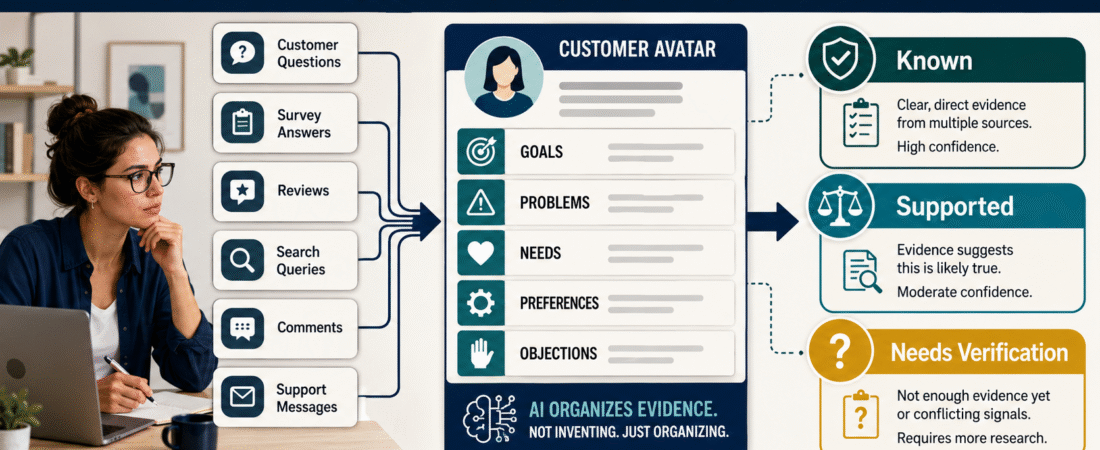
AI can help you organize customer research, identify patterns, summarize repeated questions, and turn scattered information into a useful customer avatar.
What it should not do is invent the customer.
That distinction matters.
A weak approach asks AI:
Create my ideal customer avatar for a digital product about starting an online business.
The AI can certainly produce a polished profile. It might describe the person’s age, income, frustrations, fears, goals, preferred social networks, buying objections, and daily routine.
The problem is that much of that information may be nothing more than a plausible guess.
A better process is to give AI actual evidence and ask it to organize what the evidence supports.
The basic method is:
- Define the market you want to understand.
- Gather real customer information.
- Separate evidence from assumptions.
- Give the evidence to AI.
- Ask AI to identify patterns rather than invent facts.
- Build a working customer avatar.
- Mark uncertain conclusions for verification.
- Update the avatar as you learn more.
That produces a customer profile that can guide content, products, emails, lead magnets, and marketing without pretending you know things you have never actually learned about your audience.
What Is a Customer Avatar?
A customer avatar is a practical description of the type of person you are trying to help.
It may include information such as:
- The person’s situation.
- The problem they are trying to solve.
- What they have already tried.
- Questions they ask.
- Obstacles slowing them down.
- Results they want.
- Concerns they have before making a purchase.
- Knowledge they already possess.
- Knowledge they still need.
- The language they use when describing the problem.
The purpose is not to create a fictional biography.
You do not necessarily need to know that your customer is 47 years old, drives a specific vehicle, drinks a certain brand of coffee, and checks Facebook at 7:15 every morning.
Unless that information genuinely affects your offer, it is probably unnecessary.
For a small online business, the useful question is:
What do I need to understand about this person so I can help them make progress?
Start With Evidence Instead of Imagination
The U.S. Small Business Administration recommends using market research to understand customers and notes that businesses can combine existing sources with direct research such as surveys, questionnaires, focus groups, and interviews. The SBA’s market-research guidance provides a useful starting framework.
For a small internet business, your evidence might come from:
- Emails from subscribers.
- Questions customers ask.
- Blog comments.
- YouTube comments.
- Survey responses.
- Product reviews.
- Online discussion forums.
- Search queries.
- Support requests.
- Sales-page questions.
- Questions appearing repeatedly in communities.
- Your own conversations with people in the market.
You do not need thousands of responses before beginning.
You simply need to recognize the difference between evidence you have and information you are guessing.
Use Three Evidence Categories
One of the easiest ways to keep AI from turning assumptions into facts is to classify customer information into three groups.
Known
These are facts directly supported by information you collected.
Example:
Seven subscribers asked how to choose their first email-marketing platform.
You know the question was asked.
Supported
These are conclusions that appear reasonable because multiple pieces of evidence point in the same direction.
Example:
Beginners appear concerned about paying for advanced email features they may not need.
Perhaps several reviews, comments, and questions support that conclusion.
It is stronger than a guess, but it is still an interpretation.
Needs Verification
These are ideas that may be useful but have not yet been supported sufficiently.
Example:
Retired beginners probably prefer lifetime-payment software over subscriptions.
That might be true for part of your audience.
It might also be completely wrong.
Marking it Needs Verification prevents the assumption from quietly becoming part of your marketing strategy.
Build an AI Customer Research Packet
Before asking AI for an avatar, gather your evidence in one document.
A simple packet can contain:
Customer Questions
Paste actual questions people have asked.
Search Questions
Record phrases and questions people appear to use when researching the subject.
Review Language
Record recurring compliments, complaints, frustrations, and desired improvements from legitimate reviews.
Survey Responses
Include responses exactly or summarize them carefully.
Comments
Gather relevant comments from your blog, videos, social channels, or communities where appropriate.
Product or Service Context
Explain what you are considering offering.
Your Current Assumptions
List your assumptions separately and label them clearly.
This approach is similar to building an organized source file before relying on AI for higher-level work.
You can also improve the instructions you give the system by following the principles in my guide to writing better AI prompts for more consistent business results.
Give AI a Research Job, Not a Fiction-Writing Job
Instead of saying:
Create a detailed customer avatar.
Try a prompt such as:
Analyze the customer-research material below. Identify repeated problems, questions, desired results, objections, and phrases. Use only information supported by the material. Separate your conclusions into Known, Supported, and Needs Verification. Do not invent demographics, income, motivations, fears, purchasing behavior, or personal details that are not supported by the evidence.
That instruction changes the role of AI.
It is no longer being asked to imagine an interesting customer.
It is being asked to analyze evidence.
Google’s current guidance on generative AI similarly notes that generative AI can be useful for research and for adding structure to original content, while warning against producing large amounts of material without adding value. Google’s generative-AI content guidance reinforces the importance of usefulness and human review.
What Should Your Finished Avatar Include?
For a beginner online business, I would keep the finished profile practical.
Audience
Who appears to have the problem?
Example:
Adults beginning a small online business who have limited experience with email marketing.
Current Situation
What is happening before they look for help?
Example:
They have a website or business idea but have not built an email list.
Primary Problem
What specific difficulty are they attempting to solve?
Example:
They do not know which email service they need or which features matter at the beginning.
Desired Result
What practical outcome are they trying to reach?
Example:
Set up a simple subscriber list, signup form, and first welcome sequence without buying unnecessary software.
Questions
List questions appearing repeatedly in your evidence.
Obstacles
Identify barriers such as:
- Confusing terminology.
- Too many software choices.
- Uncertain costs.
- Technical concerns.
- Lack of a clear sequence.
- Fear of buying the wrong tool.
Decision Criteria
What appears to matter before choosing a solution?
Examples might include simplicity, price, learning curve, support, automation, integrations, or scalability.
Language
Record phrases customers themselves use.
This can become particularly useful when writing:
- Blog titles.
- Headings.
- Emails.
- Lead magnets.
- Product descriptions.
- Frequently asked questions.
Do Not Allow Demographics to Become Decoration
Demographics can matter.
Age, geographic location, occupation, family situation, business size, and income may influence a buying decision.
But include demographic details because they are useful—not because every avatar template contains a demographic section.
Suppose you create material specifically for people entering retirement.
Age range and retirement status may matter because the audience may have different time, income, technical, and lifestyle considerations.
However, knowing whether the person owns a blue sedan probably does nothing to improve your digital-product marketing.
Collect information that improves decisions.
Ignore decorative details.
Use the Avatar to Validate Product Ideas
A customer avatar becomes valuable when you use it to make decisions.
Before creating an ebook, course, checklist pack, membership, or software-related offer, compare the product idea with the evidence in your avatar.
Ask:
- Does the product address a documented problem?
- Is the promised result something the audience actually wants?
- Is the format appropriate for their experience level?
- Does the product solve too many problems at once?
- What objections will need to be addressed?
- Which assumptions still require verification?
This should work alongside—not replace—the process of validating a digital product idea before spending weeks creating it.
The avatar tells you whom you believe you are serving.
Validation helps determine whether the problem and proposed solution are strong enough to deserve additional work.
Use the Avatar to Improve Your Content
Your customer avatar can also make content planning easier.
Suppose the avatar reveals these recurring questions:
- Which AI tools do I need first?
- How do I know whether an AI answer is correct?
- Do I need a paid email platform?
- Should my first digital product be an ebook or course?
- How do I avoid becoming overwhelmed by software?
Those questions can become individual articles.
That is much stronger than asking AI:
Give me 50 blog ideas about online business.
Your content begins with actual audience questions rather than a random topic generator.
Use the Avatar to Create Better Lead Magnets
A lead magnet should solve one smaller problem that matters to the intended subscriber.
If your research shows that beginners repeatedly struggle to identify the minimum tools necessary to start, a useful lead magnet might be:
The Beginner’s Three-Tool Online-Business Setup Checklist
If the research instead shows that they are struggling with prompts, the lead magnet could focus on a simple prompt-planning worksheet.
The objective is alignment.
The audience problem should lead to the resource—not the other way around.
My guide on creating a lead magnet with AI that people will actually want explains this connection in greater detail.
Watch for AI’s Most Convincing Mistake
One of the most dangerous problems in AI-assisted customer research is not an obviously ridiculous answer.
It is an unsupported answer that sounds reasonable.
For example:
Your ideal customer is a 52-year-old professional earning $82,000 per year who is frustrated with corporate life and wants to build passive income before retirement.
That profile sounds possible.
But ask:
Where did those facts come from?
If the answer is nowhere, remove them.
A polished assumption is still an assumption.
Keep a Customer Evidence Log
Your avatar should not become a document you create once and never review again.
Keep a simple record containing:
- Date.
- Source.
- Customer statement or question.
- Topic.
- What it may indicate.
- Evidence classification.
- Follow-up needed.
Over time, individual comments may turn into reliable patterns.
You may discover that an assumption was wrong.
That is useful.
The goal of research is not to prove your original avatar correct. It is to understand the customer more accurately.
A Simple Example
Imagine you want to help retired educators create their first digital product.
Your evidence shows:
Known
- Several people ask what type of product they should create first.
- Some are concerned about technical complexity.
- Questions frequently involve ebooks, checklists, and short courses.
Supported
- A smaller first product may feel more manageable than a complex membership.
- Clear step-by-step instructions appear important.
Needs Verification
- Buyers prefer a $27 ebook over a $97 course.
- Buyers want video instead of written instruction.
- Buyers prefer one software platform over another.
The resulting avatar might say:
Retired educators exploring their first digital product need help narrowing their knowledge into one useful offer and choosing a manageable creation and delivery process.
That is enough to guide useful decisions.
You do not need to invent the person’s favorite television program.
Conclusion
AI can make customer-avatar creation faster, but speed is only useful when the information remains grounded in evidence.
Start with real questions, reviews, surveys, search behavior, comments, and customer interactions. Separate what you know from what appears supported and what still needs verification. Then ask AI to organize those materials rather than invent the customer for you.
Your first action is simple: collect ten pieces of genuine audience evidence and place them into a single customer-research document before asking AI to build your next avatar.