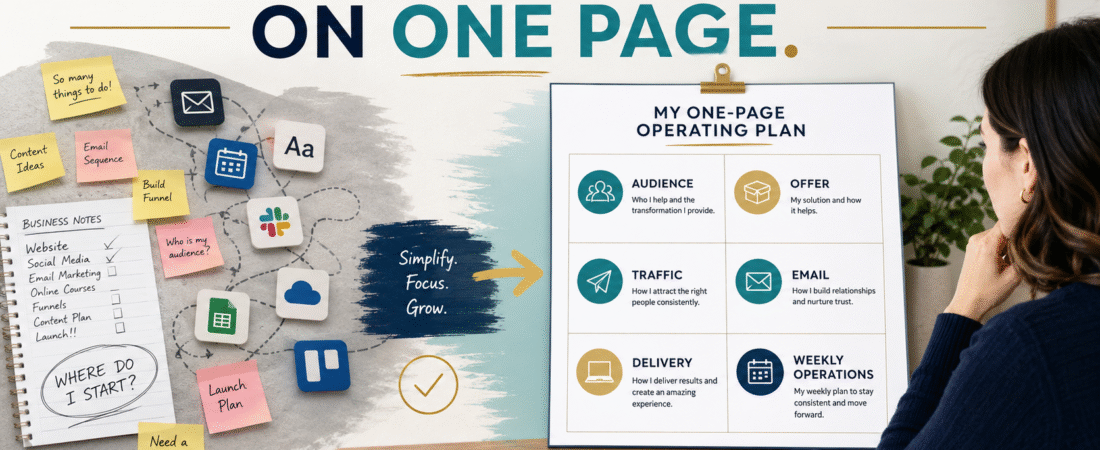
A small online business does not automatically need a 40-page business plan.
It does need a clear explanation of how the important pieces fit together.
For a beginner, a one-page online-business operating plan can answer six practical questions:
- Who are you helping?
- What are you offering?
- How will people discover you?
- How will you stay connected with them?
- How will customers buy and receive the product?
- What work must be repeated to keep the system operating?
If you cannot explain those six pieces on one page, adding more software, content, funnels, and products may create more confusion rather than more progress.
The U.S. Small Business Administration recognizes both traditional business plans and streamlined lean-startup plans. Its guidance notes that lean plans can be appropriate for relatively simple businesses that expect to refine the plan over time. The SBA’s business-planning guidance provides additional information about both approaches.
For a small self-funded online business, a one-page operating plan can serve a different purpose from a formal document created for a bank or investor.
It is primarily a decision-making tool for you.
Section 1: Define One Primary Audience
Begin with the person you want to help.
Do not write:
Anyone who wants to make money online.
That is too broad to guide useful decisions.
A more specific audience might be:
Retired professionals who want to turn useful knowledge into a small digital product without operating a complicated online company.
Or:
First-time ebook creators who need a structured way to organize and publish educational information.
Your audience statement should tell you whom your business is designed to serve.
Write:
My primary audience is __________.
Then add:
They are trying to __________.
This gives the rest of your plan a foundation.
Section 2: Define the Problem and Offer
Next, identify the problem you intend to solve.
Suppose your audience is retired professionals exploring digital products.
Their broad problem might be:
They have useful knowledge but do not know how to package it into a manageable online offer.
Your offer might be:
A step-by-step workbook that helps them select one idea, define the buyer, outline the content, and prepare the first version.
Notice what is missing.
You do not need:
- Ten products.
- A large membership.
- Multiple coaching tiers.
- Five funnels.
- A complicated affiliate program.
- Weekly live calls.
- Twenty bonuses.
Start with one understandable offer.
If you are still deciding what belongs in your initial tool setup, my guide to building a simple online-business starter stack can help you separate necessary tools from optional ones.
Section 3: Define One Main Discovery Method
How will new people find you?
Potential channels include:
- Google search.
- YouTube.
- Social media.
- Referrals.
- Paid advertising.
- Podcast appearances.
- Online communities.
- Affiliate partners.
- Marketplace traffic.
A beginner does not have to become excellent at every channel simultaneously.
Choose a primary method and perhaps one supporting method.
Example:
Primary discovery method: Helpful search-focused blog articles.
Supporting discovery method: YouTube videos based on the same educational subjects.
This creates focus.
Instead of waking up and wondering whether you should post on seven platforms, you know where your core audience-building work belongs.
Section 4: Define the Audience-Building Step
Traffic becomes more useful when interested visitors have a reasonable way to stay connected.
A simple pathway might be:
Helpful article → useful lead magnet → email list → educational follow-up
You do not need a complicated 27-step funnel.
Write down:
Lead Magnet: What useful free resource introduces people to your approach?
Email List: Where are subscribers stored?
Welcome Process: What should a new subscriber receive first?
Ongoing Communication: How often do you realistically want to send useful email?
The objective is not maximum automation.
The objective is a process you can actually maintain.
Section 5: Define the Sales and Delivery Path
Now answer:
What happens when somebody decides to buy?
Write the sequence from the customer’s perspective.
For example:
- Customer visits the product page.
- Customer reviews what is included.
- Customer completes checkout.
- Payment is confirmed.
- Customer receives access instructions.
- Customer opens the download or member area.
- Customer knows where to request support.
Keep the sequence visible on the one-page plan.
A simple business can still create a poor customer experience if the owner understands the process but the buyer does not.
If your business revolves around one digital product, you may also find it useful to review how to build a simple evergreen sales funnel for one digital product.
Section 6: List the Work That Must Repeat
This may be the most overlooked section of the plan.
A business does not operate because you drew a funnel.
It operates because certain tasks continue getting completed.
Examples include:
Daily
- Review support messages.
- Check for failed customer access.
- Respond to important customer questions.
Weekly
- Publish content.
- Send an email.
- Review website or campaign activity.
- Back up important files.
- Organize new customer questions.
Monthly
- Review sales and expenses.
- Check important links.
- Review product feedback.
- Evaluate affiliate links.
- Review traffic trends.
Quarterly
- Review product accuracy.
- Check pricing.
- Evaluate software subscriptions.
- Update important procedures.
This converts your business plan into an operating system.
Tasks that become repetitive can then be documented properly. My guide to creating an SOP with AI for business tasks you repeat explains how to turn recurring work into instructions another qualified person can follow.
Add a Simple Money Section
A business plan should not ignore money.
You do not need to pretend you can predict exact future revenue.
Instead, record what you can reasonably estimate.
Core Expenses
List recurring expenses such as:
- Website hosting.
- Domain renewals.
- Email service.
- Product-delivery platform.
- AI subscriptions.
- Design software.
- Video software.
- Payment-processing costs.
- Advertising, if used.
Revenue Sources
List actual or planned sources such as:
- Digital-product sales.
- Affiliate commissions.
- Course sales.
- Ebook sales.
- Advertising.
- Memberships.
Break-Even Question
Ask:
Approximately how much revenue must this business produce each month before it covers its recurring operating expenses?
That question is more useful than creating an impressive-looking forecast based on numbers you invented.
Add a “Not Doing” Section
This small section can protect your time.
Write down activities you have deliberately decided not to pursue right now.
Examples:
- No private coaching.
- No paid community.
- No second YouTube channel.
- No daily livestreams.
- No new software unless an existing task requires it.
- No second product until the first product has a complete sales and delivery process.
A plan is partly about deciding what deserves your attention.
It is also about deciding what does not.
Example One-Page Plan
Imagine a retired educator building a simple digital-information business.
Audience
Retired or near-retirement professionals interested in turning their knowledge into a manageable digital product.
Problem
They have expertise but are overwhelmed by product formats, AI tools, marketing systems, and software choices.
Core Offer
A practical digital-product planning workbook.
Discovery
Two useful search-focused blog articles each week plus supporting educational video content.
Audience Building
Free checklist → email subscription → five-email educational introduction.
Sales
Educational content → product information page → checkout.
Delivery
Automated digital access plus a clear support address.
Weekly Operations
Publish, email, check support, review customer questions, and record useful content ideas.
Monthly Review
Check expenses, sales, traffic sources, affiliate results, product questions, and software usage.
Not Doing
No coaching program, large membership, complex community, or multiple product launches.
That is enough to guide many weekly decisions.
How AI Can Help Build the Plan
AI can help you organize information, but do not ask it to make all the decisions for you.
Useful AI tasks include:
- Turning rough notes into sections.
- Identifying unanswered questions.
- Finding contradictions in the plan.
- Listing recurring tasks.
- Converting recurring tasks into SOP candidates.
- Creating alternative wording for the audience statement.
- Reviewing whether the sales path has missing steps.
- Creating a weekly checklist from the operating plan.
A useful prompt might be:
Review my one-page online-business plan as an operations assistant. Identify unclear responsibilities, missing customer steps, unnecessary complexity, unsupported assumptions, recurring tasks that should become SOPs, and software that does not appear necessary for the stated business model. Do not add new products or marketing channels unless they solve an identified gap.
That keeps AI focused on simplifying the plan rather than expanding it.
Review the Plan Every Month Without Rebuilding It
Do not rewrite your business every week.
Instead, ask whether anything important has changed.
Review:
- Audience.
- Main offer.
- Primary discovery channel.
- Lead magnet.
- Email process.
- Sales path.
- Delivery system.
- Costs.
- Recurring tasks.
- Current priorities.
If the system still works, leave it alone.
Constantly rebuilding an online business can become another form of procrastination.
Know When One Page Is Not Enough
A one-page plan is not appropriate for every purpose.
You may need more detailed planning if you are:
- Seeking outside financing.
- Hiring employees.
- Entering a regulated market.
- Building substantial software.
- Taking on significant financial obligations.
- Working with multiple owners.
- Preparing formal financial projections.
- Negotiating with investors or lenders.
The SBA distinguishes streamlined lean plans from more traditional plans that can include extensive market, organizational, financial, and funding information.
Use the level of planning appropriate to the decision.
Do not use simplicity as an excuse to ignore genuine financial, legal, tax, or operational responsibilities.
Conclusion
A beginner online business needs clarity more than complexity.
Your one-page operating plan should tell you who you help, what you offer, how people find you, how you build a relationship with them, how customers buy and receive the product, and which tasks keep the system operating.
Once those pieces fit together, new ideas become easier to evaluate.
If a new tool, platform, product, or marketing tactic does not support something on the page, you have a good reason to question whether you need it.
Create the first version of your plan today using only six headings: Audience, Offer, Discovery, Audience Building, Sales and Delivery, and Recurring Operations.