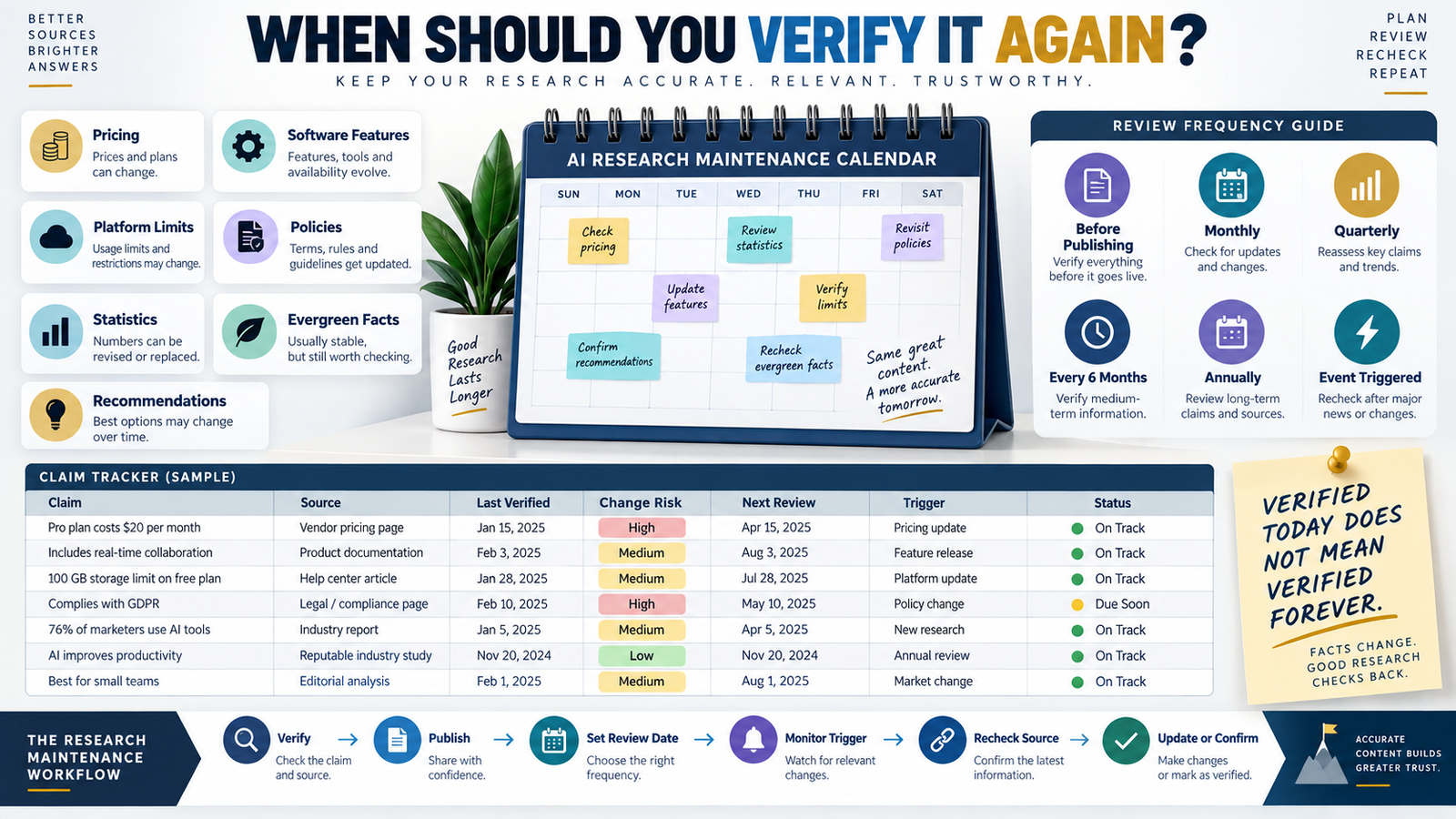
Verifying an AI-generated claim once does not guarantee that the claim will remain correct forever.
Suppose you verify:
Software Plan A costs $29 per month.
The statement is accurate today.
Six months later, the company changes its plans.
Your original research was not wrong.
It became outdated.
This is a common problem with evergreen AI-assisted content.
The article stays online.
The information inside it keeps aging.
A simple AI fact reverification schedule gives you a way to decide which claims should be checked again and when.
The process is:
Verify → Classify Change Risk → Set Review Date → Monitor Trigger → Recheck → Confirm or Update
Not Every Fact Needs the Same Review Schedule
Some information changes quickly.
Other information is relatively stable.
For example:
“Email marketing involves sending messages to subscribers.”
That is unlikely to require monthly verification.
But:
“The Starter plan includes one automation workflow.”
could change tomorrow.
The first question should therefore be:
How quickly could this claim reasonably become outdated?
Create Four Change-Risk Categories
A simple four-level system is enough.
HIGH CHANGE RISK
Examples:
- Pricing.
- Promotions.
- Software-plan limits.
- Current feature availability.
- Platform interface instructions.
- Policies.
- Support options.
These deserve the shortest review cycle.
MODERATE CHANGE RISK
Examples:
- Software workflows.
- Integrations.
- Product positioning.
- Marketing-platform capabilities.
- Recommended procedures tied to current technology.
These may remain valid for months but should still be revisited.
LOW CHANGE RISK
Examples:
- Established definitions.
- General business principles.
- Basic writing concepts.
- Stable operating procedures.
These may require only occasional review.
EVENT-TRIGGERED
Some claims should be reviewed when something specific happens.
Examples:
- Company announces new pricing.
- Software releases major version.
- Google changes a report.
- Business switches platforms.
- Regulation changes.
The trigger matters more than a calendar date.
Step 1: Identify the Claims Worth Tracking
Do not create review dates for every sentence.
Prioritize information such as:
- Prices.
- Numerical limits.
- Feature availability.
- Policies.
- Statistics.
- Procedures tied to external software.
- Product comparisons.
- Recommendations that depend on current conditions.
A useful rule is:
If a reader could make a purchasing or business decision from the claim, consider tracking it.
Step 2: Record the Last Verification Date
For each important claim, record:
Last Verified: September 23, 2026
Now you know exactly how old the verification is.
Without that field, future-you may only know:
“I checked this sometime.”
That is not enough for efficient maintenance.
Step 3: Record the Source
Keep the source that established the claim.
For example:
Claim: Starter plan includes one workflow.
Source: Current official pricing page.
Last Verified: September 23, 2026.
Change Risk: High.
This makes future checking much faster.
You do not need to research the claim from scratch.
Step 4: Assign a Review Frequency
A simple schedule might be:
BEFORE EVERY PUBLICATION
For information that is both current and central to the article.
Examples:
- Current price.
- Current product plan.
MONTHLY
For frequently changing information that supports important ongoing content.
QUARTERLY
For software-feature articles and comparison content.
EVERY SIX MONTHS
For moderately stable tool information.
ANNUALLY
For stable reference content.
Do not treat these as universal laws.
Adjust them to your content.
Step 5: Use Event-Based Triggers Too
Calendar schedules alone can miss sudden changes.
Add triggers such as:
Reverify when company announces a pricing change.
Reverify when major software version launches.
Reverify when article receives significant traffic again.
Reverify before promoting the article heavily.
This prevents you from waiting six months when you already know something changed.
Step 6: Separate “Article Review” From “Claim Review”
You may not need to rewrite the whole article.
Suppose a 2,000-word review contains three current pricing claims.
Those three claims may require verification.
The rest of the article may remain accurate.
That makes maintenance much easier.
Your verified AI Confidence Labeling System can help identify which statements deserve stronger review.
Example: Software Pricing
Claim: Platform costs $49/month.
Change Risk: High.
Review: Before publication and quarterly while the article remains active.
Trigger: Company pricing announcement.
If the price remains unchanged:
Record:
Confirmed — No Update Required
You do not need to rewrite anything.
Example: Software Feature
Claim: Platform includes transactional email.
Change Risk: Moderate/High.
Review: Quarterly.
If the feature moves to another plan:
Update:
- Claim.
- Comparison.
- Recommendation if affected.
Example: General Business Principle
Claim: A documented checklist reduces dependence on memory.
Change Risk: Low.
You may review it annually or not track it individually at all.
Not everything needs operational overhead.
Add an “Impact if Wrong” Field
Two high-change claims may deserve different attention.
Example:
Claim A
Button color changed.
Impact if wrong:
Low.
Claim B
Software now costs $300 more per year.
Impact if wrong:
High.
Prioritize:
Change Risk + Impact
together.
Use Your Source Packet
Your verified AI Source Packet workflow gives you a logical place to preserve:
- Source.
- Date.
- Claim.
- Verification.
Add:
Next Reverification Date
and the source packet becomes useful for future maintenance too.
Use Your Error Log
Suppose you discover outdated prices repeatedly.
Your verified AI Error Log might reveal:
Recurring Problem: Current pricing was not rechecked before republishing.
Permanent rule:
All pricing must be reverified immediately before publication.
Now an error improves the process.
Create a Reverification Status
Use:
CURRENT
Checked and still accurate.
REVIEW DUE
Scheduled date reached.
CHANGE DETECTED
Source changed.
UPDATED
Article corrected.
RETIRED
Claim or article no longer worth maintaining.
This gives you a simple maintenance queue.
Do Not Automatically Change Content Because the Source Changed
Suppose a software company changes wording on its website.
Ask:
Did the underlying fact change?
A new page design does not necessarily require an article update.
Reverify the claim itself.
Review High-Traffic Content First
If you have hundreds of articles:
Do not give them all equal maintenance priority.
Prioritize pages that:
- Get traffic.
- Make product recommendations.
- Contain affiliate links.
- Compare software.
- Include pricing.
- Generate leads.
That creates more value from the same maintenance time.
Review Before Promotion
Suppose an old article has not been checked in nine months.
You are about to:
- Share it with your email list.
- Link it from YouTube.
- Run advertising to it.
Reverify the important current claims first.
Promotion is a natural review trigger.
Keep the Schedule Simple
You do not need a project-management platform.
A spreadsheet can include:
Article
Claim
Source
Last Verified
Change Risk
Next Review
Trigger
Status
That is enough.
A Simple Reverification Rule Set
Use:
PRICING: Check immediately before publication.
PLAN LIMITS: Check immediately before publication.
CURRENT FEATURES: Check before publication and periodically.
SOFTWARE PROCEDURES: Check when interface changes.
STATISTICS: Check source date and replacement availability.
EVERGREEN PRINCIPLES: Review only when needed.
This gives you a starting framework.
Conclusion
AI verification should not be treated as a one-time event.
Some facts have a much shorter useful life than others.
A practical maintenance system uses:
Claim → Source → Last Verified → Change Risk → Next Review → Trigger → Status
Review current, decision-relevant claims more frequently.
Review stable principles less often.
The goal is not to keep every sentence permanently updated.
It is to prevent your most important current claims from quietly becoming stale.
Your Next Action
Choose one software review or current-information article you already published.
Identify five claims involving:
- Price.
- Plan limit.
- Feature availability.
- Policy.
- Current workflow.
Add these columns:
Claim | Last Verified | Change Risk | Next Review
Assign each:
HIGH | MODERATE | LOW
Then set a specific next review date for every HIGH claim.
Finally, add one permanent rule to your publishing workflow:
“Before republishing or heavily promoting current-information content, reverify its highest-risk claims.”
That creates a manageable maintenance system without forcing you to rewrite entire articles unnecessarily.