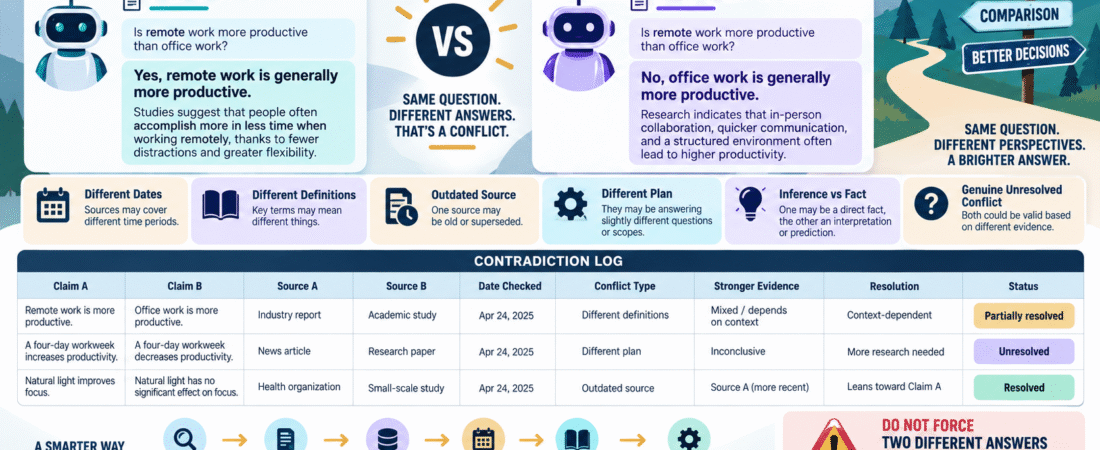
AI research becomes much harder when two credible-looking answers disagree.
You ask:
“How much does this software cost?”
Source A says:
$49 per month.
Source B says:
$99 per month.
Or:
One article says a feature is included.
Another says it is available only on a higher plan.
The easiest response is to choose the answer that seems more plausible.
That is also one of the easiest ways to publish incorrect information.
A better approach is to create an AI contradiction log.
The workflow is:
Spot Conflict → Separate Claims → Compare Evidence → Check Date → Check Definition → Identify Cause → Resolve or Preserve Uncertainty
The purpose is not to eliminate every disagreement.
The purpose is to make sure disagreement is handled deliberately.
What Is an AI Contradiction Log?
It is a short record of situations where:
- Two sources disagree.
- AI gives different answers in separate sessions.
- Current documentation conflicts with an older article.
- Two official pages appear inconsistent.
- One source uses a different definition from another.
- A recommendation changes depending on assumptions.
Instead of hiding the inconsistency, you document it.
Start by Writing Both Claims Exactly
Do not record:
“Pricing conflict.”
Record:
Claim A: ProductDyno Starter costs $49 per month when billed annually.
Claim B: Another ProductDyno sales page presents a different monthly offer.
Now you know what must be reconciled.
Do Not Assume One Claim Is Automatically Wrong
Different answers may both be correct under different conditions.
Possible reasons include:
- Different billing cycles.
- Different promotions.
- Different countries.
- Different product plans.
- Different dates.
- Legacy pricing.
- Separate checkout offers.
- Different definitions.
The contradiction may disappear once context is added.
Conflict Type 1: Different Dates
An article from 2024 may show one price.
The official page in 2026 may show another.
This is not a mysterious contradiction.
It is a time difference.
Record:
Resolution: Older information superseded by current official source.
Your AI Source Packet workflow can help keep current approved sources together before writing.
Conflict Type 2: Different Billing Terms
Source A:
$19/month
Source B:
$15.58/month
These may both describe the same product.
One may be:
Monthly billing
while the other is:
Annual billing expressed as a monthly equivalent.
Never compare prices without checking:
- Billing frequency.
- Contract length.
- Subscriber tier.
- Promotion.
Conflict Type 3: Different Definitions
Suppose one source says:
“Unlimited automation.”
Another says:
“One workflow.”
The first may refer to:
- Unlimited steps inside a workflow.
The second may refer to:
- Number of active workflows.
The terms sound similar.
The underlying definitions may differ.
Conflict Type 4: Different Plans
A feature can be:
Included on Pro
and:
Not available on Starter
Both statements can be true.
Your contradiction log should include:
Plan or Tier
when the claim depends on one.
Conflict Type 5: Official Sources Disagree
This is more important.
Suppose two current official pages show different offers.
Do not silently choose one.
Record:
Official Source A: Current pricing page.
Official Source B: Current promotional offer.
Resolution: Multiple official offers appear to be active.
Final wording might be:
“The company currently maintains more than one official offer, so buyers should verify the checkout connected to the specific promotion they are considering.”
That preserves the conflict accurately.
Conflict Type 6: Fact vs Interpretation
Source A says:
Platform includes 100 templates.
Source B says:
Platform has a weak template library.
Those are not direct contradictions.
The first is factual.
The second is evaluative.
Separate:
What exists
from:
What someone thinks about it.
Conflict Type 7: AI Inference vs Documented Fact
AI might write:
“Because the platform has fewer features, beginners will find it easier.”
The documented fact may be:
Fewer features.
The conclusion:
Easier for beginners
is an inference.
Label it accordingly.
Your verified AI Confidence Labeling System can help distinguish:
- Verified.
- Well supported.
- Needs verification.
- Unknown.
Record the Source Strength
For each side, record:
Official / Primary
Authoritative Independent
Secondary
Community
Unverified
If a current official pricing page conflicts with a three-year-old blog article, the evidence hierarchy becomes useful.
The newer first-party source usually carries more weight for current price.
Check the Date
Record:
Published:
Updated:
Checked:
A contradiction often becomes understandable once the dates are visible.
Check Whether the Sources Are Talking About the Same Thing
Ask:
Same product?
Same plan?
Same country?
Same billing period?
Same feature definition?
Same date?
Same customer type?
You cannot reconcile two claims until you establish that they are truly comparable.
Do Not Let AI “Average” Contradictory Facts
If one source says:
$49
and another says:
$99
the answer is not:
Approximately $74.
That would create a completely new unsupported claim.
When evidence conflicts, resolve the conflict or preserve the uncertainty.
Use an Unresolved Status When Needed
Some conflicts cannot be settled immediately.
Use:
UNRESOLVED — VERIFY WITH OFFICIAL SUPPORT
That is a useful result.
It tells you what must happen next.
Ask Official Support When the Claim Matters Enough
Not every disagreement deserves a support ticket.
But support may be appropriate when the question affects:
- Purchase decision.
- Account limit.
- Billing.
- Migration.
- Technical capability.
Preserve the response if it becomes important evidence.
Connect Contradictions to Escalation Rules
Your verified AI Escalation Rules workflow should include:
If current authoritative sources materially conflict, do not produce a definitive factual conclusion until the conflict is resolved or clearly qualified.
That turns contradiction handling into a permanent system rule.
Add Contradiction Findings to Your Error Log
Suppose AI repeatedly uses old pricing because a secondary article ranks highly in search.
Your AI Error Log could record:
Recurring Error: Older secondary source overrides current official pricing.
Permanent Rule: Current first-party pricing must be checked before publication.
Now the contradiction improves the workflow.
A Simple Contradiction Log Template
Use:
Topic
Claim A
Source A
Date A
Claim B
Source B
Date B
Conflict Type
Stronger Evidence
Resolution
Final Wording
Status
Statuses can be:
RESOLVED
QUALIFIED
UNRESOLVED
REMOVED
Example
Topic: Software pricing
Claim A: $49/month billed annually.
Source A: Current official pricing page.
Claim B: $99/month.
Source B: Older review.
Conflict Type: Different date.
Stronger Evidence: Current official source.
Resolution: Use current price.
Status: Resolved.
Another Example
Topic: Platform easier for beginners.
Claim A: Reviewer says easy.
Claim B: Community user says difficult.
Conflict Type: User experience.
Resolution: Both are subjective experiences.
Final wording: “Ease of use may depend on experience and workflow.”
Status: Qualified.
That is more accurate than declaring one person’s experience universally correct.
Conclusion
Conflicting AI research should not be treated as an inconvenience to hide.
It is a signal that something needs investigation.
When two answers disagree, check:
Date → Definition → Plan → Billing → Source Strength → Context → Evidence
Then choose one of four outcomes:
Resolve
Qualify
Leave Unresolved
Remove the Claim
Do not force uncertainty into false certainty merely because the finished article sounds cleaner.
Your Next Action
Take one recent AI research task where you encountered different answers.
Create these columns:
Claim A | Source A | Claim B | Source B | Conflict Type | Resolution
Then ask:
Are these sources actually discussing the same date, plan, definition, and billing terms?
If yes and they still conflict:
Move the issue to:
VERIFY WITH STRONGER EVIDENCE
or:
UNRESOLVED
Finally, add this sentence to your reusable research prompt:
“When credible sources materially disagree, identify the contradiction explicitly instead of silently choosing one answer.”
That gives you a repeatable process for handling conflicting AI research.