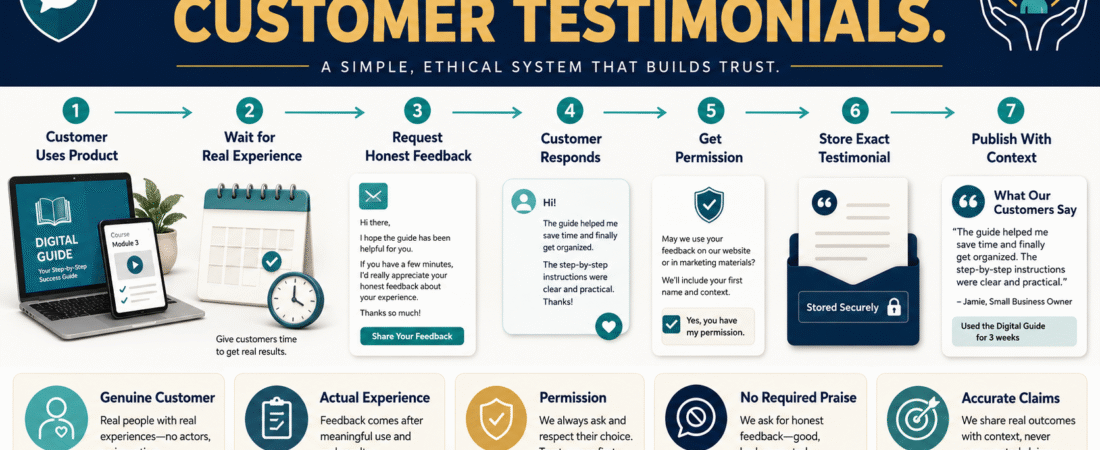
A useful testimonial can answer a question your own sales copy cannot answer as convincingly:
What was the experience like for an actual customer?
That makes testimonials valuable for ebooks, courses, workbooks, templates, memberships, software, checklists, and other digital products.
But there is an important difference between collecting genuine customer experiences and trying to manufacture flattering marketing statements.
A simple testimonial system should help you:
- Ask the right customers.
- Ask at an appropriate time.
- Request honest feedback rather than guaranteed praise.
- Preserve what the customer actually meant.
- Obtain permission before using the statement publicly.
- Keep records of what was approved.
- Avoid claims the testimonial does not actually support.
For U.S. businesses, this is also an area where current Federal Trade Commission requirements matter. The FTC’s Consumer Reviews and Testimonials Rule prohibits fake or false testimonials and prohibits incentives that are conditioned on a review expressing a particular positive or negative sentiment.
The goal is straightforward:
Real customer. Real experience. Real words. Clear permission.
Why Testimonials Matter for Digital Products
Digital products are intangible.
Before purchasing, a buyer cannot:
- Hold the ebook.
- Sit inside the course.
- Complete the workbook.
- Test every template.
- Experience the member area.
The sales page can describe the product.
A testimonial can provide another perspective.
For example:
“The Quick Start page made it clear which worksheet I should complete first.”
That statement helps because it describes a specific experience.
Compare it with:
“BEST PRODUCT EVER!!! LIFE CHANGING!!!”
The second statement may sound more exciting, but it gives the potential buyer very little useful information.
Specificity creates credibility.
Do Not Wait Until You Need Testimonials
Many creators think about testimonials only when writing a sales page.
Then they realize they have no organized method for contacting previous customers.
Build the process into the customer journey.
A simple sequence could be:
Purchase → Product Access → Product Use → Follow-Up → Feedback → Testimonial Permission
That means testimonial collection becomes a normal customer-experience process rather than an emergency marketing request.
A strong customer onboarding system for a digital product can make this easier because you know approximately when customers receive and begin using what they purchased.
Ask After the Customer Has Had a Real Experience
The correct timing depends on the product.
Short Checklist
A customer may be able to evaluate it within a day.
Workbook
Perhaps several days.
Ebook
Maybe after the reader has had time to read and apply part of it.
Course
A useful testimonial may come after a module, milestone, or completion.
Membership
A longer period may be necessary.
Do not send:
“You purchased five minutes ago. Tell us how our product transformed your business!”
The customer has not had enough experience to know.
You want evidence, not enthusiasm on demand.
Start With Feedback Rather Than Praise
One of the simplest ways to receive better testimonials is to stop asking:
“Will you give me a great testimonial?”
Ask for feedback.
For example:
“You’ve had some time to work through the Digital Product Planning Workbook. I’d appreciate your honest feedback. What part was most useful? Was anything confusing? What were you able to do after using it that felt clearer than before?”
This allows the customer to describe the actual experience.
Some responses may become testimonials.
Others may reveal product problems.
Both are valuable.
Ask Questions That Produce Useful Detail
A blank box labeled:
Testimonial:
can intimidate customers.
Give them prompts.
For example:
Before
What problem or question were you trying to solve before using the product?
Experience
Which part did you find most useful?
Clarity
Did the product make anything easier to understand or complete?
Result
What were you able to do after using it?
Recommendation
Who do you think would benefit from this product?
The customer does not need to answer everything.
The questions simply help them explain the experience.
Avoid Leading Questions That Demand Praise
Compare these two requests.
Weak
“Tell us why this is the best digital-product course you’ve ever purchased.”
That assumes the desired conclusion.
Better
“What was your experience using the course?”
Or:
“Which part helped you most, if any?”
The FTC’s current review guidance specifically warns against conditioning incentives on positive sentiment and addresses practices that distort what consumers really think about a product. The FTC’s Consumer Reviews and Testimonials Rule Q&A is worth reviewing if customer reviews or testimonials are part of your marketing.
A Simple Testimonial Request Email
Subject: Could I ask for your feedback?
Hi [First Name],
I hope you’ve had a chance to use [Product Name].
I’m working to make the product as useful and clear as possible, and I’d appreciate your honest feedback.
If you have a minute, could you reply with any of the following?
- What problem were you hoping the product would help you solve?
- Which part was most useful?
- Was anything easier to understand or complete afterward?
- Was anything confusing or missing?
- Who do you think the product would be useful for?
Positive, neutral, and constructive feedback are all helpful.
If you provide comments that I would like to feature publicly as a testimonial, I will ask for permission before publishing them.
Thank you,
Michael
That request does not require praise.
It asks for an experience.
Separate Feedback From Permission
Suppose a customer replies:
“The checklist caught three things I had forgotten before publishing my product.”
That could be useful marketing material.
Do not automatically place it on the sales page.
Ask permission.
For example:
“Thank you. Would you be comfortable with me using that statement as a testimonial on the product page? I would use your first name and last initial unless you prefer another attribution.”
Now you have a clearer record.
Create a Testimonial Permission Record
Maintain:
Customer
Product
Original Statement
Approved Version
Approved Attribution
Permission Date
Where It Can Be Used
Notes
The approved version matters.
If you edit for length, grammar, or privacy, do not change the customer’s meaning.
Do Not Rewrite a Moderate Testimonial Into an Extraordinary Claim
Customer says:
“The workbook helped me organize my ideas.”
Do not publish:
“This workbook completely transformed my business and doubled my income!”
The customer never said that.
Even smaller edits can distort meaning.
Customer says:
“The course was useful once I figured out the dashboard.”
Do not remove the qualification and publish:
“The course was useful!”
if doing so materially changes the customer’s experience.
Accuracy matters more than polish.
Be Extremely Careful With Results Claims
Suppose a customer says:
“I made $5,000 in my first month.”
That does not automatically mean your marketing should feature:
“Make $5,000 your first month!”
A testimonial describing an atypical outcome can create broader advertising implications.
The FTC’s Endorsement Guides address testimonials that communicate results consumers may interpret as representative of what they can generally expect. FTC endorsement and testimonial guidance emphasizes that testimonials and endorsements must not create misleading impressions.
For uncertain legal or compliance situations, obtain appropriate professional advice rather than guessing.
What About Incentives?
Some businesses offer:
- Coupon.
- Gift card.
- Bonus.
- Entry into a drawing.
in exchange for customer feedback or a review.
Current FTC guidance says incentives for reviews cannot be expressly or implicitly conditioned on the review being positive or negative. It also notes that incentives may need to be disclosed because they can affect how consumers evaluate the review.
The simplest approach for a small creator is often to request genuine feedback without trying to buy enthusiasm.
Never Create AI-Generated Fake Testimonials
AI can make testimonial fabrication dangerously easy.
You could prompt:
“Write ten enthusiastic testimonials from satisfied customers.”
Do not publish them as though real customers supplied them.
The FTC’s current rule specifically addresses fake or false consumer reviews and testimonials, including situations in which the person did not exist or did not have the claimed experience.
AI can help you:
- Organize genuine feedback.
- Categorize comments.
- Identify repeated themes.
- Shorten an approved testimonial carefully.
- Create a permission-request template.
It should not invent customers.
Do Not Use Family or Insider Praise Without Considering Disclosure
The FTC’s current guidance also addresses insider reviews and testimonials. Family, employee, agent, or other material relationships may require clear disclosure depending on the situation.
For a small business, that means:
“My son thinks the course is great.”
is not automatically the same evidence as an independent customer’s review.
The relationship matters.
Negative Feedback Is Not a Failed Testimonial Request
Suppose a customer responds:
“The workbook was useful, but I could not figure out where to download the templates.”
That is valuable.
You discovered friction.
Fix the access issue.
Repeated customer feedback can inform a low-maintenance digital product update plan rather than leaving the same problem for future customers.
A testimonial system should improve both marketing and the product.
Organize Testimonials by What They Prove
Do not store every testimonial in one giant document.
Use categories.
Clarity
“The examples finally made the process understandable.”
Ease of Use
“I knew exactly which step to complete next.”
Organization
“The workbook helped me turn scattered notes into a plan.”
Customer Experience
“I had trouble accessing a file, and the issue was resolved quickly.”
Product-Specific Result
“I completed my first outline using the template.”
Now when writing a sales page, you can select evidence relevant to the claim being made.
Match the Testimonial to the Sales-Page Section
If the section discusses:
Ease of use
use a testimonial about ease of use.
If it discusses:
Customer support
use one about support.
If it discusses:
Beginner friendliness
use one from a genuine beginner describing that experience.
Do not use testimonials as random decorations.
Create a Small Testimonial Library
Your testimonial library can contain:
| ID | Product | Customer | Theme | Exact Quote | Permission | Attribution |
|---|---|---|---|---|---|---|
| T-001 | Workbook | Jane | Clarity | “…” | Yes | Jane R. |
| T-002 | Course | Robert | Organization | “…” | Yes | Robert M. |
If someone withdraws permission, you can find where the testimonial came from.
This is another reason not to copy random praise from comments into advertisements without records.
Request Testimonials as Part of a Post-Purchase System
A simple schedule might be:
Day 0
Deliver product.
Day 2
Make sure access worked.
Day 7
Provide a helpful usage reminder.
Day 14
Ask for honest feedback if the product normally can be evaluated by then.
The timing should match the product.
Do not automate a request so aggressively that it feels like the customer exists mainly to produce marketing material.
Do Not Ask Every Customer for the Same Marketing Claim
Weak approach:
“Please tell us how much money you made.”
Better:
“What was your experience?”
You may discover that the real reasons people like the product are different from the claims you assumed mattered.
Perhaps customers value:
- Simplicity.
- Organization.
- Clear explanations.
- Templates.
- Reduced confusion.
That information can improve your positioning.
A Five-Step Testimonial Workflow
Step 1 — Identify Eligible Customers
They have had enough time to use the product.
Step 2 — Request Honest Feedback
Do not require positive sentiment.
Step 3 — Identify Useful Genuine Statements
Preserve the customer’s meaning.
Step 4 — Request Permission
Record approval and attribution.
Step 5 — Store and Use Carefully
Connect each testimonial with the specific claim it supports.
That is a manageable system.
Conclusion
The best digital-product testimonials are not manufactured marketing copy.
They are evidence from real customers.
Give customers enough time to experience the product. Ask for honest feedback. Use specific questions. Never require praise. Obtain permission before publishing. Preserve the customer’s meaning and keep a record of what was approved.
And when the feedback is critical rather than complimentary, use it.
Sometimes the most valuable response to a testimonial request is not a sentence for your sales page.
It is the information that helps you make the product better.