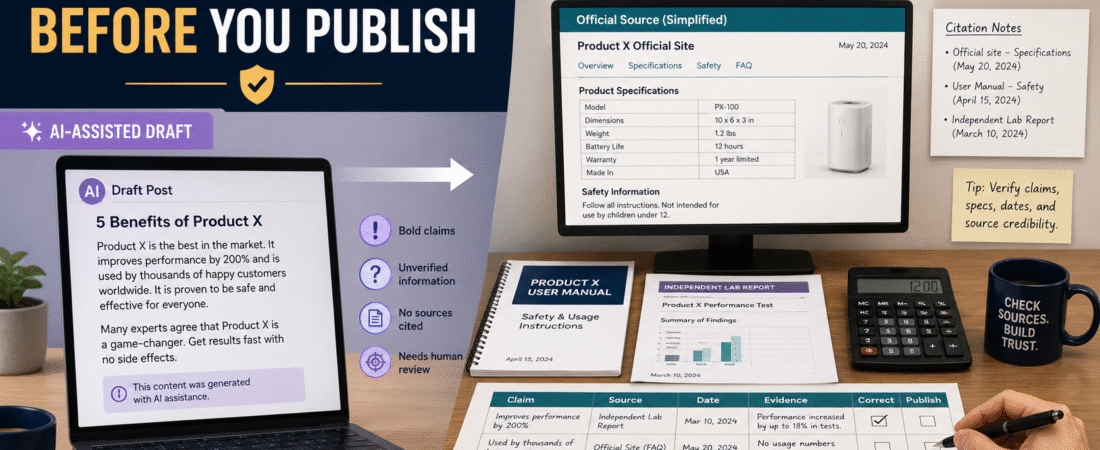
AI can produce an answer that sounds polished, specific, and confident even when an important detail is incomplete, outdated, unsupported, or wrong.
That is why the safest approach is to treat AI-generated factual information as a draft that must earn your trust, not as evidence by itself.
A practical fact-checking workflow is:
Identify the claims → decide which claims matter most → locate the original or authoritative source → check the exact claim → confirm the date → compare more than one reliable source when appropriate → correct the draft → document what you verified.
This is especially important when AI-generated content contains prices, software features, statistics, laws, health or financial information, dates, quotations, product comparisons, current events, or claims about what a company currently offers.
Recent fact-checking guidance continues to emphasize tracing claims back to credible sources rather than relying on the apparent confidence of AI-generated text. University research guides updated in 2026 similarly recommend verifying AI claims against trustworthy external evidence.
Key Takeaways
- Do not assume confident AI wording means the information is correct.
- Separate factual claims from opinion, explanation, and writing style.
- Verify changing facts with current authoritative sources.
- Look for the original source whenever possible.
- Check dates because a fact can be accurate historically but wrong today.
- Verify quotations before publishing them.
- Recalculate important numbers yourself.
- Use AI to help identify claims that require checking, but do not let AI be the only fact-checker.
What Exactly Should You Fact-Check?
Not every sentence requires the same level of verification.
Consider this statement:
“An email welcome sequence can help introduce new subscribers to your business.”
That is a broad explanatory statement.
Now compare:
“GetResponse Starter costs $19 per month and includes one custom automation workflow.”
That contains two changing facts:
- Current price.
- Current feature.
Those claims should be checked against GetResponse’s current official pricing information before publication.
The more specific the claim, the more important verification becomes.
Create a Claim Inventory
Before editing the article for style, highlight factual claims.
Look for:
- Numbers.
- Percentages.
- Dates.
- Prices.
- Product features.
- Plan limits.
- Names.
- Titles.
- Quotations.
- Research findings.
- Legal requirements.
- Platform policies.
- Technical specifications.
- Company history.
- Current events.
- Claims about what Google, YouTube, Facebook, or another platform allows.
Turn each important claim into a question.
Instead of:
“ProductDyno supports product bundles.”
Ask:
“Does ProductDyno currently support product collections or bundles, and what does the official website call that feature?”
That question is easier to verify.
Use a Risk-Based Review
Not every claim creates the same risk.
Lower-Risk Claim
“Many beginners prefer simple systems.”
That is general explanatory language.
Moderate-Risk Claim
“Email automation can send messages after a subscriber joins a list.”
Verify if you are describing a particular platform.
Higher-Risk Claim
“This software guarantees that your emails reach the inbox.”
That requires strong evidence and is probably too absolute.
Very High-Risk Claim
“This investment will earn 15% annually.”
That is a financial claim and requires serious verification and appropriate qualification.
Spend the most verification time where being wrong could affect:
- Money.
- Health.
- Legal decisions.
- Purchasing decisions.
- Reputation.
- Safety.
- Customer trust.
Start With the Original Source
Whenever practical, find the source closest to the claim.
For software:
Use the company’s current documentation.
For government rules:
Use the responsible government agency.
For academic research:
Use the original paper or institution.
For company financial information:
Use official filings or investor materials.
For platform rules:
Use the platform’s own help center or documentation.
A blog post about another blog post about a vendor announcement is weaker than the original vendor announcement.
Check the Date
AI-generated content can contain information that was once correct.
Suppose an AI draft says:
“FAQ rich results are available to certain authoritative government and health websites.”
That reflected Google’s earlier policy.
Google’s documentation update now states that FAQ rich results stopped appearing in Google Search beginning May 7, 2026.
A sentence can therefore be accurately remembered and still be outdated.
Always ask:
- When was this source published?
- When was it updated?
- Does the page describe the current version?
- Has the company changed its plans?
- Has the policy been replaced?
Separate Current Facts From Evergreen Facts
Evergreen
“The purpose of a lead magnet is to encourage an appropriate visitor to join an email list in exchange for a useful resource.”
This concept is relatively stable.
Changing
“Platform X provides 500 AI credits per month.”
That may change tomorrow.
Build your verification process around this distinction.
Changing information deserves a current source.
Never Trust an AI Citation Without Opening It
An AI system may provide:
- A valid source that does not support the claim.
- An outdated page.
- A secondary source when a primary source is available.
- An incorrectly interpreted source.
- In some cases, a nonexistent or malformed citation.
Open the source.
Then ask:
Does this page actually support the exact statement I plan to publish?
Do not stop when you see that the URL exists.
Verify Quotations Word for Word
Quotation marks tell readers:
“These are the person’s actual words.”
That creates a higher verification standard.
Before publishing a quotation:
- Locate the original source.
- Confirm the exact wording.
- Confirm the speaker.
- Confirm the date.
- Read enough context to understand what was being discussed.
- Avoid changing words inside quotation marks.
When the exact wording cannot be confirmed, paraphrase instead.
Recalculate Numbers
AI can make arithmetic errors.
Suppose an article says:
“Twenty-five sales at $37 each produce $950.”
Calculate it.
25 × $37 = $925.
The sentence sounded ordinary, but the math was wrong.
Check:
- Percent changes.
- Discounts.
- Conversion rates.
- Monthly versus annual totals.
- Affiliate commissions.
- Cost-per-sale calculations.
- Character and word counts.
For important calculations, use a calculator rather than asking the same AI model to confirm its earlier arithmetic.
Check Product Prices Directly
Prices are especially vulnerable to becoming outdated because vendors use:
- Monthly plans.
- Annual discounts.
- Introductory prices.
- Launch offers.
- Coupons.
- Different subscriber tiers.
- Regional pricing.
- Upsells.
When you write a product review, state the review date.
Better:
“As reviewed August 10, 2026, the official pricing page lists…”
Then link to the current source.
Do not present a changing price as permanent.
Verify Feature Claims
Suppose AI writes:
“Every AWeber plan includes unlimited custom segments.”
Do not assume it is correct.
Check:
- Free plan.
- Lite.
- Plus.
- Subscriber limits.
- Send limits.
- Current feature matrix.
The correct answer may depend on the plan.
Specificity matters.
Be Careful With “Best,” “Fastest,” and “Only”
Claims such as:
- Best.
- Fastest.
- Number one.
- Only platform.
- Most accurate.
- Guaranteed.
- Completely automatic.
are difficult to support.
Ask:
“Compared with what?”
If you cannot establish the comparison, use more careful language.
Instead of:
“This is the best email platform for beginners.”
write:
“This may be a practical option for a beginner who needs landing pages, email campaigns, and a simple welcome sequence.”
The second statement is more defensible.
Watch for AI-Generated Statistics
Statistics make writing look authoritative.
That is exactly why invented statistics are dangerous.
If the draft says:
“73% of small businesses now use generative AI,”
ask:
- Who measured this?
- What year?
- Which country?
- How many respondents?
- How was “use” defined?
- Where is the original research?
If you cannot answer those questions, remove the number.
You do not need statistics in every article.
Verify Research Studies Properly
Do not rely on the abstract alone when a study is central to your claim.
Review:
- Study population.
- Sample size.
- Method.
- Limitations.
- Actual conclusion.
Avoid turning:
“Researchers observed an association…”
into:
“Researchers proved that X causes Y.”
Those are different claims.
Check Names and Titles
AI can combine:
- Correct person.
- Wrong title.
- Old job.
- Misspelled name.
- Former company.
For a current executive or public officeholder, verify the role.
For an author, verify:
- Full name.
- Book title.
- Publication.
- Institution.
Small factual errors damage credibility disproportionately.
Use Lateral Reading
A useful verification habit is leaving the original page and checking what other credible sources say about:
- The organization.
- The claim.
- The research.
- The author.
University information-literacy guidance frequently recommends this kind of lateral verification rather than judging credibility only by how professional one page looks.
Do not confuse an attractive website with an authoritative source.
Use AI to Create a Verification List
AI can help with one part of fact-checking.
After drafting, ask:
“Extract every factual claim from this article that may require external verification. Prioritize prices, product features, statistics, dates, quotations, legal claims, platform rules, technical claims, and current information. Do not verify them yet.”
Now you have a checklist.
Then verify independently.
Do Not Ask the Same AI to Be the Only Judge
Suppose AI writes:
“Platform X has a free plan.”
Then you ask:
“Are you sure Platform X has a free plan?”
The model may repeat its original answer.
That is not independent verification.
Better:
- Ask AI to identify the claim.
- Visit the official pricing page.
- Confirm it yourself.
- Correct the draft.
AI can assist the process.
Evidence makes the decision.
Create a Verification Record
For important articles, keep:
Claim: Current Starter price.
Source: Official pricing page.
Reviewed: August 10, 2026.
Result: Confirmed.
Action: Keep.
For another claim:
Claim: Unlimited automation on Starter.
Source: Official pricing page.
Result: Incorrect.
Action: Corrected to one custom workflow.
This becomes especially useful when articles are updated later.
Fact-Check AI Product Reviews More Aggressively
Product reviews affect buying decisions.
Verify:
- What product does.
- Current plan.
- Current price.
- Subscription frequency.
- Usage limits.
- Commercial rights.
- Refund terms.
- Customer support.
- Integrations.
- Required upgrades.
Do not write:
“I tested this and loved it”
unless you did.
A researched review should explain its methodology.
Fact-Check Affiliate Content
Affiliate compensation makes transparency more important.
If you recommend a product:
- Explain why it fits.
- State meaningful limitations.
- Verify current information.
- Disclose the affiliate relationship.
- Avoid repeating vendor hype.
Your job is not to make every product sound perfect.
Your job is to help the reader decide.
A Hypothetical AI Fact-Checking Example
Imagine a retired creator asks AI to write:
“The Best Email Software for Retirees.”
The draft says:
- Platform A is $9 monthly.
- Platform B has unlimited automation.
- Platform C has a lifetime plan.
- All three guarantee email deliverability.
The creator should not polish the article yet.
First:
- Open each official pricing page.
- Verify the plans.
- Check the automation limits.
- Search for evidence of the lifetime offer.
- Remove the deliverability guarantee unless it can be supported.
- Date the review.
- Then edit for readability.
Verification comes before decoration.
A 10-Step AI Fact-Checking Workflow
Step 1: Complete the first draft
Do not obsess over every fact while brainstorming.
Step 2: Extract factual claims
Create a claim inventory.
Step 3: Assign risk
High-risk claims receive priority.
Step 4: Find primary sources
Go as close to the original evidence as possible.
Step 5: Check dates
Confirm the source is current enough.
Step 6: Verify exact wording
Especially quotations and policies.
Step 7: Recalculate numbers
Use an independent calculator.
Step 8: Correct or qualify
Do not force certainty when evidence is incomplete.
Step 9: Document sources
Save the evidence used.
Step 10: Complete a final read
Make sure revisions did not create contradictions.
Common Fact-Checking Mistakes
Checking only controversial claims
Ordinary product details can also be wrong.
Trusting the citation title
Open the source.
Using old pricing pages
Date-sensitive claims need current evidence.
Confusing a vendor claim with independent proof
Label vendor-described capabilities appropriately.
Asking AI to verify itself
Use independent evidence.
Keeping unsupported statistics
Remove them when the source cannot be confirmed.
Fact-checking after publication
For important claims, verify first.
Conclusion
Fact-checking AI-generated content is not about distrusting every sentence. It is about separating writing assistance from evidence.
Identify the claims that matter. Locate authoritative sources. Check the dates. Verify quotations. Recalculate numbers. Distinguish vendor claims from independent evidence. Correct anything that does not hold up.
AI can help you create and organize information quickly, but the final responsibility for what you publish remains with you.
Take your next AI-generated article and highlight every price, statistic, date, quotation, product feature, and current platform claim before you publish it.