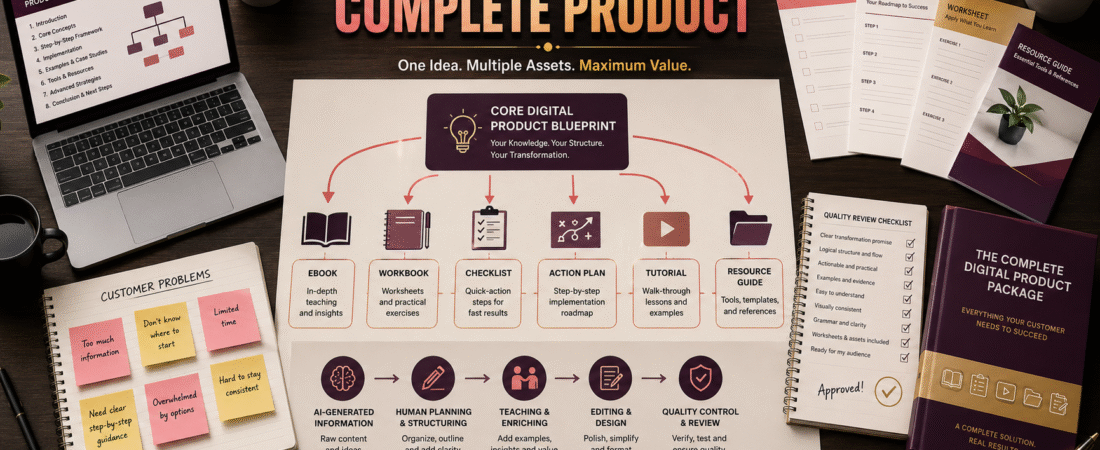
Artificial intelligence can help you produce an ebook outline, course plan, checklist, workbook, or training guide in minutes.
That speed is valuable.
It can also create a dangerous illusion.
A collection of organized information may look like a finished digital product even when it does not yet provide a complete customer experience.
The headings are present.
The paragraphs sound professional.
The formatting looks organized.
However, the reader may still finish the product without knowing what to do next.
The real challenge is not getting AI to generate more words.
The challenge is turning those words into a product that helps a specific person move from a current problem to a useful result.
That requires a process.
Disclosure: This article may contain affiliate links. I may receive a commission if you purchase through one of these links, at no additional cost to you. Recommendations should always be evaluated according to your own needs, budget, and business goals.
Why AI-Created Products Often Feel Incomplete
AI is very good at creating structure.
Ask for an ebook about email marketing, and it can produce a title, introduction, chapter list, conclusion, and several pages of content.
The result may still feel generic because the assignment was based on a topic rather than a transformation.
Consider the difference between these two product ideas:
An ebook about using AI for content creation.
and:
A step-by-step guide that helps a beginner create, review, and schedule seven days of original business content without starting from a blank page each morning.
The first describes information.
The second describes a result.
Customers do not purchase digital products merely because they contain information. They purchase them because they expect the information to help them understand, complete, improve, avoid, build, decide, or accomplish something.
AI can support that process, but it should not be asked to determine the entire product by itself.
OpenAI acknowledges that language models can produce plausible but false statements, commonly called hallucinations. Important claims, examples, statistics, and recommendations therefore require human review and independent verification. (OpenAI)
A complete product requires more than generation.
It requires direction, judgment, application, and quality control.
Step 1: Define the Customer Before Defining the Product
Begin with one specific customer.
Do not write for:
- Everyone interested in AI
- All online-business owners
- Anyone who wants to make money
- Beginners and advanced users at the same time
Choose a clearly defined person.
For example:
A beginner digital-product creator who understands basic AI tools but does not know how to turn an idea into a finished, organized product.
Then identify the customer’s current condition.
They may be:
- Overwhelmed by too many ideas
- Unsure what type of product to create
- Creating outlines that never become products
- Producing information without practical application
- Worried that AI content will sound generic
- Unable to decide when a product is complete
This starting condition helps determine what the product must contain.
Without it, AI may generate material that sounds relevant but does not solve the reader’s actual problem.
Step 2: Define the Transformation
Complete this sentence:
After using this product, the customer will be able to __________.
A strong answer describes something the customer can understand, decide, create, or complete.
Examples include:
- Select one realistic digital-product idea
- Develop a complete product outline
- Write and review an ebook
- Build a seven-day content plan
- Create a simple lead magnet
- Evaluate an AI-generated recommendation
- Set up a basic email follow-up sequence
Avoid vague promises such as:
- Become successful
- Transform your life
- Master artificial intelligence
- Build unlimited income
- Achieve financial freedom
Large promises are difficult to teach, demonstrate, and support.
A smaller, specific result is usually more useful.
The transformation becomes the standard against which every chapter, worksheet, example, and bonus should be evaluated.
Ask:
Does this component help the customer achieve the intended result?
When the answer is no, the component may not belong in the product.
Step 3: Map the Customer’s Required Progress
Now identify the steps the customer must complete.
Suppose the product helps a beginner create a lead magnet.
The customer may need to:
- Choose a specific audience.
- Identify one urgent problem.
- Select an appropriate format.
- Create the content.
- Add practical examples.
- Design the resource.
- Review it for quality.
- Connect it to an email signup process.
- Test the customer experience.
- Publish and promote it.
This sequence becomes the product’s educational pathway.
Each major step can become:
- A chapter
- A module
- A lesson
- A worksheet
- A checklist
- A demonstration
- An implementation assignment
This is much stronger than asking AI to create ten chapters about lead magnets.
The chapter count should come from the work the customer needs to complete—not from an arbitrary number.
Step 4: Create the Product Blueprint Before Writing
Do not generate the complete product immediately.
First, create a blueprint.
For each section, define:
Purpose
Why does this section exist?
Reader outcome
What should the reader understand or complete afterward?
Teaching method
Will the section use an explanation, walkthrough, example, comparison, checklist, worksheet, or diagnostic?
Practical action
What should the reader do?
Completion evidence
How will the reader know the step is finished?
A simple blueprint could look like this:
| Section | Purpose | Reader action | Completion evidence |
| Choose the audience | Establish focus | Complete an audience profile | One clearly defined customer |
| Identify the problem | Select a useful need | Write a problem statement | One specific problem |
| Build the solution | Map the transformation | Create a step sequence | Complete product pathway |
| Develop the content | Teach each step | Draft lessons and examples | Full first draft |
| Review the product | Improve quality | Complete an audit | Approved final content |
Once the blueprint is approved, AI can help develop each section separately.
This reduces repetition and prevents the product from becoming one long, uncontrolled generation.
A dedicated product-development platform may also help you organize ideas, outlines, and product components. Review your current workflow first, then explore AI Product Engine to determine whether it fits the kind of products you plan to create.
Step 5: Develop One Section at a Time
Creating one section at a time gives you more control over:
- Depth
- Tone
- Examples
- Accuracy
- Teaching method
- Repetition
- Customer application
For each section, provide AI with:
- The intended audience
- The purpose of the section
- What the reader already knows
- What the reader must learn next
- Required examples
- Required action steps
- Words or claims to avoid
- The completion standard
Then review the section before continuing.
Do not approve it merely because it is long.
Ask:
- Is the explanation clear?
- Does it teach something useful?
- Is the example realistic?
- Does the action match the lesson?
- Is anything repeated from earlier sections?
- Are important claims supported?
- Could a beginner follow it?
- Does it move the customer toward the promised result?
Google’s current people-first content guidance emphasizes original, substantial, complete, and useful information rather than mass-produced material created mainly to attract search traffic. It also encourages creators to be clear about who created the content, how automation was used when relevant, and why the content exists. (Google for Developers)
Those principles are also valuable for digital products.
The customer should feel that each section received individual thought and attention.
Step 6: Add Application, Not Just Explanation
A product becomes more useful when it helps the customer apply what they are learning.
For each major concept, consider including at least one of the following:
A completed example
Show what a good result looks like.
A blank template
Give the customer a structure to complete.
A checklist
Help the customer confirm that nothing important was missed.
A worksheet
Turn reflection into written decisions.
A decision table
Help the customer compare alternatives.
A diagnostic
Help the customer identify what is going wrong.
A practice assignment
Require the customer to use the concept.
A quality standard
Explain what “complete” looks like.
For example, a section about choosing a digital-product audience could include:
Weak audience statement:
People interested in online business.
Improved audience statement:
Retired beginners who want to create their first small digital product but feel overwhelmed by technology and do not want to appear on camera.
The example teaches the distinction more effectively than another paragraph of general advice.
Step 7: Perform the Completeness Audit
Before designing or selling the product, audit the content.
Use these questions.
Customer alignment
- Is the intended customer clear?
- Does the language match the customer’s experience?
- Are examples relevant to that person?
Transformation
- Is the promised outcome specific?
- Does the product teach every major step?
- Are there unexplained gaps?
Practical value
- Does the product contain examples?
- Are there actions after major lessons?
- Can the customer use the templates?
- Are the instructions specific enough to follow?
Accuracy
- Have factual claims been checked?
- Are statistics current and sourced?
- Are hypothetical examples labeled honestly?
- Have unsupported guarantees been removed?
Originality
- Does the product contribute your own organization, judgment, explanation, and teaching?
- Does it avoid sounding like a generic summary of information available elsewhere?
- Has the material been reviewed for repetitive AI phrasing?
Completion
- Are all placeholders removed?
- Do worksheets match the lessons?
- Does the conclusion direct the customer toward implementation?
- Is the product ready to use without additional explanation?
A product should not be labeled complete merely because all chapters have been written.
It is complete when the intended customer has a usable pathway from the starting problem to the promised result.
Step 8: Design the Customer Experience
After the content passes the quality audit, turn it into a professional customer asset.
Review:
- Cover design
- Page layout
- Heading consistency
- Font readability
- White space
- Worksheet usability
- Page numbers
- Table of contents
- Links
- Branding
- Mobile readability
- Final PDF quality
Design should support the learning experience.
It should help the customer understand:
- Where they are
- What to read
- What to complete
- What to do next
Avoid adding decoration that makes the product harder to use.
For creators who need help producing covers, product mockups, and other visual assets, explore ClickDesigns after the product content is approved. Its official website currently describes customizable templates and tools for creating flat, 2D, and 3D product presentations. (ClickDesigns)
The content should lead.
The design should strengthen it.
Step 9: Test the Product Like a Customer
Before publishing, open the product as though you purchased it from someone else.
Do not review only the words.
Review the entire experience.
Ask:
- Does the title match the content?
- Is the promise realistic?
- Is the first action clear?
- Do the examples help?
- Do the worksheets make sense?
- Are the links working?
- Can the product be read on a phone?
- Are instructions missing?
- Does the customer know when they are finished?
- Is the next step clear?
Consider giving the product to one or two test readers.
Ask them:
- Where did you become confused?
- Which section was most useful?
- Which section felt repetitive?
- What did you expect but not receive?
- Which action did you complete?
- What would make the product easier to use?
Do not ask only whether they liked it.
A customer can like a product and still fail to use it.
Application is stronger evidence than praise.
Step 10: Improve the Product After Real Use
Your first published version does not have to be your final version forever.
Record:
- Customer questions
- Support requests
- Confusing instructions
- Broken links
- Missing examples
- Frequently skipped exercises
- Useful customer outcomes
- Unnecessary sections
Use that information to improve later versions.
This creates a better product over time without forcing you to delay publication until everything feels perfect.
The goal is not careless speed.
The goal is responsible completion followed by documented improvement.
The Difference Between AI Generation and Product Creation
AI generation produces material.
Product creation produces a customer experience.
AI can help you:
- Explore ideas
- Build outlines
- Draft explanations
- Generate examples
- Organize information
- Create checklists
- Suggest worksheets
- Review structure
You remain responsible for:
- Selecting the audience
- Defining the promise
- Choosing what belongs
- Removing what does not
- Checking facts
- Protecting originality
- Improving examples
- Designing implementation
- Approving the final product
That division of responsibility is important.
AI should accelerate the process without becoming the final judge of quality.
A Simple Product-Creation Formula
Use this sequence:
Specific customer + clear problem + practical transformation + complete pathway + useful application + human review = stronger digital product
The formula does not guarantee sales.
It creates a better foundation for customer value.
Marketing may bring someone to the product.
The product itself must help justify the purchase.
Final Thoughts
AI has made it easier to generate digital-product content.
That does not automatically make it easier to create a valuable product.
The strongest results come when you combine AI speed with human direction.
Begin with the customer.
Define the transformation.
Map the required progress.
Approve the blueprint.
Develop one section at a time.
Add examples and application.
Audit the product for completeness.
Design the customer experience.
Test it before publishing.
Then improve it through real use.
The purpose is not to prove how much content AI can generate.
The purpose is to create something a customer can understand, apply, and benefit from.
Reader question: Which part of digital-product creation is most difficult for you: choosing the idea, organizing the content, writing the lessons, creating the worksheets, or finishing the product?
#AIDigitalProducts, #DigitalProductCreation, #AIForBusiness, #OnlineBusiness, #ContentCreation, #EbookCreation, #ProductDevelopment, #ArtificialIntelligence