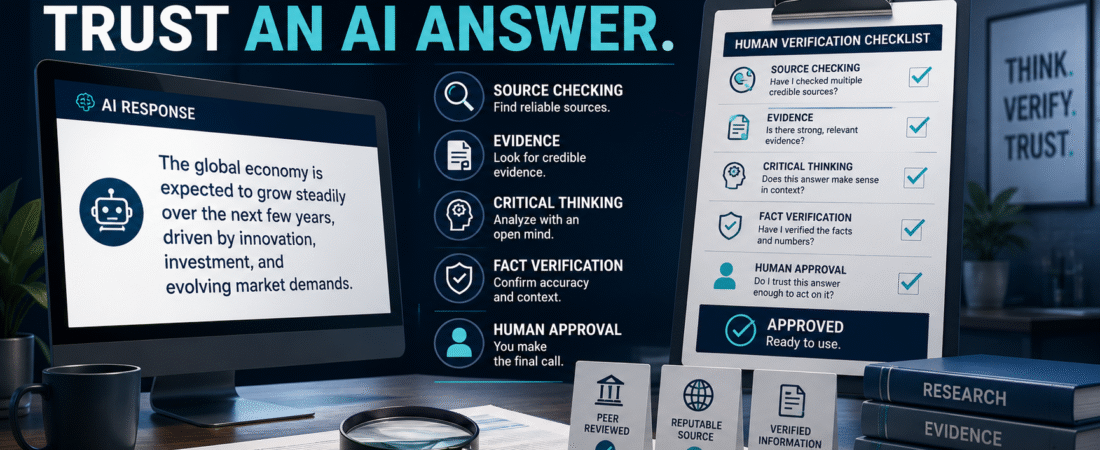
Artificial intelligence can produce an impressive answer in seconds.
The response may be clearly written, professionally organized, detailed, and delivered with complete confidence. That combination can make the information feel trustworthy before we have actually examined it.
That is where problems can begin.
A polished answer is not automatically a correct answer. A detailed recommendation is not necessarily a well-supported recommendation. Even a response containing statistics, sources, or technical language may require further review.
OpenAI describes hallucinations as plausible but false statements generated by language models and acknowledges that they remain a challenge even as AI systems become more capable.
This does not mean AI is unreliable or should not be used.
It means we need a better process for deciding when an answer can be used immediately and when it should be checked first.
As a retired teacher, I have always believed that a strong answer should be supported by sound reasoning and evidence. The same principle applies when working with artificial intelligence.
AI can help us create, organize, compare, explain, and explore information. Human judgment is still required to determine whether important information deserves to be trusted.
The following four-step reliability check can help.
Step 1: Identify What the AI Is Actually Claiming
Before checking an AI response, separate its factual claims from its suggestions and opinions.
An AI-generated answer may contain several kinds of information:
- Verifiable facts
- Numerical claims
- Assumptions
- Predictions
- Interpretations
- Recommendations
- Examples
- Personal-sounding observations
These categories should not be treated equally.
Consider this statement:
Publishing three blog posts every day will increase your website traffic by 200 percent within six months.
This sounds specific and confident, but it contains several questions:
- Where did the 200 percent figure come from?
- Was it based on a particular website or industry?
- Does it apply to a new website or an established one?
- Was traffic increased through search, social media, advertising, or email?
- Does posting frequency alone explain the result?
- Is this a documented fact or merely a prediction?
The first step is not to decide whether you like the claim.
The first step is to identify exactly what the claim says.
When reviewing an important AI response, ask:
Which parts of this answer are facts, which parts are assumptions, and which parts are recommendations?
That question forces the information into clearer categories.
Facts require evidence.
Assumptions require examination.
Recommendations require judgment.
Step 2: Examine the Evidence Behind the Answer
The next step is to determine what supports the important claims.
An AI system may provide a source, but the presence of a source does not complete the verification process. You still need to confirm that:
- The source exists.
- The source is current.
- The source is credible.
- The cited page supports the claim.
- The information has not been taken out of context.
- A stronger primary source is not available.
Suppose an AI-generated article says that a particular email-marketing platform includes a specific feature.
Before publishing the article, visit the platform’s official website or documentation.
Do not rely only on:
- An old review
- A search-result summary
- An affiliate promotion
- A social-media comment
- Another AI-generated explanation
Product features, prices, plans, policies, and terms can change. The provider’s current official information should usually be the starting point.
The same principle applies to research.
When an AI response refers to a study, do not merely confirm that the study’s title exists. Check whether the study actually supports the conclusion being presented.
A source may be real while the interpretation of that source is still inaccurate.
The National Institute of Standards and Technology provides a voluntary risk-management framework and a generative-AI profile intended to help organizations incorporate trustworthiness considerations into the development, use, and evaluation of AI systems.
The important lesson is simple:
Evidence should support the conclusion—not merely appear beside it.
Step 3: Challenge the Assumptions
Many weak recommendations are not built on false facts.
They are built on unexamined assumptions.
Imagine asking AI:
Is creating an online course the best way for me to make money from my knowledge?
The answer might provide a convincing course-development strategy.
However, the recommendation may be assuming that:
- You enjoy teaching on video.
- Your audience wants a course.
- You already have an email list.
- You can provide customer support.
- You have enough time to create the lessons.
- Your subject requires a course rather than a simpler product.
- Customers are willing to pay the recommended price.
The recommendation could be reasonable and still be wrong for your situation.
Before accepting an important answer, ask:
What assumptions must be true for this recommendation to work?
Then ask:
Which of those assumptions have actually been confirmed?
This is one of the most valuable habits you can develop when using AI for business.
AI can help you think through a decision, but it may not know:
- Your available resources
- Your financial limits
- Your audience’s behavior
- Your personal preferences
- Your existing technology
- Your level of experience
- Your tolerance for complexity
- Your long-term goals
The more important the decision, the more clearly those conditions should be defined.
You can also challenge the answer by asking:
What is the strongest reasonable argument against this recommendation?
That does not mean the opposing position is automatically correct.
It means you are testing whether the original recommendation remains convincing after it has been challenged.
Step 4: Confirm the Important Information Independently
The final step is to determine what requires confirmation outside the original AI response.
Not every AI-assisted task requires the same level of verification.
If you ask for ten headline ideas, you may only need to review whether the headlines are clear and relevant.
If you ask for information that will influence a major purchase, public claim, health decision, legal question, financial choice, or business investment, the standard should be much higher.
A useful approach is to divide AI tasks into three risk levels.
Low-risk tasks
Examples include:
- Brainstorming topics
- Rewriting a sentence
- Organizing notes
- Creating a preliminary outline
- Suggesting headline variations
These tasks normally require basic human review.
Moderate-risk tasks
Examples include:
- Publishing a blog article
- Writing an affiliate review
- Comparing software products
- Creating educational content
- Preparing marketing claims
These tasks require verification of material facts, prices, features, statistics, quotations, and sources.
High-risk tasks
Examples include:
- Legal decisions
- Medical decisions
- Significant financial decisions
- Safety instructions
- Regulatory compliance
- Major business investments
These situations may require authoritative documentation and qualified professional review.
The National Institute of Standards and Technology emphasizes testing, evaluation, verification, and validation as important parts of putting AI risk-management principles into practice.
Your verification effort should rise with the consequences of being wrong.
A Practical Example for Content Creators
Suppose you are writing an article about video marketing.
The AI provides this statement:
Short videos receive five times more engagement than written posts.
Before publishing it, apply the four-step check.
Identify the claim
The response claims that short videos receive five times more engagement.
Examine the evidence
Find the original source.
Determine:
- Which platform was measured
- What “engagement” meant
- When the research was conducted
- How many accounts were studied
- Whether the result applies to your audience
Challenge the assumptions
The claim may assume that:
- Video quality is high.
- The topic is relevant.
- The account has an established audience.
- The comparison uses similar content.
- All platforms behave the same way.
Confirm independently
Look for current platform data, your own analytics, or a reliable industry report.
If you cannot confirm the five-times figure, remove it or use more accurate wording:
Short videos can create strong engagement when the topic, opening, presentation, and platform are well matched to the audience.
The revised sentence may sound less dramatic.
It is also more responsible.
Five Common AI Verification Mistakes
1. Asking the same AI to verify its own answer
An AI system can review its earlier response, but that is not independent confirmation.
It may repeat the same mistake using different wording.
2. Assuming a citation proves the claim
A citation must be opened, read, and compared with the statement it supposedly supports.
3. Confusing confidence with accuracy
AI-generated writing can sound certain even when the underlying information is incomplete.
4. Failing to check dates
Information about software, prices, laws, policies, public figures, and market conditions may become outdated quickly.
5. Publishing before performing human review
The person publishing the material remains responsible for what the audience receives.
AI can accelerate content creation.
It does not remove editorial responsibility.
The Four Questions to Ask Before Using an AI Answer
Before publishing or acting on important AI-generated information, ask:
1. What exactly is being claimed?
Separate facts, assumptions, predictions, and recommendations.
2. What evidence supports the claim?
Inspect the strongest available source.
3. What assumptions could change the conclusion?
Identify the conditions required for the answer to be useful.
4. What must be confirmed independently?
Match the level of verification to the consequences of being wrong.
These four questions do not make the process unnecessarily complicated.
They make the process safer, clearer, and more dependable.
Better AI Use Requires More Than Better Prompts
A strong prompt can improve an AI response.
It cannot guarantee that every fact is current, every assumption is correct, or every recommendation fits your circumstances.
That is why effective AI use requires two different abilities:
- The ability to guide the output.
- The ability to evaluate the output.
Many people concentrate only on the first.
They spend time trying to write the perfect prompt but devote little attention to reviewing the result.
The stronger approach is to treat AI-generated material as work that must pass through human judgment before it becomes a published article, customer recommendation, product, or business decision.
AI should help you think.
It should not prevent you from thinking.
Final Thoughts
Artificial intelligence can save time, expand ideas, organize information, and help people complete projects they might otherwise postpone.
Those advantages become more valuable when they are supported by a reliable review process.
Before trusting an important AI answer:
- Identify the claim.
- Examine the evidence.
- Challenge the assumptions.
- Confirm the important information independently.
The goal is not to distrust everything AI produces.
The goal is to know what deserves immediate use, what requires revision, and what must be verified before action.
That distinction can protect your content, your audience, your reputation, and your business.
Reader Question
Which part of an AI-generated answer do you find most difficult to verify: facts, sources, statistics, or recommendations? Leave a comment and share your experience.