AI can gather information quickly.
That speed creates a new problem:
The easiest source to find is not always the strongest source to trust.
Suppose you ask AI:
“What features are included in Software X?”
The answer could be based on:
- The software company’s current documentation.
- An old blog review.
- A forum comment.
- A search-result snippet.
- An affiliate article.
- A remembered statement from older training data.
All six may discuss the same product.
They do not carry the same evidentiary weight.
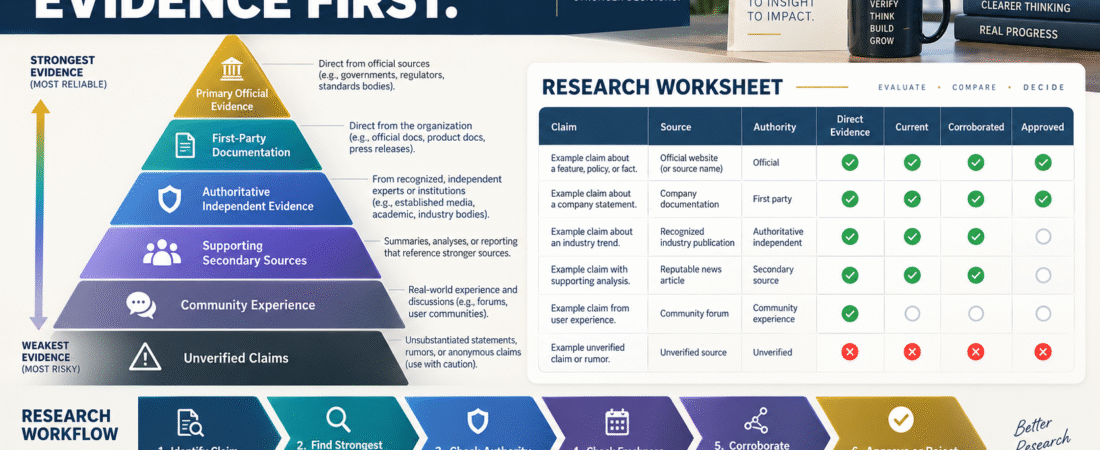
An AI evidence hierarchy gives you a simple rule:
Use the strongest available evidence for the type of claim you are making.
The process is:
Claim → Evidence Type → Authority → Directness → Freshness → Corroboration → Decision
This helps prevent weak information from outranking stronger evidence simply because it appeared first.
What Is an Evidence Hierarchy?
An evidence hierarchy ranks sources according to how directly and reliably they support a claim.
It does not mean:
“Only one type of source can ever be used.”
Different sources answer different questions.
For example:
Official documentation may be strongest for:
- Current price.
- Feature availability.
- Plan limits.
- Product policies.
A customer discussion may be more useful for:
- Common frustrations.
- Real-world usability.
- Support experiences.
The mistake is using one type of evidence as though it proves another type of claim.
Level 1: Direct Primary or Official Evidence
This is usually your strongest starting point for current factual claims.
Examples:
- Official pricing page.
- Product documentation.
- Government publication.
- Original research.
- Company support page.
- Original policy.
- Direct account screenshot.
- Written response from official support.
Use this level when verifying:
- Price.
- Limits.
- Rules.
- Current functionality.
- Official definitions.
- Account-specific behavior.
If the company says its Starter plan includes one automation workflow, that is stronger evidence of the current plan structure than an unrelated blog post from two years ago.
Level 2: First-Party Explanatory Material
This may include:
- Official company blog.
- Training article.
- Product webinar.
- Help-center tutorial.
- Official video.
These sources can provide valuable context.
But promotional material may emphasize benefits.
For example:
A product blog may say:
“Our automation saves hours every week.”
That does not prove every customer will save hours.
Separate:
Feature description
from:
performance claim.
Level 3: Authoritative Independent Evidence
Independent sources can be valuable when the question requires outside analysis.
Examples:
- Established technical publication.
- Academic institution.
- Professional organization.
- Recognized subject-matter specialist.
- Independent benchmark study.
These sources become especially useful when you need:
- Comparison.
- Interpretation.
- Industry context.
- Independent testing.
The key word is:
Authoritative.
“Independent” by itself does not make a source reliable.
Level 4: Reputable Secondary Sources
This includes:
- Reviews.
- Tutorials.
- Comparison articles.
- News summaries.
- Educational blogs.
These can be extremely useful for understanding a subject.
But they are generally one step removed from the underlying evidence.
A secondary article may say:
“Platform X costs $29.”
Before publishing that as current fact, check the official pricing page.
Level 5: Community and Experience Reports
Examples:
- Reddit.
- Forums.
- Facebook groups.
- User communities.
- Customer comments.
These are valuable for questions such as:
- What problems do users commonly report?
- What features confuse beginners?
- What workarounds do people use?
- What does the community like or dislike?
They are much weaker for proving:
- Current plan pricing.
- Official policy.
- Universal product behavior.
One person’s experience is evidence of that person’s experience.
It is not automatically evidence of what every customer will experience.
Level 6: Unverified Claims
This includes information where you cannot identify a credible source.
Examples:
- AI states something with no evidence.
- Search snippet lacks context.
- Anonymous social claim.
- Copied statistic with no original study.
- “Everyone knows…” assertion.
Treat these as:
Lead to investigate
rather than:
Fact to publish.
Source Strength Depends on the Claim
The hierarchy is not completely rigid.
Suppose your question is:
“Does this software officially support feature X?”
Official documentation should be weighted heavily.
But suppose your question is:
“Do beginners find feature X confusing?”
Official documentation cannot fully answer that.
You may need:
- Reviews.
- Community comments.
- User testing.
The strongest evidence changes with the question.
Ask: “What Would Directly Prove This?”
This is one of the most useful research questions.
Claim:
“The product costs $49 per month.”
Strong direct evidence:
Current official pricing page.
Claim:
“Customers frequently complain about setup.”
Strong evidence could require:
- Multiple independent user discussions.
- Review patterns.
- Support-community discussions.
Claim:
“This workflow works better.”
You may need:
- Comparative testing.
- Performance data.
- Controlled experiment.
Do not use weak evidence for a strong conclusion.
Separate Facts From Opinions
Suppose a review says:
“Platform A has a much better interface.”
That is an opinion.
It may still be useful.
But write it as opinion.
Do not convert it into:
“Platform A’s interface is objectively better.”
AI can accidentally remove these distinctions when summarizing several sources.
Your evidence hierarchy should preserve them.
Record the Evidence Behind Important Claims
For higher-risk content, use a simple table:
Claim: Platform allows unlimited products.
Source: Official pricing page.
Evidence Level: Level 1.
Current?: Yes.
Corroboration Needed?: No.
Status: Approved.
Another:
Claim: Beginners find setup difficult.
Source: Three community discussions.
Evidence Level: Level 5.
Status: Useful as experience evidence; do not state universally.
This makes your reasoning visible.
Freshness and Authority Are Separate
A highly authoritative source can become outdated.
An unofficial source can be very recent.
You need both dimensions.
Ask:
Is this source strong?
and:
Is this source current enough?
Your AI Source Packet guide can help you collect approved research before asking AI to produce the finished content.
Conflicting Strong Sources Require Transparency
Sometimes two strong sources disagree.
For example:
Two official pricing pages display different promotions.
Do not hide the conflict.
Write:
“The company currently maintains multiple official offers. Verify the checkout associated with the specific promotion you are considering.”
That is more trustworthy than pretending uncertainty does not exist.
Corroboration Becomes More Important as Risk Increases
For low-risk content:
One strong source may be enough.
For high-risk content involving:
- Money.
- Health.
- Legal matters.
- Security.
- Major business changes.
seek additional evidence when practical.
A second independent source may expose:
- Missing context.
- Different interpretation.
- Outdated information.
Use AI to Organize Evidence, Not Manufacture It
AI can help create a table such as:
| Claim | Source | Evidence Level | Current? | Status |
|---|
But it should not fill missing evidence with guesses.
If the evidence is unavailable:
Status: Not Yet Verified
is a valid result.
Create an Evidence Rule for Your AI Prompts
Add an instruction such as:
For factual claims, prefer the strongest available direct and authoritative evidence. Do not allow secondary summaries to override current primary documentation. Clearly label opinions, user experiences, uncertainty, and conflicting evidence.
That creates a reusable standard.
Connect Evidence Problems to Your Error Log
If AI repeatedly uses weak sources for important claims, record the pattern in your AI Error Log.
Example:
Error: Third-party article used for current pricing.
Root Cause: No evidence-priority rule.
Permanent Fix: Require current first-party pricing evidence.
The next error becomes less likely.
Use Human Review for High-Risk Evidence
The human review checkpoint workflow is especially useful when a final recommendation depends heavily on evidence quality.
Require explicit human review before publishing:
- Current prices.
- Important comparisons.
- High-impact recommendations.
- Claims affecting customer decisions.
A Simple AI Evidence Hierarchy
You can use this six-level structure:
LEVEL 1 — DIRECT PRIMARY / OFFICIAL EVIDENCE
Strongest for direct factual claims.
LEVEL 2 — FIRST-PARTY EXPLANATION
Useful for official context.
LEVEL 3 — AUTHORITATIVE INDEPENDENT EVIDENCE
Useful for analysis and outside verification.
LEVEL 4 — REPUTABLE SECONDARY SOURCES
Useful for explanation and discovery.
LEVEL 5 — COMMUNITY EXPERIENCE
Useful for qualitative experience.
LEVEL 6 — UNVERIFIED CLAIM
Investigate before use.
The labels matter less than using the hierarchy consistently.
Do Not Automatically Reject Lower-Level Sources
A community discussion may reveal an important issue that official documentation never mentions.
Use it as a lead.
Then ask:
Can this concern be corroborated?
That turns anecdotal information into responsible research.
Conclusion
An AI evidence hierarchy helps you prevent convenient information from outranking stronger evidence.
For every important claim, ask:
What exactly is being claimed?
Then evaluate:
Authority → Directness → Freshness → Corroboration → Risk
Use official and primary evidence for direct current facts whenever appropriate.
Use independent and community sources for the types of questions they are better suited to answer.
And leave uncertain information uncertain until stronger evidence appears.
Your Next Action
Choose one AI-generated article, comparison, or recommendation you created recently.
Select its five most important factual claims.
For each claim, write:
Claim | Source | Evidence Level | Current? | Needs Corroboration? | Final Status
Then identify the claim supported by the weakest evidence.
Replace that evidence with the strongest reasonable source you can find.
Finally, add this rule to your reusable AI research prompt:
“For important factual claims, use the strongest available evidence first. Secondary summaries and community opinions must not override current direct authoritative evidence.”
That creates your first working AI evidence hierarchy.