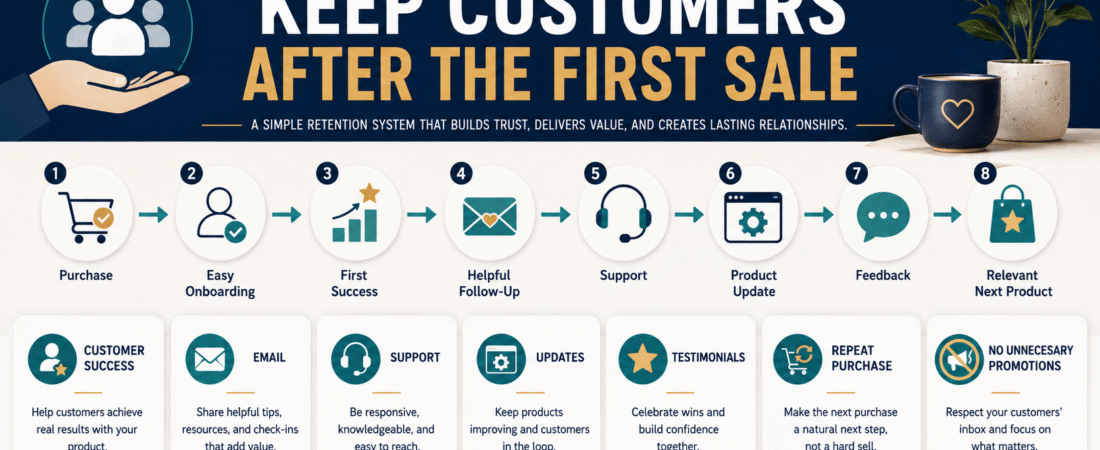
The first sale is important.
But a customer relationship does not have to end there.
Someone who purchases an ebook, course, checklist, workbook, membership, or template pack has already made one important decision:
I trust this business enough to buy something.
The next goal should not be:
How quickly can I sell this person three more products?
A better question is:
How can I help this customer successfully use what they already purchased?
That is the foundation of retention.
Current 2026 customer-retention guidance emphasizes onboarding and product education as important parts of preventing customer loss because customers need to understand how to use what they purchased before they can experience value from it.
For a small digital-product business, retention can be kept simple:
Purchase → Access → First Success → Follow-Up → Support → Feedback → Relevant Next Step
Retention Does Not Mean Only Subscriptions
The word retention is commonly associated with:
- SaaS.
- Memberships.
- Monthly subscriptions.
But the principle can also apply to one-time digital products.
If someone buys one workbook today and purchases another useful product four months later, you retained a customer relationship.
If someone remains:
- On your email list.
- Engaged with your content.
- Confident in your products.
- Willing to recommend you.
that relationship still has value.
Start With Successful Delivery
Retention begins immediately after checkout.
If the first experience is:
Where is the product?
you have already introduced friction.
The customer should quickly understand:
- Purchase succeeded.
- Product is available.
- Where to access it.
- What to do first.
- Where to get help.
Your delivery-email system is the first operational layer:
How to Write a Digital Product Delivery Email That Prevents Customer Confusion
The First Goal Is Not Another Sale
Suppose someone buys a $27 workbook.
Five minutes later, they receive:
Buy this $97 course!
Then:
Upgrade to this $197 package!
Then:
Don’t miss my $47 templates!
That may monetize aggressively.
It does not automatically create a strong customer relationship.
First help the buyer use the purchase.
Define the Customer’s First Success
Ask:
What is one useful result this product should help a buyer achieve quickly?
Examples:
Prompt Workbook
Create one useful prompt.
Affiliate Checklist
Complete the first setup section.
Course
Finish the Quick Start lesson.
Template Pack
Customize the first template.
Ebook
Understand and apply the first framework.
Do not require completion of the entire product before value appears.
Build Onboarding Around First Success
Your onboarding should move customers toward that result.
A simple sequence:
Immediately
Delivery and access.
Day 1
Quick Start reminder.
Day 3
One usage tip.
Day 7
Ask whether the customer is having trouble.
You do not need dozens of automated emails.
Use the minimum sequence that genuinely improves product use.
A deeper framework is available here:
How to Create a Customer Onboarding System for a Digital Product
Customer Support Is a Retention System
Support requests reveal where customers get stuck.
Track repeated questions.
For example:
Where is the download?
How do I edit the template?
Which lesson comes first?
Can I use this commercially?
If several customers ask the same question, improve:
- Delivery.
- Product.
- FAQ.
- Sales page.
- Onboarding.
Retention improves when friction is removed systematically.
Do Not Make Customers Repeat Information
If a customer emails from the same address used during purchase, your support process should help you locate the order.
Do not make the buyer reconstruct the entire transaction every time.
A simple customer-support log can record:
- Product.
- Issue.
- Resolution.
- Repeated problem.
This helps the business learn.
Follow Up After the Customer Has Had Time to Use the Product
Do not ask:
How was the course?
ten minutes after purchase.
Give customers enough time to experience it.
Then ask:
Were you able to access everything?
Which part has been most useful?
Was anything confusing?
Is there anything you expected but could not find?
Those questions create useful retention information.
Feedback and Testimonials Are Different
A feedback request should invite:
- Positive feedback.
- Neutral feedback.
- Problems.
- Suggestions.
Some genuine positive responses may later become testimonials after permission.
Your testimonial system should preserve that distinction:
How to Get Testimonials for a Digital Product Without Manufacturing Praise
Update Products When Customer Evidence Justifies It
Retention suffers if customers repeatedly encounter an outdated resource.
That does not mean constantly rebuilding everything.
Use a controlled update process.
Good reasons might include:
- Broken link.
- Changed software interface.
- Incorrect instruction.
- Major new requirement.
- Repeated customer confusion.
Then notify affected customers appropriately.
Product Updates Can Create Positive Re-Engagement
A useful update email might say:
I updated the Quick Start Guide and added a clearer example to Section 3. Existing customers can access the updated version from the same download area.
That email provides value.
It is not merely promotional.
Customers have another reason to return.
Keep Customers on a Helpful Email Path
After the onboarding sequence, transition the customer into normal communication.
That might include:
- Educational newsletter.
- New articles.
- Product updates.
- Relevant resources.
- Occasional offers.
Do not trap buyers in a permanent sales sequence.
Segment Customers When It Helps
If your email platform supports tags or segmentation, you may identify:
Purchased Product A
Now you can avoid promoting Product A to someone who already owns it.
You can also send:
- Product-specific updates.
- Related instructions.
- Relevant next offers.
Segmentation should reduce irrelevant communication.
Do Not Over-Segment a Tiny List
If you have 300 subscribers, you probably do not need 47 behavioral segments.
Start with useful distinctions:
Lead only
Customer
Product A customer
Product B customer
That may be enough.
Create a Logical Next Product
Retention becomes easier when your products connect.
Suppose the first product helps someone:
Choose a digital-product idea.
A logical second product might help them:
Build and launch it.
A random next product about:
AI avatar video editing
may not continue the same journey.
Your product ladder should create logical progression:
How to Create a Simple Digital Product Ladder Without Building Ten Products
Do Not Build Ten Products Just to Increase Retention
More products can create more confusion.
You might need:
Entry Product
Solves the first small problem.
Core Product
Solves the larger problem.
Advanced Product
Provides more depth where appropriate.
That is enough for many businesses.
Make the Next Offer Contextual
A customer who just completed an introductory workbook might receive:
If you’re ready for the next step, this course takes the same process further.
That is very different from:
Buy this because you’re on my customer list.
The relationship between products should be obvious.
Measure Repeat Purchase
A simple retention metric:
How many existing customers bought again?
Example:
100 customers purchased Product A.
15 later purchased Product B.
That does not automatically mean your retention strategy is good or bad.
But it creates a baseline.
Track Customer Engagement Too
For digital products, useful indicators may include:
- Course logins.
- Download completion.
- Email clicks.
- Support activity.
- Update access.
- Repeat purchases.
Do not track metrics you cannot use.
Membership Retention Requires More Attention
A subscription or membership is different because the customer actively decides whether continued access remains worth the recurring cost.
Ask:
- Is new value being delivered?
- Is the member using the product?
- Is onboarding working?
- Are cancellations increasing?
- Why do customers leave?
Current retention research particularly emphasizes identifying churn causes and improving onboarding and product education rather than relying only on discounts to stop cancellations.
Do Not Use Discounts to Hide a Weak Product
A customer says:
I don’t understand how to use this.
Offering:
20% off another month
does not solve the problem.
Fix:
- Onboarding.
- Instructions.
- Product.
- Support.
Discounts can be appropriate promotions.
They are not substitutes for customer success.
Create a Simple Retention Calendar
Purchase Day
Delivery.
Day 1
Quick Start.
Day 3–7
Helpful usage tip.
Day 14
Feedback or check-in where appropriate.
Monthly or Regular Newsletter
Useful content.
Product Update
Notify when meaningful.
Relevant Next Offer
Only when it matches the customer’s next problem.
That is a retention system.
Avoid Constant Selling
A customer can quickly learn:
Every message from this business is another pitch.
Then even useful emails become less valuable.
Maintain a useful balance.
Teach.
Update.
Help.
Recommend.
Sell when relevant.
Build a Customer Record Without Becoming Intrusive
You may need only:
- Email.
- Product purchased.
- Purchase date.
- Relevant tags.
- Support issues.
- Refund status.
Do not collect information merely because software gives you a field for it.
Use only what supports a legitimate business purpose.
Review Retention Monthly or Quarterly
Ask:
Did customers receive their purchases successfully?
What problems repeated?
Did customers engage after purchase?
Which products led naturally to another purchase?
Which follow-up emails received useful responses?
What should be improved?
Do not rebuild the retention system every week.
Customer Retention Is Primarily a Product and Experience Question
Marketing helps.
Email helps.
Automation helps.
But customers remain interested because the experience is useful.
A weak product surrounded by sophisticated retention automations is still a weak product.
A strong simple product with:
- Clear delivery.
- Good onboarding.
- Responsive support.
- Useful updates.
- Relevant follow-up.
can create a much stronger relationship.
Conclusion
Customer retention after a digital-product sale should begin with customer success.
Do not rush directly into the next promotion.
Help the customer access the product.
Show them where to start.
Help them reach one meaningful result.
Provide support.
Ask for genuine feedback.
Improve repeated problems.
Then, when there is a logical next product, make the recommendation in context.
The simplest retention system is not:
Sell again as quickly as possible.
It is:
Help first-time customers become satisfied customers who are willing to keep listening to you.