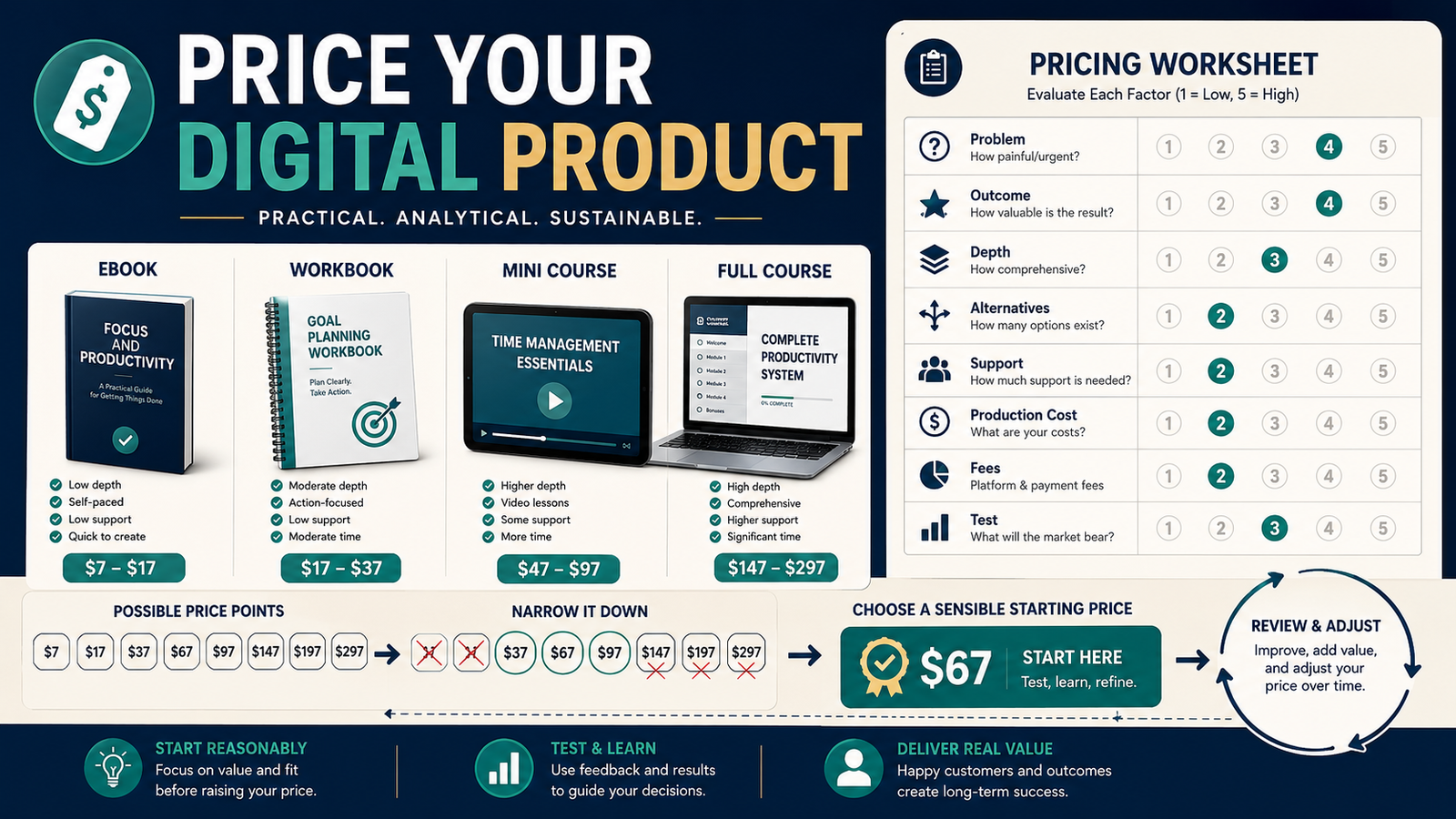
There is no universal correct price for an ebook, workbook, course, prompt pack, checklist bundle, or other digital product.
A useful starting price comes from understanding what the product helps the customer accomplish, how substantial the solution is, what alternatives exist, how much support is included, what it costs you to sell and deliver the product, and how real buyers respond.
The goal is not to discover a magical number before you launch.
The goal is to choose a price you can explain, test it responsibly, and adjust when you have better evidence.
Key Takeaways
- Price the result rather than the number of pages.
- Compare products that solve a similar problem, not merely products in the same format.
- Include transaction, software, affiliate, support, and refund costs.
- A low price can create problems as easily as a high price.
- Use a reasonable starting price rather than searching for certainty.
- Test with real buyers and adjust when evidence supports the change.
Begin With the Problem
Write:
“This product helps [AUDIENCE] solve [PROBLEM].”
Example:
“This workbook helps retired educators choose and outline one manageable digital-product idea.”
Now ask:
- How important is this problem?
- How difficult is it to solve without help?
- What happens if the customer does nothing?
- How many steps does the product remove?
- What decision does it make easier?
A product addressing a small convenience is different from one addressing a costly or time-consuming problem.
Define the Outcome
Do not price according to page count.
A 15-page workbook that helps a customer complete an important decision can be more useful than a 150-page ebook that contains mostly background information.
Write the result:
“By the end, the buyer will have…”
Examples:
- One validated ebook topic.
- A five-email welcome sequence.
- A completed blog-quality checklist.
- A course outline.
- A launch calendar.
- A finished set of prompts.
The clearer the result, the easier it becomes to explain the price.
Evaluate Depth
Ask what the product contains.
Simple resource
- Checklist.
- Template.
- Short guide.
Moderate product
- Ebook.
- Workbook.
- Multi-template package.
- Prompt system.
More substantial product
- Detailed course.
- Toolkit.
- Certification training.
- Membership.
The format does not automatically determine value, but complexity can influence customer expectations.
Compare Real Alternatives
Do not ask only:
“What are other ebooks charging?”
Ask:
“What would the buyer use instead?”
Alternatives may include:
- Free blog articles.
- YouTube videos.
- Another ebook.
- Course.
- Consultant.
- Software.
- Trial and error.
- Doing nothing.
Your product needs a reason to justify its price compared with those alternatives.
Do Not Copy Competitor Prices Blindly
A competitor charging $97 may have:
- Established brand.
- Large email list.
- Strong customer support.
- Additional bonuses.
- Different audience.
- Different product depth.
- Different reputation.
Another creator charging $7 may be using the product primarily to acquire customers for a larger offer.
Copying either number without understanding the strategy tells you very little.
Calculate Your Selling Costs
Digital products do not have inventory costs in the same way physical products do, but they are not necessarily free to sell.
Possible costs include:
- Checkout fees.
- Payment-processing fees.
- Product-delivery software.
- Email software.
- Design tools.
- Video tools.
- Affiliate commissions.
- Advertising.
- Customer support.
- Refunds.
- Taxes.
- Hosting.
List the actual costs.
Do not assume that a $20 sale produces $20 in usable revenue.
Include Your Support Burden
Some products require almost no support.
Others require:
- Login help.
- Course access.
- Technical questions.
- Coaching.
- Updates.
- Community moderation.
- Software troubleshooting.
A course that includes direct personal support cannot be evaluated the same way as a downloadable PDF.
Consider the time commitment.
Decide What Role the Product Plays
A product may be:
Entry Product
Low-friction introduction to your paid offers.
Core Product
Main solution to the audience problem.
Premium Product
Deeper implementation, support, or access.
A $17 workbook may work well as an entry product.
A complete course with coaching may require a very different pricing structure.
Do not force every product to maximize immediate revenue.
Avoid Pricing Too Low Automatically
Beginners often believe low prices eliminate buyer resistance.
Low prices can also:
- Attract people who never use the product.
- Leave insufficient room for affiliate commissions.
- Make advertising difficult.
- Create support costs larger than the sale.
- Reduce perceived seriousness.
That does not mean higher is always better.
It means low pricing should be intentional.
Avoid Pricing Too High Because of “Perceived Value”
Do not add imaginary values:
- Ebook: “Worth $997.”
- Checklist: “Worth $497.”
- Five prompts: “Worth $1,997.”
unless there is a defensible basis.
A price comparison should help the customer understand the offer, not create an artificial bargain.
Use a Pricing Worksheet
Answer these questions:
- Who is the buyer?
- What problem does the product solve?
- What specific result does it help create?
- How important is that result?
- What alternatives exist?
- How complete is the solution?
- What support is included?
- What are the ongoing costs?
- What are similar solutions charging?
- What starting price seems reasonable?
Then write why you chose the price.
If you cannot explain it, keep working.
Example: Pricing a Small Ebook
Imagine:
Product: First Digital Product Planning Guide
Audience: Retirees starting a small online business.
Outcome: Choose one product idea and build a 30-day creation plan.
Includes: 60-page guide, worksheet, scorecard, and checklist.
The creator might research comparable beginner guides and workbooks, calculate checkout and affiliate costs, and select a modest entry-level price.
After launch, the creator should examine:
- Sales.
- Refunds.
- Questions.
- Completion.
- Feedback.
The goal is to learn.
Example: Pricing a Course
Now imagine:
Product: Build Your First Digital Product Course
It includes:
- Eight modules.
- Video lessons.
- Worksheets.
- Templates.
- Student portal.
- Updates.
The course requires greater production and support.
It may justify a higher price than the introductory ebook because the buyer receives a more guided solution.
The difference comes from the product experience, not merely because “courses cost more.”
Decide Whether to Offer Payment Plans
Payment plans can make higher-priced products easier to purchase.
However, they can also create:
- Failed payments.
- Additional fees.
- Administrative work.
- Refund complexity.
A $27 ebook probably does not need installments.
A several-hundred-dollar course might.
Keep the payment structure proportional to the product.
Consider Affiliate Commissions
If affiliates will promote the product:
Suppose you sell a product for $20 and pay a substantial commission.
You still need enough revenue to cover:
- Payment fees.
- Refunds.
- Delivery.
- Support.
Affiliate commissions should be considered before the public price is finalized.
Do not reduce commissions after affiliates begin promoting without carefully reviewing the program terms and communication.
Decide Whether You Need a Discount
Discounts can be appropriate for:
- Launch testing.
- Existing customers.
- Bundles.
- Seasonal promotions.
Avoid constant discounting.
If a $97 product is “temporarily” $17 every day, customers learn that $17 is the real price.
Use a Founding-Customer Price Carefully
A first group may receive a lower price because:
- Product is new.
- Feedback is needed.
- Some materials may still be refined.
Be transparent.
Do not create fake scarcity.
You can state:
“The introductory price is available while I collect feedback from the first group.”
only if that is true.
Test the Price
Pricing becomes more informed after real transactions.
Track:
- Product-page visits.
- Checkout starts.
- Purchases.
- Refunds.
- Support questions.
- Buyer feedback.
Do not change the price after every visitor.
Collect enough evidence to recognize a pattern.
Ask Buyers Useful Questions
After purchase:
- What convinced you to buy?
- What almost stopped you?
- What problem were you trying to solve?
- Which part has been most useful?
For non-buyers, you may ask:
- Was anything unclear?
- Was the product relevant?
- Did the price feel high relative to the problem?
- Was another solution preferable?
Do not assume every lost sale is a price objection.
The offer itself may be unclear.
When to Raise the Price
A price increase may make sense when:
- Product has been substantially expanded.
- New support is included.
- Buyer results demonstrate stronger usefulness.
- Demand remains healthy.
- Costs increased.
- Positioning changed.
Do not increase the price only because a marketing guru told you that charging more proves confidence.
When to Lower the Price
A reduction may make sense when:
- Product is intended as an entry offer.
- Current price does not match audience expectations.
- Product is narrower than originally planned.
- A lower price supports a bundle strategy.
Do not automatically lower it because sales are slow.
Traffic and positioning may be the real problems.
Consider a Two-Product Ladder
A simple structure can be:
Entry Product
Focused guide or workbook.
Core Product
More comprehensive implementation product.
For example:
$27 Ebook: Choose Your First Digital Product.
Higher-Priced Course: Build and Launch the Product.
This gives beginners a lower-cost starting point without forcing the course price downward.
Create a Pricing Review Schedule
Review periodically.
Check:
- Costs.
- Product depth.
- Competitors.
- Buyer feedback.
- Refunds.
- Support workload.
- Affiliate economics.
Avoid constant changes.
Stability makes measurement easier.
Digital Product Pricing Checklist
Before publishing the price, confirm:
- Buyer is clearly defined.
- Problem is clear.
- Outcome is clear.
- Product scope is clear.
- Alternatives were researched.
- Costs were calculated.
- Support was considered.
- Refund exposure was considered.
- Affiliate commissions were considered.
- Starting price can be explained.
- Price can be tested.
- Claims do not exaggerate value.
Common Pricing Mistakes
Pricing by page count
Length is not the same as usefulness.
Copying competitors
Their business may be different.
Ignoring fees
Digital sales still have costs.
Automatically charging very little
Low price is a strategic decision, not a requirement.
Inflating “value”
Use credible comparisons.
Changing the price constantly
Give tests time to produce evidence.
Blaming price for every lost sale
The problem may be traffic, positioning, or product fit.
Conclusion
Pricing a digital product is a decision you refine rather than a number you magically discover.
Start with the customer problem and desired result. Evaluate the product’s depth, alternatives, support requirements, and selling costs. Research comparable solutions, choose a reasonable starting price, and explain why that price makes sense.
Then let real buyer behavior improve the decision.
Write down the outcome of your product and the ten answers from the pricing worksheet before entering a price on your checkout page.