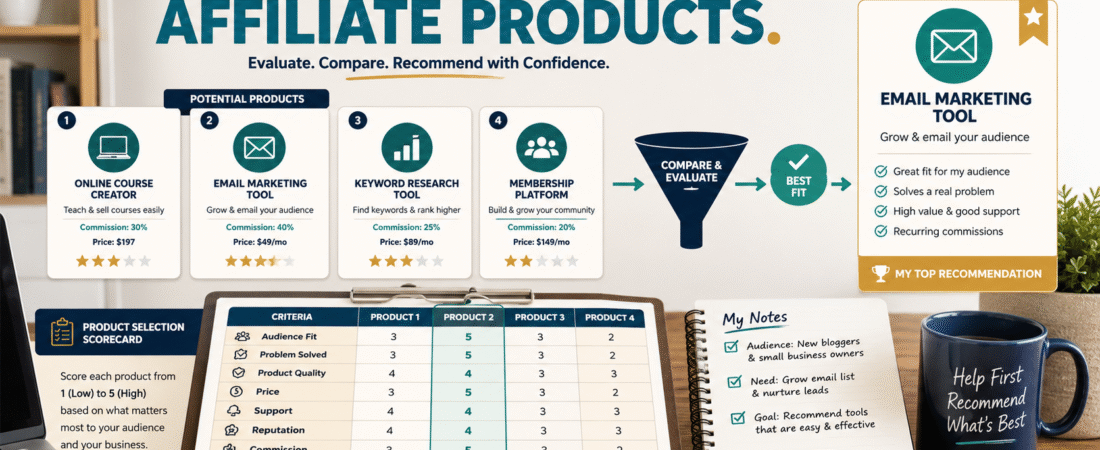
One of the easiest mistakes in affiliate marketing is choosing products according to commission size instead of reader usefulness.
A product may pay an attractive commission and still be completely wrong for your audience. Another product may pay less but solve a problem your readers are actively trying to fix. Over time, the second recommendation is usually more consistent with building a trustworthy business.
The practical rule is simple:
Choose the audience problem first and the affiliate product second.
Before recommending anything, determine who the product is for, what problem it solves, what it costs, whether its claims can be supported, what limitations matter, and whether you would feel comfortable explaining those limitations to a reader before the purchase.
Affiliate relationships should also be disclosed clearly. The Federal Trade Commission advises marketers to disclose material connections that could affect how consumers evaluate an endorsement, and its guidance specifically discusses affiliate links and the need for understandable disclosure.
Key Takeaways
- Start with the audience’s problem, not the affiliate marketplace.
- Promote products that fit the content you already publish.
- Evaluate usefulness before commission rate.
- Read the sales page critically.
- Verify important product details.
- Explain meaningful limitations.
- Avoid products that depend heavily on exaggerated income claims.
- Use clear affiliate disclosures before or near recommendations.
- Track whether recommendations actually help readers make informed decisions.
Start With Your Audience
Before looking at affiliate products, describe the person you serve.
For example:
“A beginner over age 50 who wants to create a small online business without learning a complicated technology stack.”
That person may need:
- Email software.
- Ebook-creation tools.
- Product-delivery software.
- Lead-magnet tools.
- Course-creation tools.
- Graphic-design tools.
- Beginner affiliate-marketing education.
The person probably does not need every advanced marketing platform available.
Your affiliate strategy becomes easier when the audience is clear.
Identify the Problem Before the Product
Ask:
What is the reader trying to accomplish right now?
Examples:
- Build an email list.
- Create an ebook.
- Deliver a digital product.
- Design a lead magnet.
- Produce narration.
- Create an online course.
- Refresh existing content.
Now you can search for a product that helps with that specific task.
This is stronger than browsing an affiliate marketplace and asking:
“Which offer pays the most?”
Use a Product-Relevance Test
A product should usually pass four questions.
1. Does it match the article?
If the article teaches list building, an email platform or lead-magnet tool can be relevant.
An unrelated cryptocurrency course would not be.
2. Does it match the reader?
A sophisticated enterprise system may be useful software while still being inappropriate for a beginner.
3. Does it solve a real problem?
A product should make a necessary task easier, faster, clearer, or more manageable.
4. Can you explain why it is relevant?
You should be able to describe the connection in one or two sentences.
If you cannot, the product probably does not belong in that article.
Evaluate the Product Independently
Do not simply repeat the vendor’s sales page.
Review:
- What the product actually does.
- Who created or provides it.
- What is included.
- What is excluded.
- Current pricing.
- Subscription or one-time payment structure.
- Product limits.
- Upgrade requirements.
- Refund terms.
- Support.
- Licensing.
- Integrations.
- Commercial-use rights.
- Learning requirements.
If the information changes frequently, tell readers to verify the current details.
A sales page is designed to sell.
Your content should be designed to help the reader decide.
Be Careful With Income Claims
Some affiliate offers are promoted using:
- Large earnings screenshots.
- “Push-button income.”
- “Passive income overnight.”
- Artificial deadlines.
- Supposed guaranteed traffic.
- Claims that anyone can make money quickly.
Those claims should make you more cautious, not less.
The FTC’s general advertising guidance emphasizes that advertising claims should be truthful and supported, and its endorsement guidance applies to marketers who recommend products in exchange for compensation.
You do not have to repeat a vendor’s most aggressive claims in your own article.
Instead, explain what the product does.
Look at the Complete Cost
A $27 front-end product may require:
- $97 upgrade.
- Monthly subscription.
- Additional credits.
- Hosting.
- Email software.
- Another checkout.
- A separate design tool.
Before recommending the product, determine what a typical buyer actually needs.
Ask:
- Can the main product function by itself?
- Is an upgrade essential?
- What happens when usage increases?
- Are there recurring costs?
- Does it require third-party services?
A beginner should know the likely complete setup.
Evaluate the Learning Curve
Software that saves time after two weeks of training may not be the best solution for someone who only needs one small task completed.
Assess:
- Setup difficulty.
- Technical terminology.
- Number of screens.
- Tutorials.
- Help documentation.
- Support.
- Integrations.
- Maintenance.
For your audience, simplicity may be a major product benefit.
Consider Product Longevity
Affiliate marketers sometimes build a large amount of content around products that disappear quickly.
Consider:
- How long has the company existed?
- Is the software actively maintained?
- Are help pages current?
- Is the website functional?
- Are recent updates visible?
- Are support channels available?
- Is the product dependent on another service?
No product can be guaranteed to exist indefinitely, but these questions can reduce unnecessary risk.
Check the Refund Policy
A refund policy can matter when recommending digital software or training.
Verify:
- Length of refund period.
- Conditions.
- Whether downloadable products have restrictions.
- Whether refunds apply to upgrades.
- Where a request is submitted.
Do not describe an offer as “risk free” simply because the vendor uses that phrase.
A buyer may still invest time, setup effort, and personal information.
Understand Licensing
This is particularly important for:
- PLR products.
- Graphics.
- Templates.
- AI-generated content.
- Courses.
- Software.
- Stock media.
Determine whether the buyer can:
- Use the product personally.
- Sell created products.
- Create client work.
- Modify templates.
- Rebrand assets.
- Transfer rights.
- Use outputs commercially.
Never assume “commercial license” means unlimited rights.
Decide Whether You Need Personal Experience
You do not have to personally purchase every product you discuss, but you must be accurate about the basis of your recommendation.
Possible approaches include:
- Personally used.
- Personally tested.
- Trial access.
- Demonstration reviewed.
- Official documentation reviewed.
- Public information researched.
Do not say:
“I use this every day”
unless that is true.
A researched recommendation can still be valuable when its methodology is transparent.
Use an Affiliate Evaluation Scorecard
Rate each product from 1 to 5.
Audience Fit
Does the intended buyer match your audience?
Problem Fit
Does it solve the problem discussed in the content?
Usefulness
Does the product provide meaningful functionality?
Simplicity
Can the intended reader realistically use it?
Cost
Is the price reasonable for the likely use?
Transparency
Can you verify the important product information?
Support
Are support options clearly described?
Reputation
Does the provider appear established and accountable?
Limitations
Can you identify and explain meaningful drawbacks?
Commission
Is the affiliate arrangement worthwhile?
Notice that commission appears last.
That is intentional.
Match Affiliate Products to Content
Create a simple product map.
Email-list content
Possible tools:
- GetResponse.
- AWeber.
- LeadMagnet IQ Commercial.
Ebook and digital-product content
Possible tools:
- AI Product Engine.
- ClickDesigns.
- ProductDyno.
Course creation
Possible tools:
- CourseMate AI.
- ProductDyno.
Voice and video
Possible tool:
- ElevenLabs.
PLR content
Possible tools:
- PLR.me.
- BigProductStore.
Content refreshing
Possible tool:
- Spin Rewriter.
This creates natural recommendations instead of random promotions.
Do Not Put Affiliate Links Everywhere
More links do not automatically produce more commissions.
Too many recommendations can:
- Distract the reader.
- Reduce trust.
- Make an educational article look like a sales page.
- Create conflicting choices.
- Make updates difficult.
One strong recommendation can be better than six weak ones.
Explain Why You Recommend the Product
Affiliate Disclosure: This article contains affiliate links. If you purchase through one of these links, I may earn a commission at no additional cost to you. Affiliate compensation does not determine the conclusions or recommendations presented in this article.
Suppose you are writing about beginners who want to learn affiliate marketing from a structured system.
You could review the Master Affiliate Profits System as one possible training resource because it is positioned around affiliate marketing and beginner online-business education.
The recommendation should still explain:
- Who it may suit.
- What the reader should verify.
- Whether additional tools are required.
- Why it relates to the article.
Do not say that purchasing training guarantees affiliate income.
Use Clear Affiliate Disclosures
A disclosure should be understandable.
The FTC has cautioned that merely labeling something “affiliate link” may not clearly communicate to every consumer that compensation can result from a purchase.
A clearer statement is:
“Affiliate Disclosure: This article contains affiliate links. If you purchase through one of these links, I may earn a commission at no additional cost to you.”
Place the disclosure where readers can reasonably see it before encountering the compensated recommendation.
Review Affiliate Products Regularly
Affiliate offers change.
Schedule periodic checks for:
- Broken links.
- Product availability.
- Pricing.
- Plan limits.
- Refund terms.
- Features.
- Bonuses.
- Company changes.
- Affiliate-program terms.
A recommendation that was accurate two years ago may be misleading today.
Track More Than Commissions
Useful measurements include:
- Article traffic.
- Affiliate-link clicks.
- Click-through rate.
- Product-page visits.
- Conversion information when supplied by the affiliate network.
- Refunds when available.
- Reader questions.
- Complaints.
If readers repeatedly ask:
“Do I actually need the upgrade?”
your article probably needs a clearer explanation.
A Practical Beginner Example
Imagine a beginner publishes an article:
How to Create Your First Lead Magnet
Three affiliate products could theoretically be inserted:
- Email software.
- Lead-magnet creator.
- Graphic-design tool.
The best article might recommend only two:
- Lead-magnet software for creating the resource.
- Email software for collecting and communicating with subscribers.
A course platform would be unrelated.
The reader receives a focused recommendation rather than a catalog.
An Affiliate Product Selection Checklist
Before adding a link, confirm:
- The product matches the audience.
- It solves the article’s problem.
- Important features can be verified.
- Current pricing has been checked.
- Meaningful limitations are explained.
- Upgrade requirements are understood.
- Licensing has been reviewed when relevant.
- Refund terms are clear.
- Claims are realistic.
- The affiliate disclosure is visible.
- Anchor text explains where the link goes.
- The article would remain useful without the affiliate link.
That final question is especially important.
If the article loses its value when the affiliate product is removed, it may be too promotional.
Common Mistakes
Choosing commission over relevance
A large commission cannot repair a poor recommendation.
Promoting too many products
Readers can become overwhelmed.
Copying vendor claims
Independent explanation builds more trust.
Hiding limitations
A balanced recommendation should acknowledge drawbacks.
Failing to disclose
Material connections should be clearly communicated.
Inventing personal experience
State how the product was evaluated.
Ignoring the total cost
Consider upgrades and recurring expenses.
Never updating reviews
Product information changes.
Conclusion
Choosing affiliate products to promote should begin with the audience and the problem they need to solve.
Evaluate the product independently. Check its usefulness, cost, learning curve, support, licensing, limitations, and current terms. Then decide whether the recommendation improves the article.
Commission matters because affiliate marketing is a business, but it should not be the first selection criterion.
A smaller number of relevant, carefully explained recommendations can build a stronger long-term affiliate business than promoting every offer available.
Choose one affiliate product you currently promote and score it against the ten-point evaluation checklist before placing it in another article.