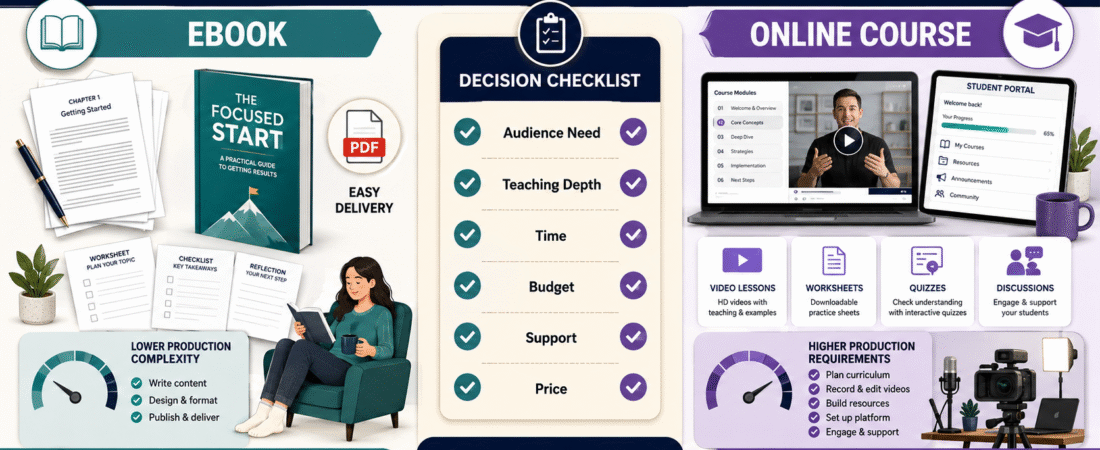
For many beginners, an ebook is the simpler first digital product.
It usually requires fewer moving parts, can be produced with tools you may already understand, is easier to revise, and does not require you to build a complete student-learning environment.
That does not mean an ebook is always the better product.
An online course may be the stronger choice when the customer needs demonstrations, sequential instruction, exercises, checkpoints, video explanations, or a more guided learning experience.
The best decision is based on the problem you are solving—not on the assumption that a course is automatically more valuable because it can be priced higher.
Key Takeaways
- Start with the customer’s learning problem.
- Ebooks are generally simpler to produce and maintain.
- Courses are useful when instruction requires demonstration or guided application.
- The amount of content should match the promised result.
- Consider production time, support, technology, and updates.
- An ebook can later become the foundation for a course.
- A course should provide more than a narrated version of an ebook.
What Does an Ebook Do Best?
An ebook works well when information can be learned primarily through reading.
Examples include:
- Step-by-step guides.
- Checklists with explanations.
- Reference manuals.
- Planning systems.
- Frameworks.
- Business setup instructions.
- Resource guides.
- Decision-making guides.
- How-to books.
- Educational reports.
A reader can move at an individual pace.
They can:
- Highlight.
- Revisit sections.
- Search the document.
- Print worksheets.
- Keep the book as a reference.
An ebook is especially useful when the goal is knowledge transfer rather than supervised skill development.
What Does a Course Do Best?
A course is often stronger when the learner needs:
- Demonstrations.
- Screenshare tutorials.
- Guided exercises.
- Assessments.
- Module progression.
- Video explanation.
- Audio instruction.
- Student downloads.
- Completion tracking.
- Repeated practice.
For example, explaining the concept of building an email welcome series can work well in an ebook.
Showing someone exactly how to create automation inside a particular email platform may benefit from video demonstration.
The course format should solve an instructional problem.
Compare the Production Requirements
An ebook might require:
- Audience research.
- Outline.
- Writing.
- Editing.
- Fact-checking.
- Formatting.
- Cover.
- PDF or ebook export.
- Delivery.
- Sales page.
A course may require all of those planning tasks plus:
- Module architecture.
- Lesson objectives.
- Scripts.
- Video recording or generation.
- Audio.
- Screen recordings.
- Worksheets.
- Quizzes.
- Student portal.
- Lesson uploads.
- Navigation.
- Progress testing.
- Access management.
- Student support.
This is one reason an ebook can be easier for a first product.
Compare Revision Difficulty
Suppose you discover that one section contains outdated information.
In an ebook you may:
- Correct the text.
- Export the new file.
- Replace the old version.
For a course, the change may require:
- Rewrite the lesson.
- Record or regenerate video.
- Edit video.
- Replace downloads.
- Update quiz questions.
- Re-upload files.
- Check student navigation.
A course can remain manageable, but it contains more components.
Compare Development Time
Do not choose a product format based on how quickly someone online claims it can be created.
Ask:
- How much original knowledge must be organized?
- How much research is required?
- Does the product need demonstrations?
- How many supporting resources are needed?
- How much editing is necessary?
- What quality level will customers expect?
A focused ebook may be finished considerably sooner than a multi-module course.
A small course may also be completed faster than a comprehensive ebook if the subject is best taught through short demonstrations.
There is no universal production time.
Compare Technology Requirements
An ebook can often be created with:
- Word processor.
- PDF export.
- Cover-design tool.
- Checkout.
- File-delivery system.
A course generally adds:
- Course platform.
- Video hosting or embedded video.
- Student logins.
- Lesson organization.
- Potential quizzes.
- Progress tracking.
- Support system.
ProductDyno currently supports courses, digital downloads, memberships, articles, audio, video, downloadable files, public access, free registered access, and paid access within its product-delivery system.
A platform can simplify delivery, but you still need to create and organize the learning experience.
Compare Customer Support
An ebook customer may ask:
- Where is my download?
- How do I open the PDF?
- Can I download it again?
A course student may ask:
- How do I log in?
- Where is Lesson 4?
- Why does the video not play?
- How do I reset my password?
- Where is the worksheet?
- Why did my progress reset?
- How do I submit the quiz?
- When does the next module unlock?
The more interactive the product, the more support questions may arise.
If your goal is a low-maintenance digital business, this matters.
Consider the Customer’s Preferred Learning Style
Some people prefer:
- Reading.
- Watching.
- Listening.
- Practicing.
- A combination.
You do not have to satisfy every preference inside the first product.
Consider what is necessary to solve the problem well.
A financial planning checklist may work better as a printable workbook.
A software setup process may work better as a video tutorial.
A strategic business concept may work well as an ebook with examples.
Compare Price Without Letting Price Make the Decision
Courses are often sold at higher prices than ebooks, but a higher possible price does not automatically create a better business.
A course may also have:
- Higher production costs.
- More support requirements.
- Higher buyer expectations.
- More refund concerns.
- More technology.
An ebook can be:
- Lower priced.
- Easier to purchase.
- Easier to deliver.
- Easier to use as an entry product.
The correct price depends on:
- Problem.
- Outcome.
- Audience.
- Depth.
- Original value.
- Format.
- Market.
- Support.
- Positioning.
Do not create a large course solely because you want to charge more.
Ask Whether Demonstration Is Necessary
One of the easiest decision questions is:
Does the buyer need to watch the process?
If no, an ebook may be sufficient.
If yes, consider a course.
Examples:
Ebook-friendly
- How to choose an ebook subject.
- How to evaluate digital-product ideas.
- Beginner affiliate-marketing terminology.
- Retirement online-business planning.
- Content quality-control checklist.
Course-friendly
- How to configure a WordPress website.
- How to build an automation workflow.
- How to edit videos.
- How to use a complex software platform.
- How to create a sales funnel inside a particular tool.
Ask Whether Practice Is Necessary
Does the learner simply need information?
Or must the learner develop a skill?
If practice is essential, a course may provide:
- Assignments.
- Exercises.
- Quizzes.
- Checkpoints.
- Demonstrations.
- Feedback.
For a knowledge-based subject, an ebook may be enough.
Start With an Ebook When You Are Still Learning the Market
An ebook can act as a lower-complexity test.
You can learn:
- Which questions buyers ask.
- Which chapters they value.
- Which steps cause confusion.
- Which examples help.
- Whether the problem is large enough for a course.
- What additional resources customers request.
This feedback can later shape the course.
Instead of guessing what ten modules should contain, you begin with real buyer questions.
Create the Ebook With Future Expansion in Mind
If a course may follow later, organize the ebook carefully.
Each major section can contain:
- Core concept.
- Example.
- Action step.
- Common mistake.
- Checklist.
Later, a chapter can become:
- Course module.
- Video lesson.
- Worksheet.
- Quiz.
- Demonstration.
- Bonus resource.
The ebook becomes the intellectual foundation.
Use AI to Develop the First Product
Affiliate Disclosure: This article contains affiliate links. If you purchase through one of these links, I may earn a commission at no additional cost to you. Affiliate compensation does not determine the conclusions or recommendations presented in this article.
For ebook and digital-product development, you can review the current AI Product Engine offer.
For structured course development—including outlines, lessons, worksheets, quizzes, and educational materials—you can review the current CourseMate AI offer.
Use these types of tools to support your planning rather than allowing software to decide what your audience needs.
A Simple Decision Scorecard
Give each statement one point when it applies.
Ebook
- The subject can be taught mainly through text.
- The reader needs a reference resource.
- I want a lower-complexity first product.
- The product requires limited customer support.
- The information will need regular updates.
- I want to validate the subject before creating video.
- I am comfortable writing.
Course
- The subject requires demonstration.
- Students need a sequence of lessons.
- Exercises are important.
- Video makes the subject easier to understand.
- Assessments would improve learning.
- The customer needs more guidance.
- I can maintain the course platform and student experience.
A higher score does not automatically decide the product, but it makes the tradeoffs visible.
A Hypothetical Example
Imagine a retired teacher who wants to help new substitute teachers prepare for their first assignments.
The creator could begin with:
The New Substitute Teacher Survival Guide
The ebook could explain:
- What to prepare.
- Classroom routines.
- Student behavior.
- Emergency procedures.
- Teacher notes.
- End-of-day checklist.
After selling the ebook, the creator learns that readers repeatedly ask:
- How should I introduce myself?
- What do I do when students ignore instructions?
- How do I organize the first ten minutes?
- What does a good end-of-day report look like?
Those questions could support a course containing:
- Demonstration videos.
- Sample scenarios.
- Printable scripts.
- Practice exercises.
The ebook helped validate and shape the course.
When a Course Should Come First
A course may be the better first product when:
- You already teach the process.
- The curriculum already exists.
- The audience clearly wants video instruction.
- Demonstration is essential.
- You have an existing student audience.
- You already have the technology.
- The subject requires guided practice.
- The buyer expects a structured learning experience.
Do not force an ebook to teach something that genuinely needs demonstration.
Consider a Hybrid Product
You do not have to choose between a massive ebook and a massive course.
A practical hybrid could include:
- 50-page guide.
- Five short videos.
- Workbook.
- Checklist.
- Resource page.
This can provide demonstration without creating a 40-video course.
The hybrid approach can be especially useful for a solo creator.
Deliver the Product Properly
If you eventually sell both ebooks and courses, a delivery platform can help organize customer access.
ProductDyno currently supports digital downloads and online courses as separate product types and can provide paid, free registered, or public access depending on the setup.
You can review ProductDyno’s current digital-product delivery options when you are ready to compare delivery systems.
Test the entire customer experience before selling either format.
Common Mistakes
Assuming courses are always more valuable
The format must fit the problem.
Creating too much content
More lessons do not automatically create a better result.
Choosing based only on price
Consider production and support requirements.
Building the platform before the product
Define the curriculum first.
Recording videos before outlining the course
This can create unfocused lessons.
Creating an ebook that is too broad
Solve one defined problem.
Turning the ebook directly into narrated video
A course should provide instructional value beyond reading the text aloud.
Conclusion
For many beginners, an ebook is the more manageable first digital product because it is easier to create, revise, deliver, and maintain.
An online course becomes the better choice when the subject genuinely benefits from demonstration, guided practice, lessons, exercises, or assessments.
Do not decide by asking which format sounds more impressive.
Ask what the customer needs in order to get the promised result.
If you are still uncertain, create the smallest useful ebook or workbook first, learn what readers need next, and use that evidence to determine whether a complete course should follow.