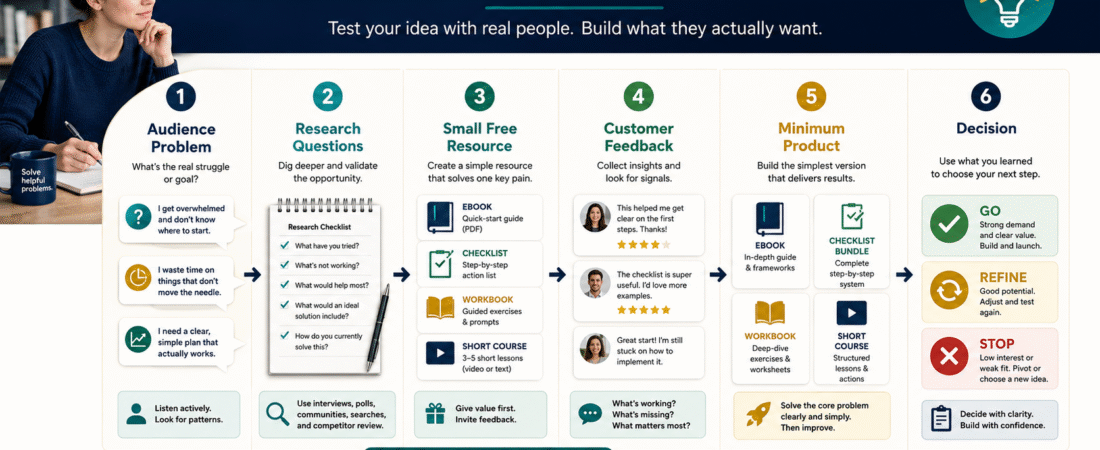
A digital-product idea should be tested before you spend weeks creating the complete ebook, workbook, course, or membership.
Validation does not prove that a product will sell.
It helps you collect evidence that:
- A specific audience has the problem.
- People understand the proposed result.
- The solution is important enough to deserve attention.
- The format fits how people want to learn.
- The product can be created and delivered realistically.
A simple validation process begins with conversations, questions, small content tests, and a minimum version of the solution.
The goal is to learn before making a large commitment.
Key Takeaways
- Validate a specific problem rather than a broad topic.
- Look for repeated questions and actions, not only polite compliments.
- Test the idea with useful free or low-cost content.
- Create the smallest complete version of the solution.
- Decide in advance what evidence would justify continuing.
Affiliate Disclosure: This article contains affiliate links. If you purchase through one of these links, I may earn a commission at no additional cost to you. Affiliate compensation does not determine the conclusions or recommendations presented in this article.
What Digital-Product Validation Means
Validation is the process of collecting evidence that an audience problem and proposed solution deserve further development.
It may include:
- Customer questions
- Email replies
- Survey responses
- Search behavior
- Content engagement
- Lead-magnet downloads
- Workshop attendance
- Preorders
- Small paid tests
- Customer interviews
No single signal proves demand.
A person may download a free checklist but never purchase a $197 course.
Use several forms of evidence.
Step 1: Define the Audience
Avoid beginning with:
My product is for anyone who wants to make money online.
Choose a group whose problem you understand.
Examples include:
- Retirees exploring simple online-business ideas
- First-time ebook creators
- Bloggers building an email list
- Course creators organizing existing content
- Affiliate marketers learning how to write balanced reviews
A specific audience makes research and communication easier.
Step 2: Define One Problem
Complete this statement:
[AUDIENCE] struggles with [PROBLEM] because [REASON].
Example:
First-time ebook creators struggle to finish their manuscript because they begin writing without a clear reader problem or chapter plan.
This statement is more useful than:
People need help writing ebooks.
The smaller problem can be tested.
Step 3: Identify the Desired Result
Write:
The product helps [AUDIENCE] move from [CURRENT SITUATION] to [PRACTICAL RESULT].
Example:
The workbook helps first-time ebook creators move from disconnected notes to a complete chapter-by-chapter outline.
Keep the result realistic.
Do not promise:
- Guaranteed publication
- Bestseller status
- Guaranteed revenue
- Completion without effort
- A finished book created automatically
Step 4: Collect Existing Questions
Review places where your audience communicates.
Possible sources include:
- Email replies
- Website forms
- Support messages
- Social-media comments
- Video comments
- Online communities
- Questions from friends
- Search terms
- Product reviews
- Course discussions
Record the exact wording.
Repeated questions provide stronger evidence than one isolated comment.
Step 5: Separate Interest From Action
A person may say:
That sounds like a great product.
That is encouraging, but it requires little commitment.
Stronger signals include:
- Requesting more information
- Joining a waiting list
- Downloading a related resource
- Completing a worksheet
- Attending a workshop
- Replying with detailed questions
- Paying for a small version
- Preordering with clear terms
Do not pressure people into purchasing merely to prove the idea.
Use honest invitations and clear expectations.
Step 6: Publish Educational Content
Create several articles, emails, or videos addressing the problem.
For an ebook-outline product, publish content such as:
- How to choose an ebook reader
- How to narrow an ebook topic
- How to organize reader questions
- How to create a chapter sequence
- Common outlining mistakes
Review which questions generate:
- Email replies
- Downloads
- Comments
- Follow-up questions
- Return visits
- Requests for additional help
Engagement does not guarantee sales, but it helps identify which parts of the problem matter.
Step 7: Create a Small Lead Magnet
A lead magnet can test whether people want help with the problem.
Possible formats include:
- Checklist
- Worksheet
- Template
- Short guide
- Decision chart
- Email lesson
For example:
The One-Page Ebook Topic Validation Worksheet
Track:
- Signup-page visits
- Completed signups
- Resource downloads
- Email replies
- Questions
- Unsubscribes
- Use of the resource
LeadMagnet IQ Commercial may be relevant to users creating lead-generation pages, subscriber resources, and related campaign assets.
You can review the current LeadMagnet IQ Commercial offer.
A software platform can help build the delivery system, but the audience problem should determine the lead magnet.
Step 8: Ask Focused Questions
Avoid asking:
Would you buy this?
People may try to be polite.
Ask:
- What is the hardest part of this process?
- What have you already tried?
- What prevented it from working?
- Which step takes the most time?
- What would make the process easier?
- Do you prefer a guide, worksheet, video, or course?
- What information would you need before purchasing?
Listen for repeated patterns.
Step 9: Create the Minimum Useful Product
A minimum useful product is the smallest complete version that solves the defined problem.
It is not an incomplete product.
For example, instead of creating a 20-module course about publishing an ebook, create:
The Five-Step Ebook Outline Workshop and Workbook
It may include:
- One short training
- One workbook
- One completed example
- One review checklist
- One support method
The customer should receive the promised result.
Step 10: Decide What Evidence You Need
Set criteria before testing.
Example:
Continue developing the product when:
- At least 50 relevant people visit the signup page.
- Ten or more join the waiting list.
- Several people complete the worksheet.
- At least three people provide detailed feedback.
- Two or more people purchase the small version.
These numbers are planning examples rather than universal standards.
A small specialized audience may produce fewer responses with stronger interest.
A Practical Retiree Example
Imagine a retired teacher wants to create a course about turning professional experience into a digital guide.
Instead of recording 25 lessons immediately, the teacher:
- Publishes three articles about organizing experience.
- Creates a one-page guide-idea worksheet.
- Invites subscribers to download it.
- Asks what prevents them from creating a guide.
- Holds one small paid workshop.
- Reviews questions and completed worksheets.
- Creates a five-lesson course based on repeated needs.
The validation process may reveal that customers want a workbook rather than a large course.
That information saves creation time.
Step 11: Test the Price Carefully
Price testing should reflect the product’s:
- Scope
- Format
- Support
- Audience
- Result
- Competition
- Delivery cost
- Ongoing management
Do not ask AI to select a price without context.
Compare:
- A low-cost self-study guide
- A workbook and video package
- A short course
- A course with personal support
- A membership with recurring content
The correct price depends partly on what you are willing to deliver.
Step 12: Review the Delivery Requirements
A product idea may appear attractive until the management responsibilities are clear.
Ask:
- Does it require video hosting?
- Will customers need accounts?
- Is ongoing support included?
- Will updates be necessary?
- Is a community required?
- Are live calls included?
- Can customers download the product?
- Does the platform require a recurring fee?
ProductDyno may be relevant for delivering digital downloads, courses, memberships, and protected customer content.
You can review ProductDyno’s current digital-product delivery options.
Choose delivery after confirming the product format.
Warning Signs That the Idea Needs Revision
Reconsider the product when:
- The audience cannot be described clearly.
- The problem is too broad.
- People show interest but take no action.
- The product requires more support than you want to provide.
- The format does not match customer preferences.
- A free article already solves the complete problem.
- The result depends on unsupported promises.
- Creation costs exceed the realistic opportunity.
Revision is not failure.
It is one of the main purposes of validation.
Common Product-Validation Mistakes
Asking Friends Only
Friends may not represent the intended customer.
Treating Downloads as Purchases
Free and paid behavior differ.
Building the Product Before Research
Validation should occur before the largest commitment.
Changing the Idea After Every Comment
Look for patterns, not isolated opinions.
Using Fake Scarcity
Be honest about tests, preorders, and deadlines.
Taking Payment Without Clear Terms
Explain what buyers receive and when.
A Simple Validation Worksheet
Audience:
[Audience]
Problem:
[Problem]
Desired Result:
[Result]
Current Alternatives:
[What people currently use]
Questions Collected:
[Questions]
Content Test:
[Article, email, or video]
Lead-Magnet Test:
[Resource]
Minimum Product:
[Small version]
Evidence Required:
[Evidence]
Creation Cost:
[Cost]
Management Requirements:
[Requirements]
Decision Date:
[Date]
Final Decision:
[Create, revise, delay, or reject]
Conclusion
Digital-product validation helps you learn whether an audience problem, promised result, format, and delivery system deserve further investment.
Collect real questions, publish useful content, test a small resource, create the minimum complete solution, and define the evidence you need before expanding.
Choose one product idea and write the specific audience problem it solves before creating the outline.