Affiliate marketing works best when the content helps the reader make a decision or solve a problem before asking the reader to consider a product.
A beginner does not need to publish dozens of product promotions every week.
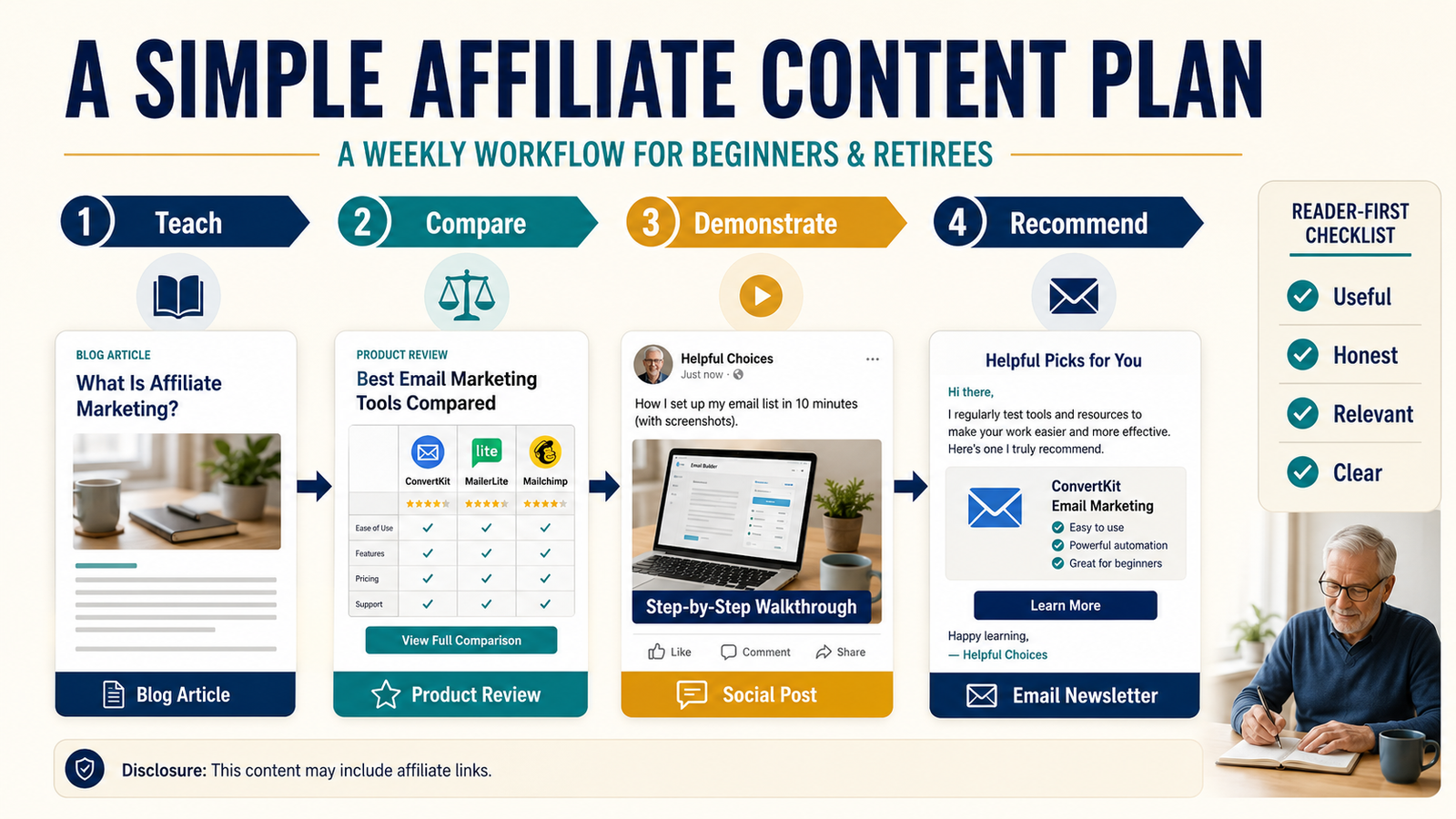
A manageable affiliate content plan can use four types of articles:
- Educational content
- Comparison content
- Demonstration or tutorial content
- Product reviews and recommendations
This approach provides useful information while creating natural opportunities to mention relevant tools.
It also helps prevent a website from becoming a collection of sales pages.
Key Takeaways
- Begin with the reader’s question rather than the commission.
- Use several types of content instead of publishing only reviews.
- Recommend products only when they fit the article.
- Place a clear affiliate disclosure before the first affiliate link.
- Follow a publishing schedule you can maintain consistently.
Affiliate Disclosure: This article contains affiliate links. If you purchase through one of these links, I may earn a commission at no additional cost to you. Affiliate compensation does not determine the conclusions or recommendations presented in this article.
What Affiliate Marketing Content Should Accomplish
Affiliate content should help readers understand:
- What problem they are trying to solve
- Which type of solution may help
- What criteria matter
- What a product does
- Who may benefit from it
- Who may not need it
- What limitations should be considered
- What action to take next
The affiliate link is part of the content, but it should not be the entire purpose.
A trustworthy article should remain useful even when the reader does not purchase anything.
Why Beginners Often Become Overwhelmed
New affiliate marketers may believe they need:
- Several websites
- Daily product reviews
- Paid advertising
- Complicated funnels
- Large email lists
- Multiple social platforms
- Advanced automation
- Dozens of affiliate programs
This can create too many responsibilities before the first basic system is working.
A simpler approach is to select:
- One audience
- One subject area
- A small group of relevant products
- One main website
- One email list
- One repeatable publishing schedule
The system can be expanded later when the existing work produces useful information and consistent activity.
Step 1: Choose One Audience Problem
Do not begin with a product catalog.
Begin with a recurring audience problem.
Examples include:
- Beginners do not know which email service to choose.
- Ebook creators need help organizing their ideas.
- Retirees want simple online-business options.
- Content creators need affordable design tools.
- Course creators need a way to deliver lessons.
- Affiliate marketers need a manageable publishing routine.
One problem can support several related articles.
For example, “beginners need help building an email list” could support:
- How to choose an email service
- How to create a lead magnet
- How to write a welcome sequence
- GetResponse versus AWeber
- Common email-list mistakes
- How to create a signup page
Products can be recommended naturally within those articles.
Step 2: Select a Small Product Group
Choose three to five products that solve problems within your main subject.
Evaluate each product based on:
- Purpose
- Audience
- Cost
- Learning curve
- Important features
- Limitations
- Support
- Licensing
- Relevance to your content
Do not join an affiliate program solely because the commission appears attractive.
A product should fit the audience and the website.
For example, a beginner online-business website might focus on:
- An email-marketing service
- A digital-product creation tool
- A product-delivery platform
- A design tool
- A course-creation tool
This group can support a complete beginner workflow.
Step 3: Use Four Types of Affiliate Content
Educational Articles
Educational content teaches a strategy or process.
Examples:
- How to create a first lead magnet
- How to organize an ebook
- How to start an email list
- How to review AI-generated content
- How to choose a digital-product format
A product appears only where it supports a step.
Comparison Articles
Comparison articles help readers choose between alternatives.
Examples:
- GetResponse versus AWeber
- Ebook versus mini course
- Checklist versus workbook
- Free plan versus paid plan
- Recording your own voice versus using AI narration
Use the same decision criteria for each option.
Tutorials and Demonstrations
Tutorials show how a process works.
Examples:
- How to set up a welcome sequence
- How to create a product cover
- How to upload a digital download
- How to build a simple course outline
Do not claim firsthand use unless the experience is true and approved.
Reviews and Buying Guides
Reviews evaluate one product.
A balanced review should explain:
- What the product does
- Who it is for
- Who may not need it
- Advantages
- Limitations
- Pricing considerations
- Support and training
- Licensing
- Final verdict
Do not automatically recommend every product.
Step 4: Create a Four-Week Publishing Plan
A beginner could publish two articles per week.
Week 1
Educational article:
How to choose a first digital-product idea
Supporting article:
Checklist, ebook, or mini course: which format fits?
Week 2
Tutorial:
How to outline a beginner digital product
Review:
Review a relevant creation tool
Week 3
Educational article:
How to deliver a digital product
Comparison:
Simple download delivery versus a membership platform
Week 4
Implementation article:
How to connect a product, email list, and delivery system
Buying guide:
Which beginner tools are necessary and which can wait?
This schedule creates a useful series instead of unrelated promotions.
Step 5: Use Natural Affiliate Placement
Do not place an affiliate link in the opening paragraph.
First explain the problem and the solution.
Then introduce the product with enough context.
A useful recommendation should explain:
- What the product does
- Why it relates to the article
- Who may benefit
- What limitation should be considered
- Where to review the current information
For beginners who want structured guidance about setting up an affiliate business, the Master Affiliate Profits System may be relevant.
Before purchasing any training program, review the current curriculum, support, price, refund terms, and required tools. Training can provide structure, but it does not guarantee traffic, commissions, or income.
Step 6: Use Clear Disclosures
The Federal Trade Commission states that material connections between an advertiser and an endorser should be clearly disclosed. Its guidance emphasizes that disclosures should be understandable and placed where people are likely to notice them.
For a blog article, place the disclosure before the first affiliate link.
Do not rely only on:
- A disclosure page
- The website footer
- A vague statement
- The word “affiliate” without explanation
- A notice placed after all recommendations
A clear disclosure protects reader trust by explaining the financial relationship.
Step 7: Build an Email Follow-Up System
A blog visitor may not be ready to purchase during the first visit.
An email list allows you to provide:
- Additional instruction
- New articles
- Answers to common questions
- Product comparisons
- Updated recommendations
- New resources
A beginner email system might include:
- Lead-magnet delivery
- Welcome message
- Educational email
- Helpful article
- Product comparison
- Relevant recommendation
GetResponse can support email communication, landing pages, and automated follow-up. You can explore GetResponse’s current email-marketing features.
Choose the plan based on the system you need now. Avoid paying for advanced automation until you are prepared to use it.
A Practical Retiree Example
Imagine a retired teacher who wants to help beginners create simple digital products.
The teacher chooses one audience problem:
Beginners have useful knowledge but do not know how to turn it into a small product.
The monthly content plan includes:
- How to identify a teachable topic
- How to choose a checklist, ebook, or course
- How to create a product outline
- How to review AI-generated content
- A product-creation tool review
- A product-delivery platform review
- A beginner email-list guide
- A simple product-launch checklist
Relevant tools are introduced only when the article reaches the part of the workflow they support.
The website becomes an educational resource instead of a catalog of affiliate links.
Step 8: Track Content Performance Simply
You do not need a complicated dashboard.
Record:
- Article title
- Publication date
- Primary topic
- Affiliate product
- Page visits
- Link clicks
- Email signups
- Reader questions
- Updates needed
Do not judge an article only by immediate commissions.
A useful article may:
- Attract email subscribers
- Answer customer questions
- Support another review
- Supply video topics
- Build trust
- Continue receiving visitors over time
Common Affiliate Content Mistakes
Promoting Too Many Products
Too many recommendations make it difficult for readers to decide.
Choose the most relevant option.
Writing Only Reviews
Educational and tutorial content helps readers before they reach the buying stage.
Hiding Limitations
A review that treats every feature as perfect feels promotional.
Explain who may not need the product.
Copying the Vendor’s Sales Page
Readers can visit the vendor for promotional claims.
Your article should provide evaluation, context, and decision criteria.
Using Fake Urgency
Do not claim that an offer ends soon unless the deadline can be verified.
Promising Income
Affiliate marketing depends on many factors, including audience, traffic, trust, offer quality, and consistent work.
No article or product can guarantee commissions.
A Simple Weekly Workflow
Monday
Choose one audience question.
Tuesday
Research the subject and create an outline.
Wednesday
Write the article.
Thursday
Verify facts, links, and product information.
Friday
Publish the article and send an email.
Saturday
Create one social post or short video.
Sunday
Record reader responses and plan the next question.
Adjust the workflow to fit your available time.
Conclusion
A beginner affiliate marketing content plan should focus on teaching, comparing, demonstrating, and recommending.
Choose one audience problem, work with a small group of relevant products, publish useful content consistently, disclose affiliate relationships clearly, and avoid exaggerated promises.
Select one audience problem and outline four related articles before choosing the first product to recommend.