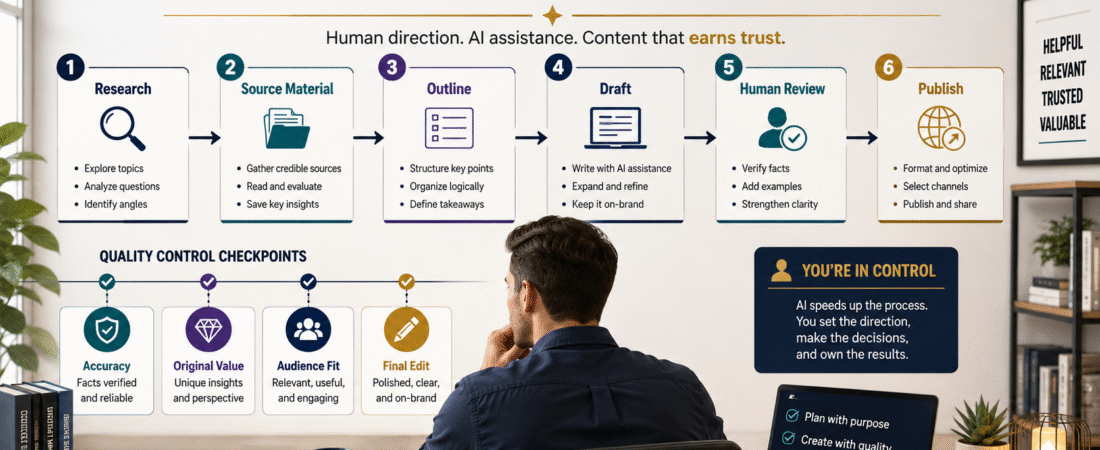
AI can help a solo online-business owner create content more efficiently, but a poor workflow can also produce repetitive articles, unsupported claims, and material that sounds like it was created from the same template hundreds of times.
The solution is not to stop using AI.
It is to separate the work into stages.
A practical AI content workflow looks like this:
Research → source material → planning → AI-assisted draft → human review → fact-checking → editing → publication → measurement.
Google’s current guidance does not prohibit AI-assisted content merely because AI was involved. Its focus remains on whether content is helpful, reliable, original, people-first, and created to benefit readers rather than primarily to manipulate search rankings.
Key Takeaways
- Do not begin with “write me an article.”
- Research the reader’s question first.
- Give AI meaningful source material.
- Create a content brief before drafting.
- Use AI for controlled tasks.
- Review every factual claim.
- Add original examples and judgment.
- Remove repetitive AI language.
- Measure whether the finished content helps readers.
Stage 1: Define the Reader
Before using AI, answer:
- Who is this content for?
- What does the person already know?
- What are they trying to accomplish?
- What is confusing them?
- What would count as a useful result?
For example:
“Beginner affiliate marketer who understands what affiliate marketing is but does not know how to choose products to promote.”
That audience requires a different article from:
“Experienced affiliate manager comparing attribution software.”
AI cannot reliably choose the correct audience if you have not defined it.
Stage 2: Identify the Search Question
Write the question the reader is asking.
Examples:
- How do I create a lead magnet?
- Should I create an ebook or course?
- Why is my blog getting impressions but few clicks?
- Which email platform should I choose?
- How do I deliver a digital product?
Then write the central answer in one paragraph.
If you cannot explain the central answer before drafting, more research may be necessary.
Stage 3: Gather Source Material
Collect:
- Your own notes.
- Existing articles.
- Product documentation.
- Search Console queries.
- Audience questions.
- Official sources.
- Checklists.
- Examples.
- Research.
The source material should guide the AI.
Without it, the system may produce generic information based on broad patterns.
Google’s people-first guidance encourages original information, analysis, substantial treatment of a subject, clear sourcing, and material that provides value beyond merely summarizing other pages.
Stage 4: Build a Content Brief
A content brief might contain:
Primary Question:
How do I create an AI content workflow?
Audience:
Solo online-business beginner.
Problem:
AI drafts are generic and repetitive.
Central Answer:
Separate research, source material, drafting, verification, and editing.
Required Sections:
Workflow, example, checklist, mistakes, conclusion.
Original Value:
A practical human-review process.
Constraints:
No ranking guarantees. No invented statistics. No fake personal experience.
This brief becomes the instruction set.
Stage 5: Create the Outline
Ask AI to organize the brief.
Do not automatically accept the outline.
Check:
- Does each section answer part of the question?
- Is any section redundant?
- Does the reader need this information?
- Is an important decision missing?
- Is the article trying to cover too much?
Remove sections that exist only because they commonly appear in generic articles.
Stage 6: Draft in Sections
For important long-form content, write one major section at a time.
This allows you to:
- Control depth.
- Insert original examples.
- Prevent repetition.
- Verify claims.
- Maintain the correct audience.
After each section, compare it with the brief.
Do not wait until 3,000 words have been generated before noticing that the article moved in the wrong direction.
Stage 7: Add Original Value
AI-assisted content becomes more useful when you contribute material the AI did not invent.
This can include:
- Your decision criteria.
- Your workflow.
- An original checklist.
- A hypothetical scenario.
- A practical warning.
- A comparison framework.
- An observation based on your expertise.
- A downloadable worksheet.
Google’s current Search guidance continues to encourage content that provides original information or analysis and substantial value compared with material already available.
Stage 8: Separate Fact-Checking From Writing
Create a factual-review pass.
Highlight:
- Product prices.
- Features.
- Plans.
- Laws.
- Policies.
- Statistics.
- Dates.
- Company information.
- Technical instructions.
- Search-engine claims.
Verify these through authoritative sources.
Do not ask:
“Does this article look accurate?”
Instead ask:
“List every statement in this draft that should be independently verified.”
Then verify them.
Stage 9: Review for AI Repetition
Look for repeated patterns.
Repeated openings
“In today’s digital world…”
Repeated transitions
“It is important to note…”
Repeated conclusions
“By following these steps…”
Repeated adjectives
Powerful. Revolutionary. Game-changing.
Repeated structure
Every section has exactly three paragraphs followed by five bullets.
Variation improves readability.
Stage 10: Read the Draft Out Loud
Reading aloud reveals:
- Awkward wording.
- Sentences that are too long.
- Repeated phrases.
- Unnatural transitions.
- Overly formal language.
If a sentence does not sound like something a knowledgeable person would naturally explain, rewrite it.
Stage 11: Check the Reader’s Next Action
The article should help the reader do something.
Possible actions include:
- Complete a checklist.
- Compare two tools.
- Create a worksheet.
- Review an old article.
- Test a form.
- Write an email.
- Choose a product idea.
An article can be informative without turning into a long list of action steps, but the reader should understand what to do next.
Stage 12: Conduct a People-First Review
Google recommends asking whether content serves an existing or intended audience, demonstrates useful knowledge, satisfies the reader, and helps the person achieve their goal.
Ask:
- Would I publish this if Google did not exist?
- Does it genuinely help my audience?
- Does it contain original value?
- Is the article complete?
- Are the claims accurate?
- Does the title accurately describe the content?
If the answer is no, revise it.
Use AI for Specific Jobs
AI can help with:
- Topic organization.
- Outline creation.
- Drafting.
- Simplifying explanations.
- Generating alternative headings.
- Identifying repetition.
- Creating checklist drafts.
- Creating questions.
- Summarizing your own source material.
- Quality-control analysis.
The workflow becomes stronger when AI has a defined job.
Use Specialized Software Only When It Simplifies the System
Affiliate Disclosure: This article contains affiliate links. If you purchase through one of these links, I may earn a commission at no additional cost to you. Affiliate compensation does not determine the conclusions or recommendations presented in this article.
If a significant portion of your content supports ebooks, checklists, guides, and digital products, you can review the current AI Product Engine offer.
The product’s current official sales page describes AI-assisted ebook creation, sales pages, thank-you pages, ebook covers, hosting, and product launching within one cloud-based environment. Those are vendor-described capabilities and should be evaluated against your actual workflow before purchase.
A specialized system is useful only if it removes unnecessary steps.
Create a Content Production Board
Use five columns:
Ideas
Unapproved topics.
Research
Topics currently being investigated.
Draft
Articles being written.
Review
Fact-checking and editing.
Published
Completed content.
Do not allow fifty ideas to move into Draft simultaneously.
Finish content.
Create Reusable Quality-Control Checklists
Every article can pass through:
Research Check
- Search question identified.
- Sources gathered.
- Audience defined.
Draft Check
- Direct answer included.
- Required sections present.
- Original example added.
Accuracy Check
- Product claims verified.
- Statistics sourced.
- Links tested.
Human Review
- Repetition removed.
- Tone natural.
- Unnecessary filler removed.
- Conclusion useful.
Publication Check
- Title correct.
- Image added.
- Formatting clean.
- Links functioning.
This makes the workflow repeatable.
A Weekly AI Content Workflow
Monday: Research
Select topics and gather sources.
Tuesday: Planning
Build briefs and outlines.
Wednesday: Drafting
Create controlled drafts.
Thursday: Verification
Fact-check and add original examples.
Friday: Editing
Humanize, simplify, proofread, and format.
Saturday: Publication
Publish and distribute.
Sunday: Review
Check performance and reader questions.
You can adjust the schedule.
The important idea is separating tasks.
Common Mistakes
Generating before researching
AI fills gaps with general information.
Using one prompt for the entire production process
Complex work benefits from stages.
Publishing without verification
AI-generated confidence is not evidence.
Creating too much content
More posts do not automatically create more value.
Reusing identical article structures
Readers notice repetition.
Automating the final decision
A human should decide what is published.
Ignoring reader feedback
Comments and questions should improve future content.
Conclusion
An effective AI content workflow does not remove the human creator.
It gives the creator better control.
Research the audience and question first. Gather reliable source material. Build a brief. Use AI to assist with planning and drafting. Then verify facts, add original judgment, remove repetition, and complete a human editorial review before publishing.
AI can increase production capacity, but quality still depends on the process surrounding it.
Take one article you plan to create next and build the research brief before asking AI to write the first paragraph.