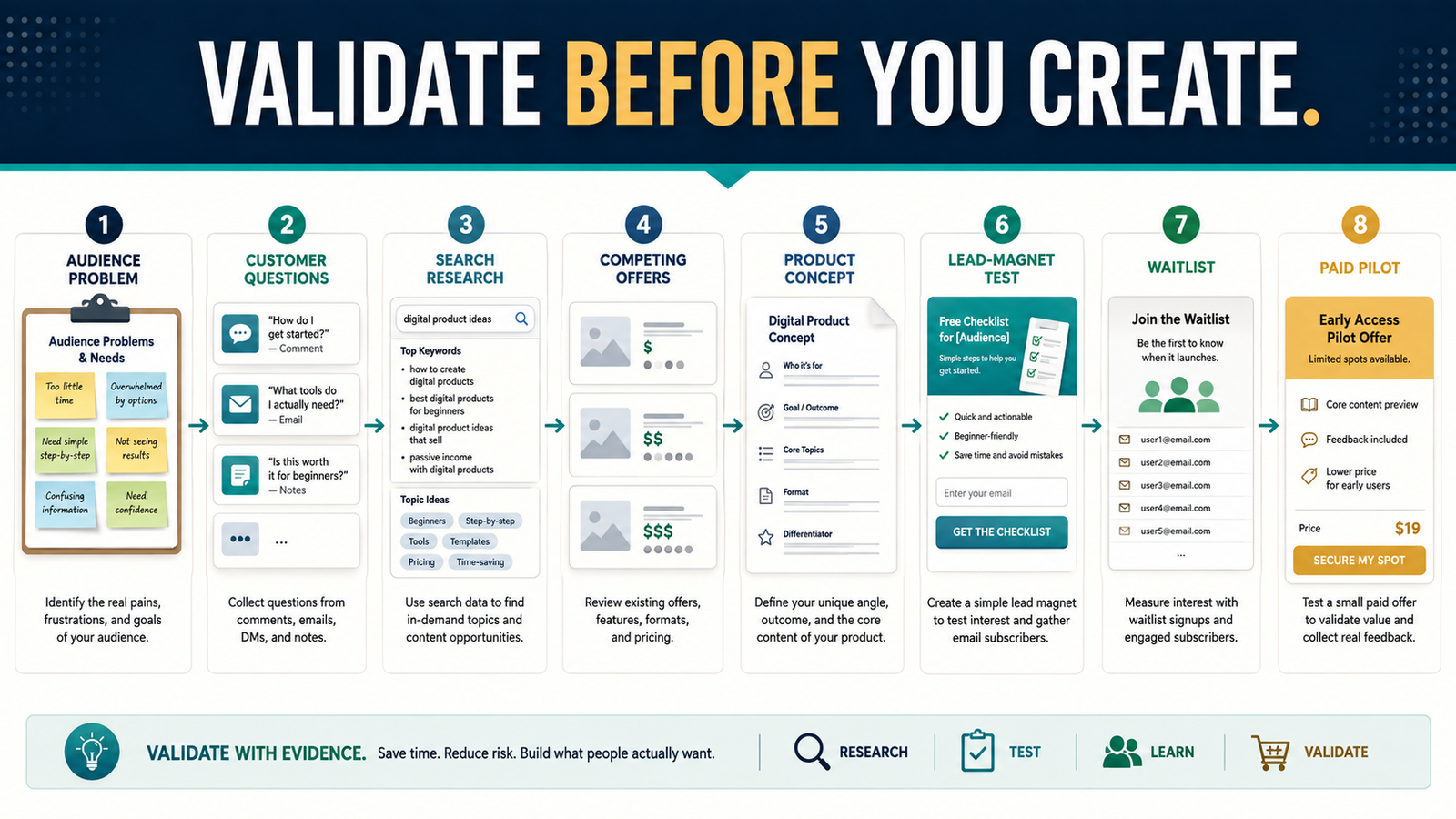
A digital-product idea should be tested before you spend weeks writing an ebook, recording a course, designing a membership, or building a large collection of templates.
Validation does not prove that a product will succeed. It provides evidence that a specific audience recognizes the problem, cares enough to seek help, understands your proposed solution, and may be willing to take a meaningful next step.
The most useful validation process begins with the problem rather than the product format. Talk with potential buyers, examine the questions they ask, review existing alternatives, present a clear product concept, and test whether people respond through signups, replies, pilot participation, or purchases.
Recent product-validation guidance continues to emphasize understanding audience problems, testing concepts with quick feedback, and using small versions or early commitments before building a complete product.
Key Takeaways
- Validate the problem before validating your solution.
- Define one intended buyer and one desired result.
- Use customer language rather than invented marketing phrases.
- Review competing products for gaps, not for material to copy.
- Test a concept with a landing page, lead magnet, waitlist, or pilot.
- Treat compliments as weaker evidence than action.
- Build the smallest useful version before investing in a large product.
Begin With the Problem
Many creators become excited about a product format:
- A 100-page ebook.
- A twelve-module course.
- A membership.
- A prompt pack.
- A large template bundle.
- A software application.
The format may be appealing, but it does not prove that an audience needs it.
Begin with this question:
“What specific problem is the person trying to solve?”
A broad statement such as “People want to make money online” is not precise enough.
A clearer problem might be:
“Retired beginners want to create a small online income asset but feel overwhelmed by the number of tools, business models, and promotional methods.”
This problem can lead to several possible products, but you should not choose the format until you understand what type of help the audience values.
Define the Intended Buyer
Write a short description of one likely buyer.
Include:
- Current situation.
- Experience level.
- Main goal.
- Main obstacle.
- Available time.
- Budget concerns.
- Preferred learning method.
- What has already been tried.
- What would make the product feel manageable.
For example:
“The intended buyer is a retiree with useful professional experience who wants to turn that knowledge into a small digital product. The buyer has limited technical confidence, does not want a complicated full-time business, and needs a clear process that can be followed in short work sessions.”
This description helps you evaluate whether the product concept is focused.
State the Product Hypothesis
A product hypothesis is a testable statement.
Use this format:
“I believe [specific audience] will want [specific solution] because it helps them [specific result] without [major obstacle].”
Example:
“I believe retired educators will want a short digital-product planning workbook because it helps them turn professional knowledge into one manageable product idea without requiring complicated software or a large startup budget.”
This is not a fact. It is an assumption that must be tested.
Separate Facts From Assumptions
Create two columns.
Facts
Information you can support through direct evidence.
Examples:
- Several subscribers asked how to choose an ebook topic.
- A related blog post receives search impressions.
- Three people replied to an email describing the same difficulty.
- Existing products receive reviews mentioning confusion about setup.
Assumptions
Ideas that may be reasonable but have not been confirmed.
Examples:
- People will pay $47.
- Buyers prefer video.
- Retirees want a twelve-module course.
- The product can be completed in two weeks.
- The audience wants a community.
- A long ebook will be seen as more valuable.
This exercise prevents enthusiasm from being mistaken for evidence.
Review Questions Your Audience Already Asks
Useful evidence may come from:
- Email replies.
- Comments.
- Support requests.
- Search Console queries.
- Social-media discussions.
- Forums.
- Product reviews.
- Survey responses.
- Conversations.
- Questions asked during webinars.
- Questions from former students or customers.
Look for repeated patterns.
One question may be interesting. The same concern expressed in several different ways is stronger evidence.
Record the audience’s wording. A product title based on real language is often clearer than a phrase invented during brainstorming.
Talk With Potential Buyers
You do not need a formal research department.
Speak with people who resemble the intended buyer and ask open-ended questions:
- What are you trying to accomplish?
- What has made it difficult?
- What have you already tried?
- What happened?
- Which part feels most confusing?
- What would a useful solution help you complete?
- What would make the solution too complicated?
- How do you prefer to learn?
- Which tools do you already use?
- What would prevent you from purchasing?
Avoid asking:
“Would you buy my amazing course?”
People may say yes because they want to be supportive.
Ask about current behavior and past decisions. What people have already attempted can provide better evidence than a polite prediction.
Review Search Behavior
Search behavior can reveal:
- How people describe the problem.
- Whether they want instructions, comparisons, templates, or reviews.
- Which related questions appear.
- Whether the subject is broad or narrow.
- Which stages of the problem receive the most attention.
- Whether searchers appear to be looking for free information or a paid solution.
Do not treat search volume as proof that people will purchase your product.
A popular informational query may produce many readers who do not want a paid offer. A smaller problem connected to an urgent decision may produce stronger product interest.
Study Existing Products
Competition is not automatically a negative sign. It may demonstrate that businesses are already trying to solve the problem.
Review:
- Product format.
- Intended audience.
- Promised result.
- Price range.
- Depth.
- Delivery method.
- Customer reviews.
- Common complaints.
- Missing examples.
- Unanswered questions.
- Unnecessary complexity.
- Required tools.
- Support provided.
Do not copy the product’s content, title, sales page, bonuses, or framework.
Look for an opportunity to serve a narrower audience or solve one part of the problem more clearly.
Create a One-Page Product Concept
Before building the product, summarize it on one page.
Include:
- Working title.
- Intended buyer.
- Main problem.
- Promised result.
- Product format.
- What is included.
- What is not included.
- Estimated completion time.
- Required tools.
- Proposed price range.
- Delivery method.
- Primary limitation.
For example:
Working title: The Retired Educator’s First Digital Product Planner
Buyer: Retired educators with limited online-business experience.
Result: Choose and outline one small educational digital product.
Format: Twenty-page workbook with examples and checklists.
Not included: Website setup, advertising, advanced funnels, or course creation.
The concept should be understandable without a long explanation.
Test the Message Before the Product
Create several versions of the product statement.
Example 1:
“Create your first digital product.”
Example 2:
“Turn your professional experience into one manageable digital-product idea.”
Example 3:
“Use a step-by-step workbook to choose, narrow, and outline your first digital product.”
Show these statements to potential buyers or test them in email subject lines, landing-page headlines, or small content posts.
The goal is not to manipulate people into clicking. It is to discover which description accurately communicates the value.
Create a Related Lead Magnet
Affiliate Disclosure: This article contains affiliate links. If you purchase through one of these links, I may earn a commission at no additional cost to you. Affiliate compensation does not determine the conclusions or recommendations presented in this article.
A small lead magnet can test whether people care about the problem.
For example:
- Product-Idea Readiness Checklist.
- First Ebook Topic Worksheet.
- Course-or-Ebook Decision Guide.
- Digital-Product Validation Scorecard.
- Ten Questions to Ask Before Creating a Course.
You can review the current LeadMagnet IQ Commercial offer when you want assistance creating checklists, guides, worksheets, and other subscriber incentives.
Track:
- Page visits.
- Signups.
- Confirmation completions.
- Downloads.
- Email replies.
- Link clicks.
- Questions.
- Unsubscribes.
A lead-magnet signup does not prove that someone will purchase, but it shows more interest than a social-media like.
Build a Waitlist Page
A waitlist page can explain:
- Who the product is for.
- The problem it addresses.
- The expected result.
- The proposed format.
- What early participants may receive.
- When more information will be provided.
- That joining the list does not guarantee a launch.
Ask one useful question after signup:
“What is the biggest difficulty you currently face with this problem?”
Responses may improve the product more than the number of signups.
Offer a Small Pilot
A pilot is a limited early version delivered to a small group.
It may be:
- A live workshop.
- A short workbook.
- A three-lesson mini course.
- A guided challenge.
- A consultation plus template.
- A small digital toolkit.
- An early-access version.
The pilot should deliver a real result. Do not sell an empty promise merely to collect money.
A pilot can reveal:
- Which instructions are unclear.
- Where participants stop.
- Which questions repeat.
- What examples are needed.
- Whether the result is realistic.
- Whether the format is appropriate.
- How much support is required.
- Whether people will pay.
Consider Preorders Carefully
A preorder can provide strong evidence because the person makes a financial commitment.
However, you must be able to:
- Explain what is being purchased.
- Provide a realistic delivery date.
- State what is and is not complete.
- Process refunds.
- Communicate delays.
- Deliver the promised product.
- Follow applicable consumer and platform requirements.
Do not accept payment when you are uncertain whether the product can be delivered.
A waitlist or paid pilot may be a safer first test for some beginners.
Define Validation Signals in Advance
Decide what evidence would justify continuing.
Possible signals include:
- Repeated audience questions.
- A minimum number of relevant interviews.
- A specific waitlist response.
- Several detailed email replies.
- Pilot participation.
- Preorders.
- People completing the lead magnet and requesting more help.
- A clear pattern in product reviews.
- Evidence that buyers currently pay for related solutions.
Do not invent a universal number. The appropriate threshold depends on the audience size, product price, production cost, and risk.
For a small workbook, a few strong buyer conversations may justify creating a minimum version.
For an expensive software product, much stronger evidence would be required.
Evaluate the Strength of Different Signals
Signals do not have equal value.
Weak signals
- Likes.
- General compliments.
- Friends saying the idea sounds good.
- High search volume without buyer evidence.
- AI stating that the niche is profitable.
- A large audience that has not shown interest.
Moderate signals
- Lead-magnet signups.
- Survey responses.
- Detailed email replies.
- Waitlist registrations.
- Repeated questions.
- High engagement with closely related content.
Stronger signals
- Paid pilot participants.
- Preorders.
- Customers purchasing a smaller related product.
- People asking when they can buy.
- Existing buyers requesting the solution.
- Buyers completing the first version and reporting that it solved the intended problem.
No signal guarantees success, but stronger signals reduce guesswork.
Use AI to Organize Validation Research
AI can assist with:
- Grouping audience questions.
- Identifying repeated themes.
- Creating interview questions.
- Comparing proposed product angles.
- Drafting survey questions.
- Summarizing responses.
- Developing a minimum product outline.
- Identifying assumptions that need testing.
- Creating a validation checklist.
You can examine the current AI Product Engine offer when you want help organizing digital-product ideas, guides, checklists, product content, and supporting assets.
Do not ask AI to determine whether people will buy. It cannot replace direct evidence from the intended audience.
Build the Minimum Useful Product
A minimum useful product is the smallest version that can deliver the central result responsibly.
It is not:
- An incomplete file.
- A collection of unedited AI responses.
- A sales page without a product.
- A low-quality sample.
- A product missing essential instructions.
Suppose the long-term idea is a comprehensive course about creating a retirement online business.
The minimum useful product might be a focused workbook that helps a retiree choose one business model and create a thirty-day action plan.
The workbook tests the core problem without requiring months of course production.
A Simple Validation Process
Step 1: Define one buyer
Describe the person’s current situation and desired result.
Step 2: State the problem
Use language obtained from real questions when possible.
Step 3: Write the product hypothesis
Identify the audience, solution, result, and obstacle.
Step 4: Gather evidence
Review questions, searches, discussions, reviews, and existing products.
Step 5: Conduct conversations
Ask potential buyers about their current behavior and frustrations.
Step 6: Create the one-page concept
Explain the proposed product clearly.
Step 7: Test the message
Use a lead magnet, email, landing page, or content post.
Step 8: Invite a waitlist or pilot group
Measure meaningful action.
Step 9: Build the smallest useful version
Deliver the core result.
Step 10: Review the evidence
Continue, revise, narrow, change the format, or stop.
Stopping a weak idea is not failure. It can save weeks of work.
Common Validation Mistakes
Asking only friends and family
They may not represent the buyer.
Validating the format instead of the problem
Interest in courses does not prove interest in your course.
Counting compliments as commitments
Positive comments are encouraging but weak evidence.
Building before speaking with buyers
This increases the risk of solving the wrong problem.
Copying successful products
Existing demand does not justify copying another creator’s material.
Making the product too large
A large product takes longer to test and revise.
Changing the idea after every opinion
Look for repeated patterns rather than reacting to one comment.
Assuming validation guarantees sales
Validation reduces uncertainty. It does not remove risk.
Conclusion
The best way to validate a digital-product idea is to gather evidence before committing to full production. Begin with a specific audience problem, separate facts from assumptions, review real questions, speak with potential buyers, and test a clear product concept through meaningful actions.
A lead-magnet signup, waitlist registration, pilot payment, or preorder provides more useful evidence than general praise. Use what you learn to narrow the product, improve the result, change the format, or decide not to continue.
Write your product hypothesis and identify the first three assumptions you need to test before creating the complete product.