Writing an ebook can feel overwhelming when you are looking at a blank page and trying to organize years of knowledge into a useful resource. You may know your subject well but still struggle to decide what belongs in the book, how the chapters should be arranged, and where to begin writing.
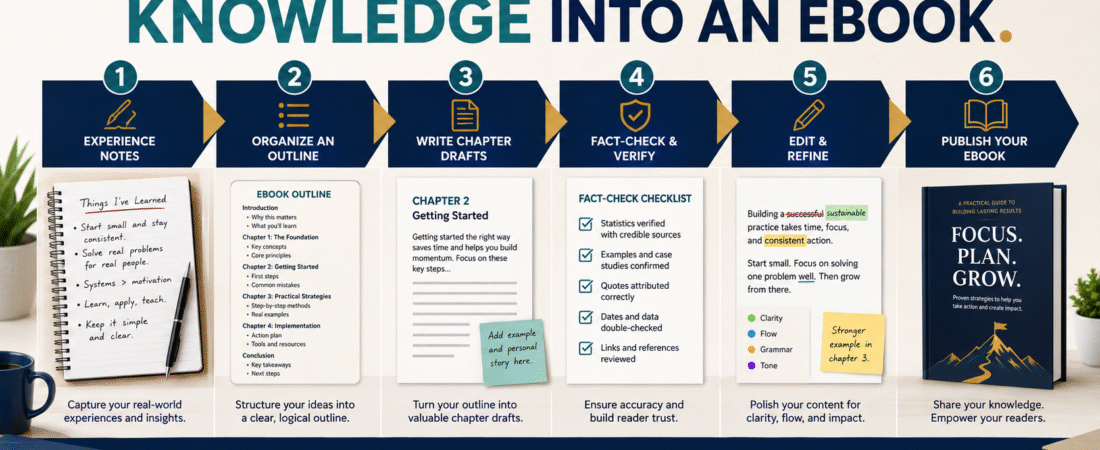
The most practical way to use AI to write an ebook is to treat it as a planning, drafting, and editing assistant rather than as an automatic book-writing machine. You provide the subject knowledge, intended reader, examples, opinions, and final decisions. AI helps you organize that material, identify missing explanations, create working drafts, and improve clarity.
ChatGPT and similar tools can respond to instructions, help develop written material, and assist with creating structured work, but the quality of the finished ebook still depends heavily on the information and direction supplied by the creator.
A useful ebook should sound as though it came from someone who understands the reader’s problem. It should not sound like a collection of generic AI responses placed between a cover and a conclusion.
Key Takeaways
- Begin with one reader, one problem, and one promised result.
- Give the AI your real knowledge before requesting an outline.
- Build and approve the book one section at a time.
- Add original examples, warnings, and practical judgment.
- Verify facts and remove unsupported claims.
- Complete a separate human editing and quality-control stage before publishing.
Start With the Reader’s Problem, Not the Ebook Title
Many first-time authors begin by trying to create a clever title. A title matters, but it should come after you understand the problem the book will solve.
Before using AI, write down clear answers to these questions:
- Who is this ebook for?
- What is the reader trying to accomplish?
- What is preventing the reader from making progress?
- What mistakes is the reader likely to make?
- What should the reader be able to do after finishing the book?
- What experience or knowledge can you contribute that generic online articles cannot?
For example, suppose a retired teacher wants to help other retirees create their first simple online business. “Online Business Guide” would be too broad. The intended reader might need a manageable plan that avoids complicated technology, large startup costs, and full-time work.
A more focused book could help a retiree choose one simple digital product, create it, establish a basic email list, and build a small promotional system. That gives the book a defined reader and a practical result.
Create a Knowledge Inventory Before Asking AI to Write
Your knowledge inventory is the raw material from which the ebook should be built. It can include:
- Lessons you have learned.
- Steps you follow.
- Common mistakes you have observed.
- Questions beginners repeatedly ask.
- Personal opinions about what is necessary and unnecessary.
- Checklists you use.
- Stories or hypothetical examples.
- Warnings about costs, time, tools, or unrealistic expectations.
- Definitions that beginners need explained.
- Recommendations you would give someone starting today.
Do not worry about arranging everything perfectly. The first goal is to capture your knowledge in your own words.
You might create a simple document with headings such as:
- What beginners misunderstand.
- The first decision they must make.
- The minimum tools they need.
- The process they should follow.
- Mistakes that waste time.
- What they should do after completing the process.
This knowledge inventory gives the AI something meaningful to organize. Without it, the tool will usually produce a broad outline based on common information rather than your distinctive perspective.
Give AI a Detailed Ebook Assignment
A weak instruction would be:
“Write an ebook about starting an online business.”
That request leaves too many important decisions unanswered. The AI must guess the audience, level of difficulty, business model, tone, length, and intended outcome.
A stronger assignment would explain:
- The intended reader.
- The reader’s current experience.
- The central problem.
- The result the book should help produce.
- The author’s perspective.
- Subjects that must be included.
- Subjects that should be avoided.
- The desired writing style.
- The approximate depth of the book.
- The requirement to avoid income guarantees.
For example:
“Help me develop a practical beginner ebook for retirees who want to establish a small, manageable online business. The reader has limited technical experience and does not want to create a complicated full-time company. The book should explain how to select one useful digital product, create a basic version, build a small email list, and establish a repeatable promotional routine. Use plain language, realistic examples, step-by-step guidance, and warnings against unnecessary tools and exaggerated income claims.”
That instruction provides a much better foundation.
Ask AI to Organize Your Knowledge Into a Reader Journey
An ebook should move the reader from confusion to understanding and then from understanding to action.
Ask the AI to review your knowledge inventory and propose a logical progression. A practical beginner ebook might move through these stages:
- Understanding the problem.
- Selecting a realistic goal.
- Choosing the simplest suitable approach.
- Gathering the necessary information.
- Completing the primary process.
- Reviewing and improving the result.
- Avoiding common mistakes.
- Deciding what to do next.
Do not approve the first outline automatically. Examine each proposed chapter.
Ask:
- Does this chapter help the reader achieve the promised result?
- Is it included because the reader needs it or merely because similar books contain it?
- Are two chapters covering almost the same information?
- Is an important decision missing?
- Does the book become unnecessarily complicated?
- Does the order make sense for a true beginner?
Remove material that does not serve the reader. A shorter, focused ebook is often more valuable than a long book filled with loosely related subjects.
Build Detailed Chapter Briefs
Before drafting complete chapters, create a brief for each one.
A useful chapter brief can include:
- The main question the chapter answers.
- The central lesson.
- Three to five supporting points.
- An example or scenario.
- A practical exercise or action step.
- A warning or common mistake.
- The transition to the next chapter.
Suppose one chapter is titled “Choose Your First Digital Product.” Its brief might state:
- Main question: What product should a beginner create first?
- Central lesson: Choose a small product that solves one clear problem.
- Supporting points: audience need, creator knowledge, production time, delivery method, and realistic price.
- Example: a retired educator turning a proven classroom planning method into a workbook.
- Action step: list three problems the intended audience frequently experiences.
- Warning: do not begin with a large course simply because it can be sold at a higher price.
This brief keeps the chapter focused and reduces repetitive AI-generated material.
Draft One Chapter at a Time
Requesting an entire ebook in one response can produce uneven depth. The opening chapters may be detailed while later chapters become shorter, more repetitive, or less useful.
Drafting one chapter at a time gives you better control.
For each chapter:
- Supply the approved chapter brief.
- Include any original examples, experiences, or opinions.
- State what the chapter should not repeat.
- Request the desired depth.
- Review the result before continuing.
- Correct developing style problems immediately.
You might instruct the AI:
“Write this chapter for a beginner who may not understand marketing terminology. Explain each decision in plain language. Use the provided retired-teacher example, include a five-step selection process, and discuss the danger of choosing a product that is too large. Do not repeat the general introduction from Chapter 1.”
That instruction is more likely to produce a useful chapter than “Write Chapter 3.”
Add Your Genuine Perspective
An AI draft may be organized and grammatically correct while still lacking practical judgment.
Your perspective can appear through statements such as:
- What you consider the simplest starting point.
- Which steps beginners tend to overcomplicate.
- Which tools are optional.
- Where someone should slow down and verify information.
- What can reasonably be completed with a limited budget.
- When a person should choose a different approach.
- Why a popular recommendation may not fit everyone.
For example, a generic draft might tell readers to create an ebook, course, membership, podcast, YouTube channel, and social-media presence.
A more useful teaching perspective might say:
“A beginner does not need to build every type of digital asset at once. Complete one useful ebook, connect it to one email-list offer, and learn how readers respond before adding a course or membership.”
That type of judgment makes the book more distinctive and manageable.
Use a Product-Creation Tool When It Simplifies the Workflow
Affiliate Disclosure: This article contains affiliate links. If you purchase through one of these links, I may earn a commission at no additional cost to you. Affiliate compensation does not determine the conclusions or recommendations presented in this article.
A specialized product-development platform may help a beginner move from an idea to organized product materials more efficiently. For example, you can review the current AI Product Engine offer if you want assistance developing ebook ideas, guides, checklists, content sections, and supporting product assets.
The tool should not be used to avoid thinking. You still need to define the reader, verify the information, revise the writing, and make sure the finished resource offers more than a collection of generic templates.
Fact-Check Every Important Claim
AI can produce inaccurate details, outdated information, unsupported statistics, and confident-sounding explanations that are incomplete.
Create a verification list for:
- Laws and regulations.
- Product features.
- Prices.
- Subscription plans.
- Platform rules.
- Technical instructions.
- Statistics.
- Research findings.
- Quotations.
- Historical information.
- Health or financial claims.
- Links and contact information.
Whenever possible, confirm changing information through official documentation or authoritative sources.
Do not include a statistic simply because it makes the chapter sound more persuasive. A clear explanation based on sound reasoning is more trustworthy than an impressive number that cannot be verified.
Edit for Repetition and Generic Language
AI-assisted ebooks often develop recognizable problems:
- Several chapters begin in the same way.
- Every section uses identical paragraph lengths.
- Transitions become repetitive.
- The same advice appears under different headings.
- Conclusions merely repeat the introductions.
- Examples remain vague.
- The tone becomes excessively polished or promotional.
- The writing uses too many phrases such as “unlock,” “revolutionize,” or “take your business to the next level.”
Review the complete manuscript for patterns that may not be obvious when chapters are written separately.
Read the ebook aloud. Awkward wording, repeated phrases, and overly long sentences are easier to notice when heard.
Add Practical Reader Tools
A helpful ebook should enable action. Consider adding:
- A decision checklist.
- A planning worksheet.
- A fill-in-the-blank template.
- A step-by-step implementation plan.
- A quality-control checklist.
- A list of questions to answer.
- A simple weekly schedule.
- A progress tracker.
- A resource page.
These additions should support the book’s result rather than merely increase the page count.
For a book about selecting a first digital product, a one-page product decision worksheet may be more valuable than another chapter of general encouragement.
Create a Professional Cover Without Making Misleading Claims
The cover should communicate the subject clearly when viewed as a small thumbnail.
A beginner may use a design tool to create:
- The front cover.
- A promotional product image.
- A lead-magnet graphic.
- Social-media graphics.
- A simple sales-page visual.
You can examine ClickDesigns for ebook covers and digital-product graphics when you need a structured design workflow.
Avoid cover statements that promise guaranteed sales, passive income, or immediate success. The visual presentation should make the product look credible without overstating what it can deliver.
A Simple AI-Assisted Ebook Workflow
Here is a manageable process you can follow:
Step 1: Define the reader
Write a one-paragraph description of the specific person you want to help.
Step 2: Define the result
Complete this sentence: “After reading this ebook, the reader should be able to…”
Step 3: Create a knowledge inventory
Record your lessons, steps, examples, warnings, and recommendations.
Step 4: Develop the outline
Ask AI to organize your material into a logical reader journey.
Step 5: Approve chapter briefs
Define the purpose and practical content of every chapter.
Step 6: Draft one chapter at a time
Review and revise each chapter before proceeding.
Step 7: Add original value
Insert personal judgment, examples, worksheets, and action steps.
Step 8: Verify important information
Check all facts, product details, policies, and links.
Step 9: Complete a full-manuscript edit
Remove repetition, filler, unsupported claims, and generic wording.
Step 10: Format and test the finished ebook
Review the document on different screen sizes and confirm that headings, links, page breaks, and worksheets work correctly.
Common Mistakes to Avoid
Allowing AI to define the entire book
The creator should determine the reader, result, perspective, and final content decisions.
Writing before defining the outcome
A book without a clear outcome often becomes a broad collection of information.
Accepting the first outline
An outline is a proposal, not a final plan.
Creating all chapters in one request
This can reduce consistency, control, and depth.
Failing to verify facts
Confident language does not prove that a claim is accurate.
Publishing without a complete-manuscript review
Individual chapters may look acceptable while the entire book contains repetition and uneven quality.
Adding unnecessary length
The book should be as detailed as the reader needs, not as long as possible.
Conclusion
The best way to use AI to write an ebook is to combine the efficiency of an AI assistant with the knowledge and judgment of a real creator. Begin with a specific reader and problem, provide your own source material, approve the structure, draft the book in controlled sections, and complete a careful human review.
AI can help you overcome the blank page, organize complicated ideas, and improve your workflow. It cannot decide what your readers genuinely need or replace the responsibility to verify and improve the final product.
Choose one useful ebook idea, define the result it will provide, and begin by creating your knowledge inventory today.