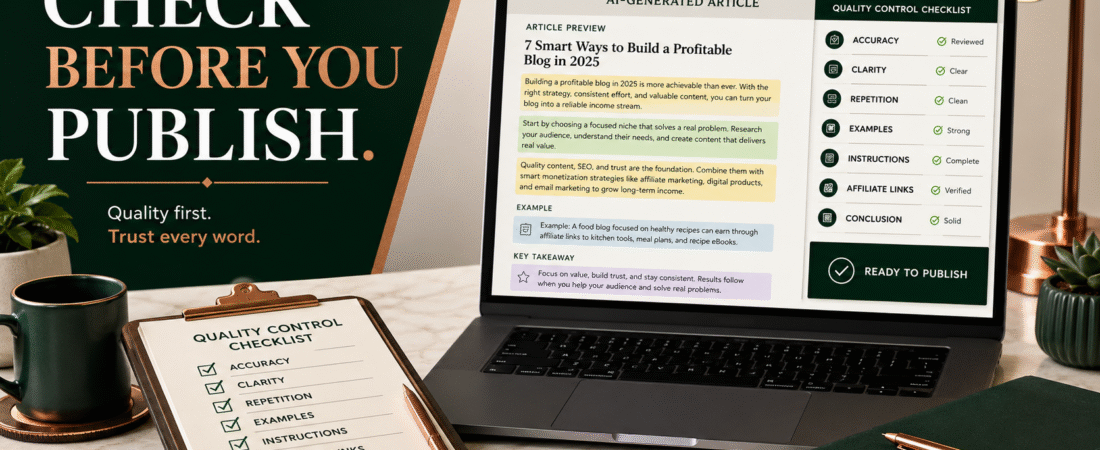
Artificial intelligence can create an article quickly, but speed does not guarantee quality.
An AI-generated draft may appear polished while containing repeated ideas, vague explanations, missing steps, weak examples, unsupported claims, or conclusions that do not match the article.
Publishing content without reviewing it can reduce reader trust and make your website feel generic.
A quality-control checklist gives you a consistent way to evaluate every article before it reaches the audience. The goal is not to make the writing perfect. The goal is to confirm that it is accurate, understandable, useful, original, and connected to a clear purpose.
Affiliate Disclosure: This article contains affiliate links. If you purchase through one of these links, I may earn a commission at no additional cost to you.
Confirm the Article Matches the Requested Topic
Begin with the title and main promise.
Ask:
- Does the article answer the question in the title?
- Is the intended audience clear?
- Does the introduction explain the problem?
- Does every major section support the main subject?
- Did the AI add unrelated information?
AI can sometimes expand a topic too broadly. Remove sections that do not help the reader reach the promised outcome.
Verify Facts and Claims
AI-generated content can present incorrect information with confident wording.
Review:
- Product features.
- Pricing statements.
- Dates.
- Statistics.
- Platform instructions.
- Legal or financial claims.
- Quotations.
- Research references.
- Company information.
When the article discusses software, encourage readers to review the provider’s current information because features and prices may change.
Do not publish a claim simply because it sounds reasonable.
Check for Missing Steps
An explanation may seem complete to the writer because the writer already understands the topic.
A beginner may notice important gaps.
Read every instructional section and ask:
- What does the reader need before beginning?
- Is each action explained?
- Are unfamiliar terms defined?
- Does the process move in a logical order?
- Could another person complete the task without guessing?
If the article says, “Create a lead magnet and connect it to your email list,” it may need to explain what type of lead magnet to create, where to place the signup form, and what message should be delivered after signup.
Remove Repetition
AI may repeat the same lesson using different wording.
Common repetition includes:
- Restating the introduction in several sections.
- Repeating the same benefit after every heading.
- Using identical transitions.
- Creating several conclusions.
- Repeating the call to action.
- Explaining the same tool more than once.
Remove repeated material unless the repetition genuinely improves understanding.
A shorter, focused article is more useful than a longer article that circles around the same idea.
Improve Generic Examples
Examples make information easier to understand, but generic examples add little value.
Instead of writing:
“A business owner can use AI to save time.”
Write:
“A blogger can provide AI with the article topic, intended reader, required sections, affiliate tools, word count, and items to avoid before requesting the first draft.”
The second example shows the reader what to do.
Add realistic details without creating exaggerated promises.
Review the Human Voice
AI writing may sound formal, distant, or overly perfect.
Read the article aloud.
Look for:
- Long sentences.
- Repeated sentence patterns.
- Excessive transition words.
- Unnecessary jargon.
- Unnatural enthusiasm.
- Overused phrases.
- Statements that do not sound like you.
Edit the content so it reflects your normal way of teaching and communicating.
A tool such as SpinRewriter may help produce alternative wording for content you own when a paragraph feels repetitive or awkward.
https://links.linkcontroller.com/mikeslinks/spinrewriter
Every revised section should still be reviewed manually so the meaning remains accurate and the voice remains natural.
Confirm the Affiliate Links Are Helpful
Affiliate links should support the article rather than interrupt it.
For each recommendation, confirm that the article explains:
- What the tool does.
- Which problem it may solve.
- Who may benefit.
- Why it is connected to the topic.
- Where the reader can learn more.
Avoid adding a link simply because the product is available.
For example, ClickDesigns may be relevant in an article about improving blog images, lead-magnet covers, or social-media graphics.
https://links.linkcontroller.com/mikeslinks/clickdesigns
The explanation should help the reader understand why the tool belongs in that specific article.
Include a Clear Affiliate Disclosure
When an article contains affiliate links, disclose the relationship clearly.
The disclosure should explain that you may earn a commission and that the buyer does not pay an additional cost because of the link.
Do not hide the disclosure at the bottom of a long page.
Trust is more important than attempting to make a recommendation appear completely independent.
Review the Structure
A publication-ready article should be easy to scan.
Confirm that it contains:
- A clear title.
- A useful introduction.
- Descriptive headings.
- Short paragraphs.
- Logical progression.
- Practical instructions.
- A conclusion.
- A natural next step.
Headings should tell the reader what each section explains.
Avoid vague headings such as “More Thoughts” or “Another Idea.”
Test the Links
Open every link before publishing.
Confirm that:
- The destination loads.
- The address is correct.
- The affiliate tracking appears properly.
- The linked product matches the explanation.
- The page is secure.
- The link is still active.
A broken link damages the reader’s experience and may prevent a conversion.
Examine the Conclusion
The conclusion should summarize the most important lessons without repeating the article word for word.
It should remind the reader:
- What problem was addressed.
- Which actions matter most.
- What should happen next.
Avoid introducing a completely new topic in the conclusion.
Check the Metadata
Before publishing, review the supporting information.
Confirm that the article includes:
- An SEO title.
- Meta description.
- Featured image.
- Alternative image description.
- Relevant keywords.
- Image caption.
- Category.
- Hashtags when appropriate.
This information helps organize the article and present it properly across the website and social platforms.
Complete a Final Reader Test
Imagine you are a beginner seeing the topic for the first time.
Ask:
- Do I understand the main point?
- Can I follow the instructions?
- Do the examples help?
- Are the recommendations reasonable?
- Is anything confusing?
- Does the article respect my time?
This final test is often more valuable than checking grammar alone.
Conclusion
AI can reduce the time required to create a draft, but the publisher remains responsible for the finished article.
A quality-control checklist helps you verify facts, remove repetition, improve examples, clarify instructions, test links, review affiliate recommendations, and strengthen the conclusion.
Before publishing your next AI-assisted article, review it as a reader rather than as the person who created it and correct every section that requires guessing, extra explanation, or unsupported trust.
#AIContentCreation, #ContentQuality, #AIWriting, #BloggingTips, #ContentMarketing, #OnlineBusiness