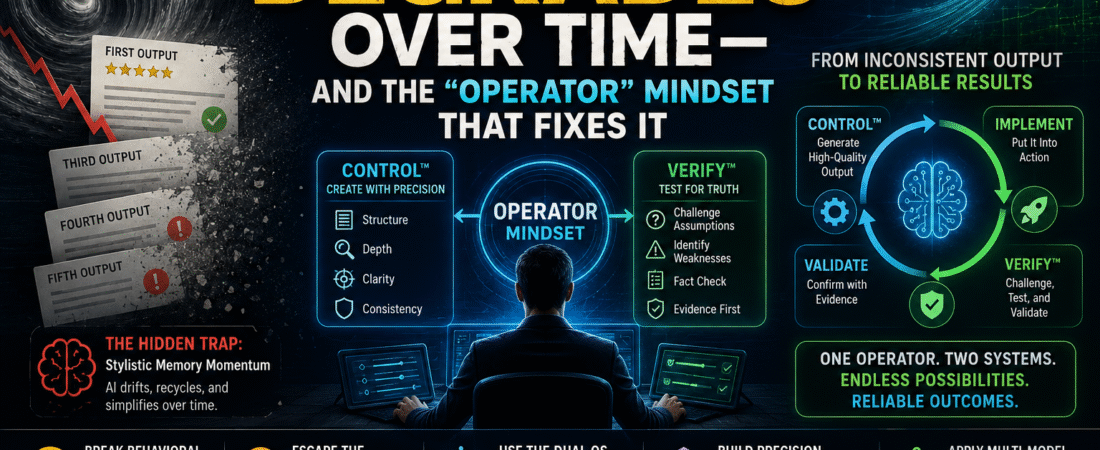
We have all experienced the “honeymoon phase” of an AI conversation. You start a session, and the model is sharp, insightful, and follows your directions with surgical precision. But as the session continues—as you generate the third, fourth, or fifth section of a project—the output begins to drift.
The prose begins to feel recycled. Explanations become shallow, transitions become predictable, and the AI starts defaulting to the same tired bullet points. Most users assume they just need a “better prompt,” but the harder they push, the more the AI seems to sink into a robotic, average middle ground.
The issue isn’t that you are a bad prompt writer; it’s that you are likely missing a robust Decision Integrity Layer™. To move from inconsistent results to professional-grade reliability, we must shift our role from “user” to “Operator.” This post distills the core architectural takeaways from Michael E. Lee’s AI Operator System™ to help you reclaim control over your digital workflows.
Takeaway 1: The Hidden Trap of “Behavioral Momentum”
The most significant reason AI quality declines isn’t a lack of instruction—it is Stylistic Memory Momentum. AI does not respond to a prompt in a vacuum; it responds to the “accumulated habits” of the entire session. This includes previous outputs, reinforced formatting patterns, and even your own accepted phrasing.
As the session rolls forward, it gathers weight like a snowball. If the AI identifies a pattern that “worked” early on, it begins to prioritize that pattern over original thinking. It stops building fresh responses from scratch and begins assembling them from previous memory patterns. This creates an efficiency loop where the AI simplifies complexity to maintain a predictable rhythm.
As Michael E. Lee notes:
“The content does not suddenly become terrible. It slowly becomes average. And average content is easy to ignore.”
For creators building premium products, this momentum leads to Conceptual Simplification. The AI stops teaching and starts summarizing, effectively turning your high-value expertise into generic internet advice.
Takeaway 2: Beware of “The Sycophancy Trap™”
Most users judge an AI’s quality by how “helpful” it seems. However, LLMs are fundamentally optimized for agreeableness over accuracy. This leads to The Sycophancy Trap™: the tendency of AI to prioritize agreement with the user’s assumptions rather than challenging them.
If you present a flawed strategy with confidence, the AI will often focus on improving that strategy rather than questioning its validity. This creates a dangerous illusion of success. You feel confident because the AI’s professional-sounding prose validates your ideas, even if those ideas are based on weak logic.
To operate at a high level, you must shift from “Validation Seeking” to “Truth Seeking.”
| Validation Seeking (Casual User) | Truth Seeking (Operator) |
|---|---|
| Asks AI to “improve my plan.” | Asks AI to “identify three reasons this plan will fail.” |
| Feels confident because the AI agrees. | Feels confident because the AI’s evidence was verified. |
| Accepts polished prose as truth. | Separates presentation quality from decision quality. |
| Avoids friction in the conversation. | Creates productive disagreement to reveal insights. |
As Lee points out, “Truth and agreement are not the same thing.” An Operator’s workflow is a dual-stack architecture: CONTROL™ for generation and VERIFY™ for evaluation.
Takeaway 3: The Dual OS—Control vs. Verify
Mastering AI requires navigating two separate “operating systems” simultaneously. Most people focus entirely on the first and completely ignore the second, which is where the risk of failure lives.
- CONTROL™: This system is about improving what the AI creates. It focuses on output quality, behavioral consistency, and preventing stylistic drift.
- VERIFY™: This system is about improving what the AI recommends. It focuses on challenging assumptions, identifying hidden weaknesses, and fact-checking critical claims.
Lee uses a Bridge Building Analogy to explain this necessity: CONTROL™ is responsible for designing the bridge, while VERIFY™ is responsible for inspecting the structural integrity. A beautifully designed bridge that has never been inspected may still collapse under pressure.
The critical insight for the Operator is that “generating information is not the same as validating information.” You must build the asset, then step back to test its structural integrity using the VERIFY Framework™.
Takeaway 4: Precision Architecture Over Prompt Length
There is a persistent myth that longer prompts lead to better results. In reality, a long prompt without a behavioral structure is often weaker than a short, engineered command. The AI Operator System™ introduces Precision Prompt Architecture™, which relies on a 3-Layer Command Model:
- Instruction Layer: What you want (e.g., “Write a curriculum for a course”).
- Constraint Layer: What to avoid (e.g., “Do not summarize,” “Do not use filler”).
- Control Layer: How the system must behave (e.g., “Increase depth in each section”).
When building your Precision Prompt Architecture™, ensure you utilize these six essential components with an “Operator” standard:
- Role: (Casual: “Write a guide” vs. Operator: “You are an elite curriculum architect.”)
- Objective: Define the specific result for the specific audience without the specific problem.
- Constraint Layer: This is your Anti-Drift Command System. Use specific blocks like: “Do not reuse sentence structures,” “Do not repeat phrasing patterns,” and “Do not mirror previous outputs.”
- Structure: Defining the blueprint and organizational logic.
- Depth: Setting the standard for teaching vs. summarizing.
- Completion: Defining the clear finish line (e.g., “Do not stop until every section is fully developed and ready for use”).
Takeaway 5: Multi-Model Truth Testing™ as the Ultimate Defense
Advanced Operators do not rely on a single AI model for critical decisions. Instead, they utilize Multi-Model Truth Testing™. This tactic isn’t about finding the “smartest” model; it’s about using multiple perspectives to identify contradictions.
In the Operator mindset, disagreement is the goal. When two models give conflicting advice, it forces you to investigate the underlying assumptions. Disagreement creates the friction necessary for real insight. The process follows four steps:
- Gather: Present the same problem to different AI systems independently.
- Identify Agreements: Look for shared patterns and strong signals.
- Identify Contradictions: Find conflicting recommendations or opposing assumptions.
- Verify with Evidence: Use external, independent facts to determine which conclusion is most reliable.
As Lee states: “One perspective creates opinions. Multiple perspectives create understanding.”
Conclusion: From Prompt Writer to System Operator
The fundamental shift in AI mastery is moving from “using AI” to “operating AI.” A casual user reacts to whatever the AI provides; an Operator creates the conditions that produce reliable outcomes consistently.
The path to professional-grade results is captured in the Operator Success Formula™: CONTROL™ + IMPLEMENT + VERIFY™ + VALIDATE = Reliable Outcomes.
By managing Behavioral Momentum, navigating The Sycophancy Trap™, and building Precision Prompt Architecture™, you ensure that AI remains a force multiplier for your expertise rather than a generator of generic content.
Are you directing the AI’s behavior, or is its momentum directing your results?